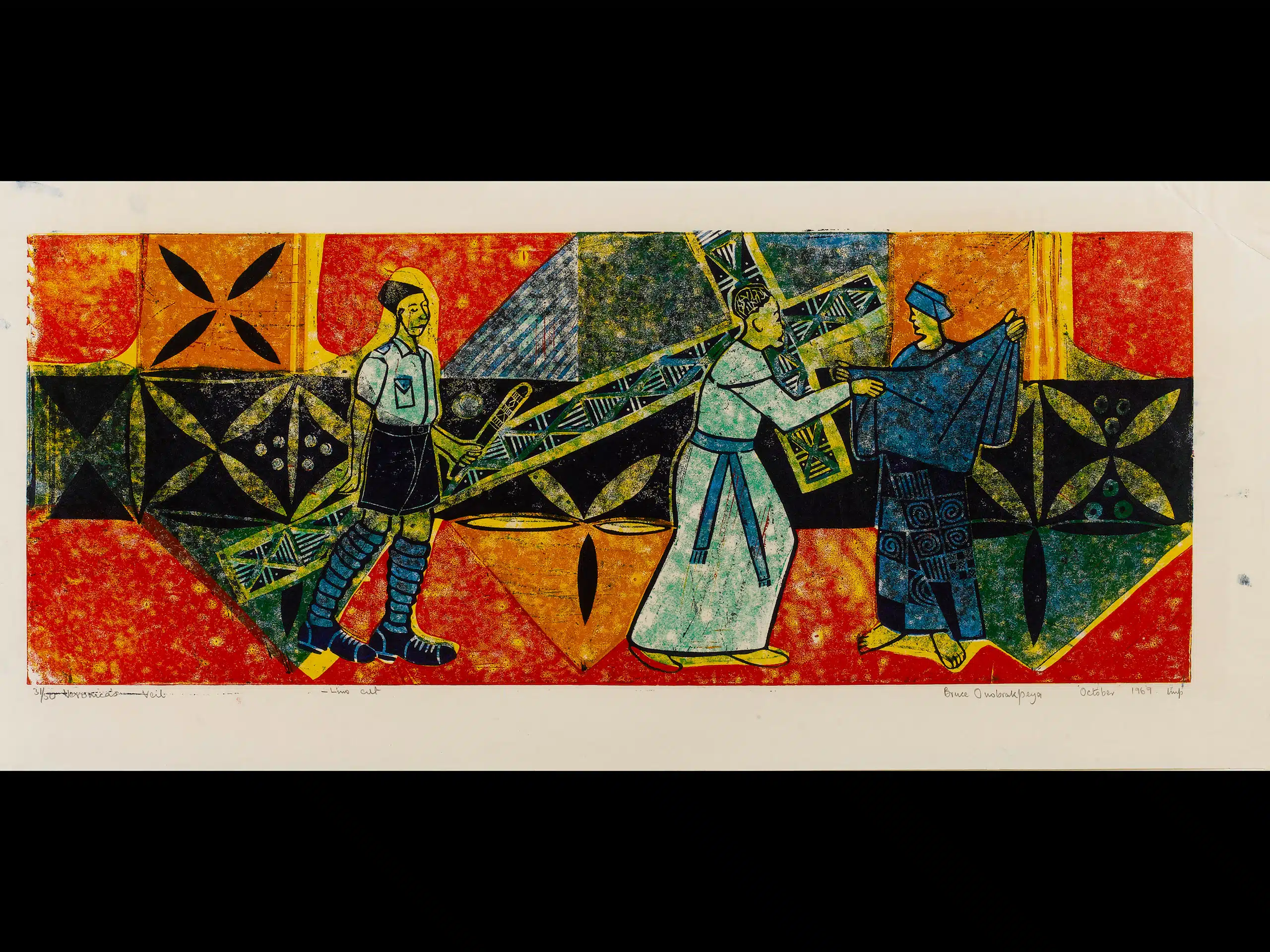
A unique series of the Stations of the Cross, originally made for St. Paul’s Catholic Cathedral in Lagos, Nigeria, is now on display at Washington’s National Museum of African Art, a branch of the Smithsonian Institution.
The colorful linoleum-block prints were created by Bruce Onobrakpeya, 91, a painter, sculptor, and pioneering printmaker who is regarded as a defining figure in Nigerian modernism.
Titled “The Mask and the Cross,” a reference to the mingling of traditional Catholic imagery with the costumes and characters of Nigerian history and spirituality, the exhibit was first on view at the High Museum of Art in Atlanta. At the Smithsonian African Art Museum, alongside the Stations of the Cross series, numerous other scenes from the Bible are on display.
Nearly half a century ago, in 1967, Irish priest Father Kevin Carroll commissioned Onobrakpeya to paint a mural of the Stations of the Cross for the cathedral. The idea was to make new versions of the Christian story and Catholic iconography. After the mural was completed, Onobrakpeya produced a print series based on the mural. He continued to produce relief, print and mural commissions for the church through 1978. The Stations of the Cross at St. Paul remained on the walls for 45 years.
The “mask” in the exhibition title refers to indigenous religious symbols and practices opposed by Christian missionaries when they arrived in Nigeria, prohibitions enforced by brutal colonial regimes. What Onobrakpeya did instead was to revive features of the indigenous heritage and make them part of the Christian story.
“I am not a Catholic,” the artist admitted in an interview for the Smithsonian. He was raised in the Anglican faith. But, he added, “The difference is small.” Then, at St. George’s College, he met Father Carroll and Father Sean O’Mahoney, who had led a workshop in Ekiti State training young artists to use Nigerian traditional art to express the Christian religion. (The Ekiti are a subgroup of the Yoruba people in southwestern Nigeria.) “The works are simple but understandable. I was free to interpret the people of Christ as ordinary people — as Nigerians.”
Controversy
He went on, “Some critics said, ‘The Yoruba people did not exist at the time of Christ. Why should they appear in my Stations of the Cross?’ I had never been to Rome or Jerusalem. Christ means something and I try to bring out what Christ means to our people.”
In the Stations of the Cross series, Christ and the people he encounters on his journey to Golgotha are dressed in traditional clothing. For example, he painted “adire,” a dyed fabric made by the Yoruba people of southern Nigeria in abstract patterns which also form part of the background of the episodes. Instead of Roman guards and executioners, these roles are played by figures dressed to look exactly like British colonial officers.
In an interview, the artist’s son elaborated, “These are pieces that speak about our spirituality as a people. My father was not interested in showing the art of the historical people from Jerusalem. He was interested in depicting or narrating about the ‘Christness’ in all of us. (The murals) were not as welcome at that point because they were very revolutionary. He took a leap of faith and anchored the fact that perhaps Christ, too, was one of us in spirit.”
According to text at the museum, initially this approach raised some hackles among viewers and parishioners at the cathedral who wanted a more traditional approach. Yet, interpreting the Gospel stories according to one’s own time and place is not new in art.
If one walks across the National Mall in Washington to the National Gallery of Art to see 500-year-old paintings of “Christ Carrying the Cross,” “The Raising of the Cross” or “St. Veronica,” no one is surprised to see that Christ’s persecutors are portrayed as German soldiers (for example) from the time when the pictures were made. Or — until Rembrandt in the 17th century began to base his images of Jesus on young Jewish men in Amsterdam — was anyone offended by seeing Jesus, Mary and the disciples portrayed as if they were Italian or Dutch. And in “Crucifixion” by Matthias Grunewald, painted around 1520, most shocking of all: Christ is shown as if afflicted by the deadly disease of ergotism, suffered by the inmates of a hospital for which the artist made his most famous altarpiece.
Hamerman writes from Reston.
If you go
“The Mask and the Cross” will be on display until January 21 at the National Museum of African Art, a branch of the Smithsonian Institution, in Washington.
Open daily. Admission is free.
For more information. visit africa.si.edu.