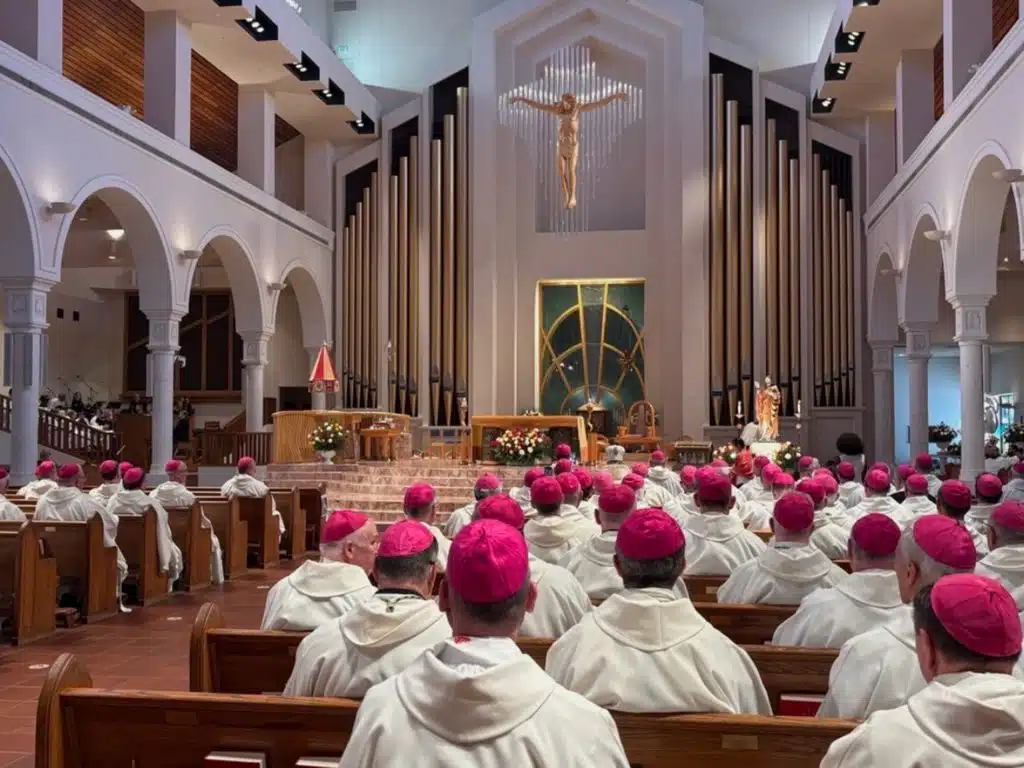
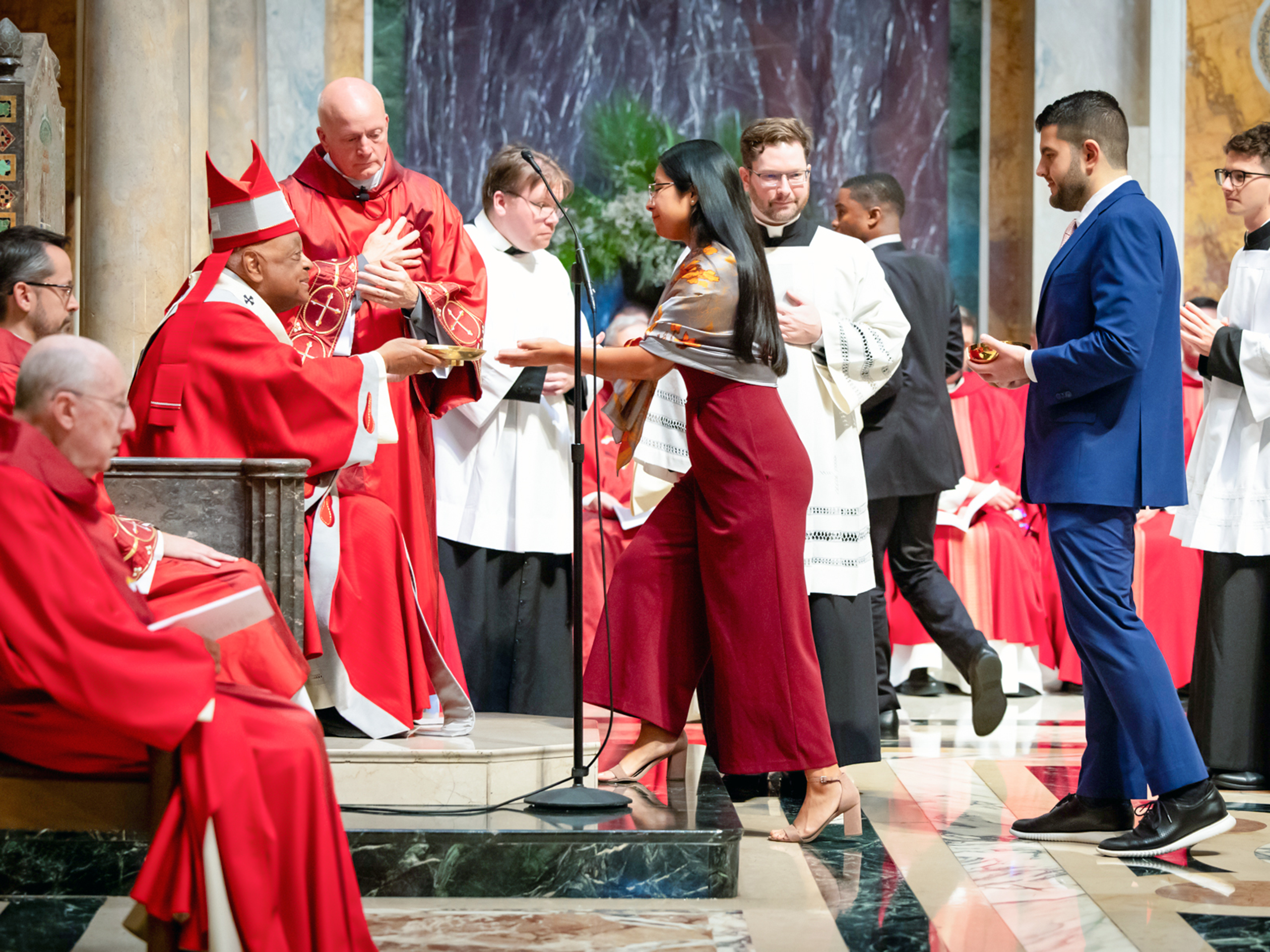
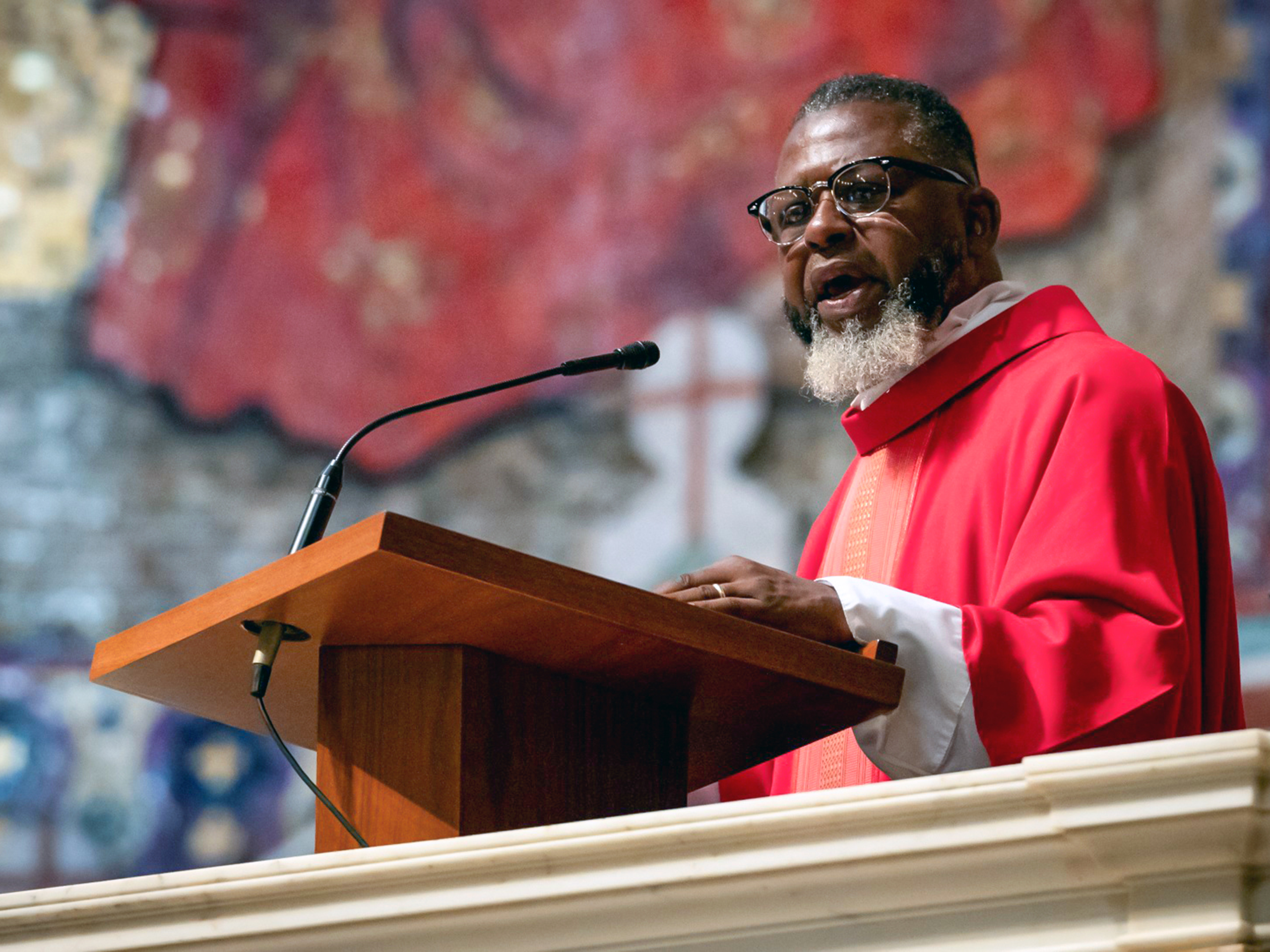
Just as the nation’s founders relied on God’s providence, so too must U.S. legal professionals today depend on the Holy Spirit for a good and just society, Deacon Darryl A. Kelley, said in his homily for the 72nd annual Red Mass celebrated Oct. 6 at the Cathedral of St. Matthew the Apostle in Washington.
“What we pray for today is no mere aspiration,” he said, adding that the day was not a mere social event at the beginning of the judicial year. “No, the gifts of the Holy Spirit can be an efficacious reality in our lives, personal and professional.”
Since 1953, the Red Mass has been celebrated in Washington on the Sunday before the opening of the U.S. Supreme Court’s new session on the first Monday in October to invoke God’s blessings on the administration of justice. The Red Mass is sponsored by the John Carroll Society in Washington. Named for the first U.S. Catholic bishop appointed in 1789, the organization is made up of more than 1,000 members of several professions who assist the archbishop of Washington in charitable projects, such as Catholic Charities’ legal and health care networks that serve the needy.
Dignitaries attending the Mass included three Catholics on the U.S. Supreme Court: John G. Roberts Jr., chief justice; Associate Justice Brett Kavanaugh; and Associate Justice Amy Coney Barrett; and Elizabeth Barchas Prelogar, U.S. solicitor general.
Deacon Kelley of St. John the Evangelist Church in Clinton, Md., is an attorney and the first permanent deacon to deliver the homily for the annual liturgy, which drew about 1,000 attendees, many of whom serve as judges, lawyers, diplomats, government officials, law school deans, professors, and students in the area.
“Today, we call upon the spirit of truth — the Paraclete, which can be translated as ‘helper’ — just like the founders of this nation also appealed to the ‘Supreme Judge of the world … with a firm reliance on the protection of divine Providence’ in declaring our independence,” he said. “When we individually or as a people disregard the spirit of truth, history shows that our failure to listen makes things worse.”
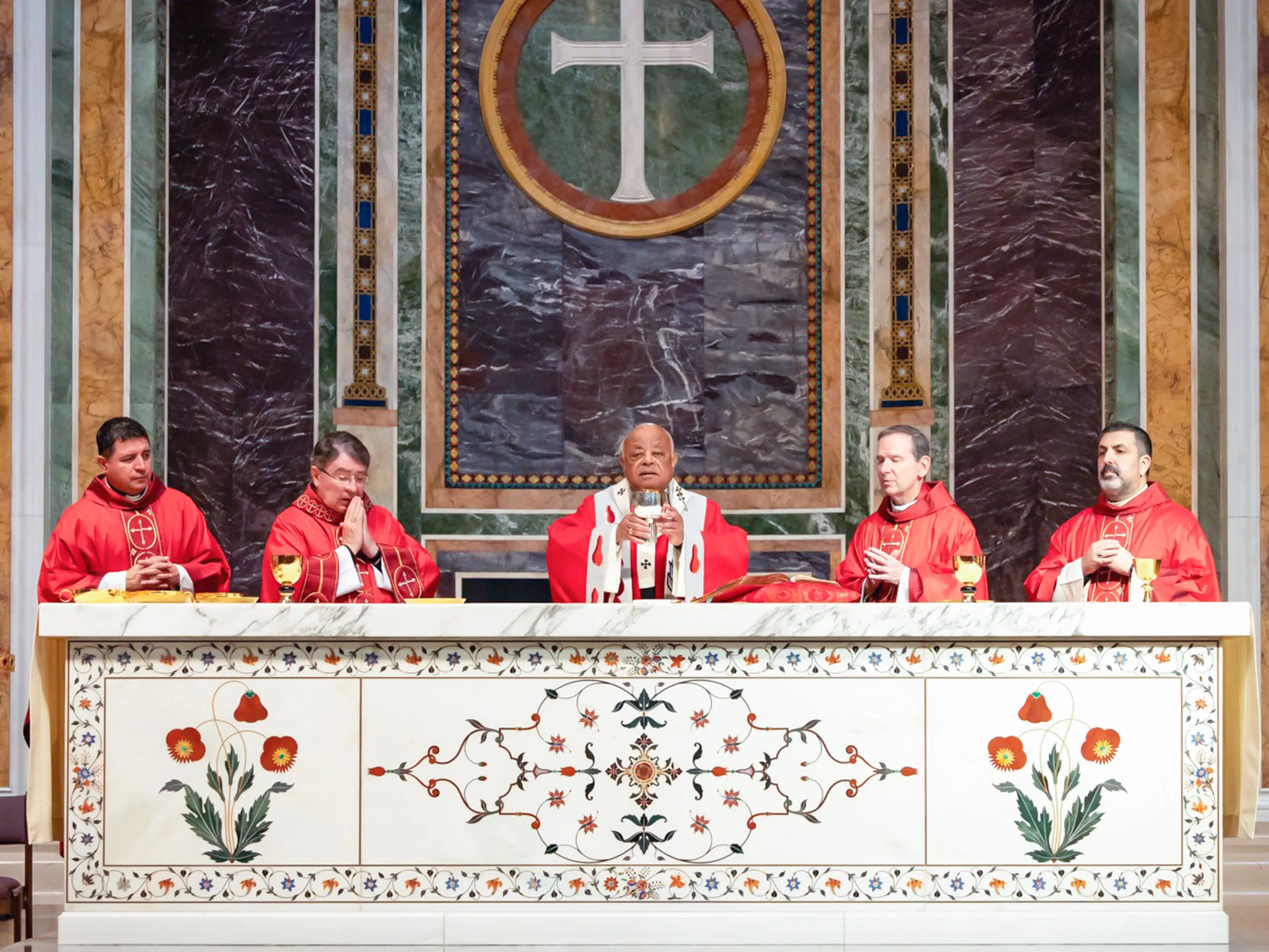
Washington Cardinal Wilton D. Gregory celebrated the Mass. Concelebrants included Cardinal Christophe Pierre, apostolic nuncio to the U.S.; Bishop Michael F. Burbidge; Washington Auxiliary Bishops Roy E. Campbell Jr., Juan R. Esposito-Garcia and Evelio Menjivar-Ayala; Bishop Emeritus Paul S. Loverde; and more than a dozen archdiocesan priests. All the clergy wore traditional red vestments to symbolize the tongues of fire representing the presence of the Holy Spirit.
Also in attendance were Peter K. Kilpatrick, president of The Catholic University of America in Washington; Robert M. Groves, provost of Georgetown University; deans and professors of area law schools; and government officials at the local, state and federal levels. Law students from the Columbus School of Law at Catholic U., Georgetown University Law Center, Howard University School of Law and the Antonin Scalia School of Law at George Mason University served as gift bearers.
Deacon Kelley noted that although in the nation’s founding the self-evident truth “that all men are created equal” was compromised, the nation’s Black Catholic bishops in their 1984 pastoral letter, “What We Have Seen and Heard” recognized that even in slavery, African Americans found ways to “celebrate that spiritual freedom which God alone can give.”
“So today, in this nation’s ongoing work to form a ‘more perfect Union’ in justice, genuine liberty and the common good, we praise God for the blessings and guidance of the Spirit of truth and gifts,” he said, adding that those gifts of the Holy Spirit can be implemented in several ways.
Among the opportunities to utilize the gifts of the Holy Spirit are through listening — the gift of counsel; advocating — the gifts and virtues of fortitude and humility; and witnessing — the gift of wisdom, Deacon Kelley said.
Recalling the roots of the Red Mass in 13th century Europe when the medieval liturgy and the common law “walked side-by-side through the centuries,” Deacon Kelley said today’s jurists dedicated to the administration and attainment of justice should remember those foundations and “humbly listen to the gift of counsel or right judgment speaking to our hearts and minds.”
In the area of humility and fortitude, Deacon Kelley spoke of being personally humbled at the invitation to preach the Red Mass homily. “Unlike many luminaries who have given the Red Mass homily over the years, I am not a cardinal. I am not an archbishop or bishop. I’m not a priest. I am a deacon, which means ‘servant,’ ” he said.
Deacon Kelley pointed to the example of the first deacon in Scripture, St. Stephen, describing the first martyr of Christianity, as a man filled with faith and the Holy Spirit and who possessed humility and fortitude. “He humbly, courageously, fearlessly and powerfully advocated for our Lord, Jesus Christ and spoke what we call today ‘truth to power,’ ” he said.
“Whether we are sole practitioners, mid-size to big law firms, corporate or government attorneys or working in judicial offices, we should always humbly remember that, however tempting the levers of power may be, we are not the masters of the law and justice, but are servants,” Deacon Kelley said.
Witnessing and the gift of wisdom, said Deacon Kelley, are needed in today’s divided and broken world, noting that Pope Francis is a witness who has spoken of a renewed spirit of fraternity, solidarity and cooperating generously for the common good, not only in his 2015 speech to the U.S. Congress, but also while addressing similar themes during his recent papal trip to Southeast Asia.
That witness to wisdom must always be carried over to the legal profession, the deacon continued. “We understand that just because we are adversaries in the courtroom, we need not be adversaries in life. This wisdom of coming together is a much-needed, fruitful example that we must work to share with the greater society and culture,” he said. “We must be agents and witnesses of civility, reconciliation and fraternity,’ e pluribus unum.’ ”
In concluding his homily, Deacon Kelley said lawyers have a special calling to touch lives of not just clients of the courts, but the whole of society, including those on the margins and peripheries of one’s own families and communities.
“This is a necessary task if we are to have a good and just society, but our own efforts cannot fully accomplish it,” he said. “Therefore today, we beseech the Holy Spirit to give us the wisdom, show us the way forward, and give us the inspirational strength to be faithful to do the right thing always. Amen.”
At a brunch at the Capital Hilton after the Red Mass, the John Carroll Society honored several legal professionals who provide pro bono support to the Catholic Charities Legal Network.
Reprinted from the Catholic Standard in Washington with permission.