For some, the Liturgy of the Hours may evoke images of monks praying over large volumes by candlelight.
In reality, the Liturgy of the Hours is a devotion that is not only practiced daily by priests, deacons and religious, but also is available to and encouraged for the lay faithful.
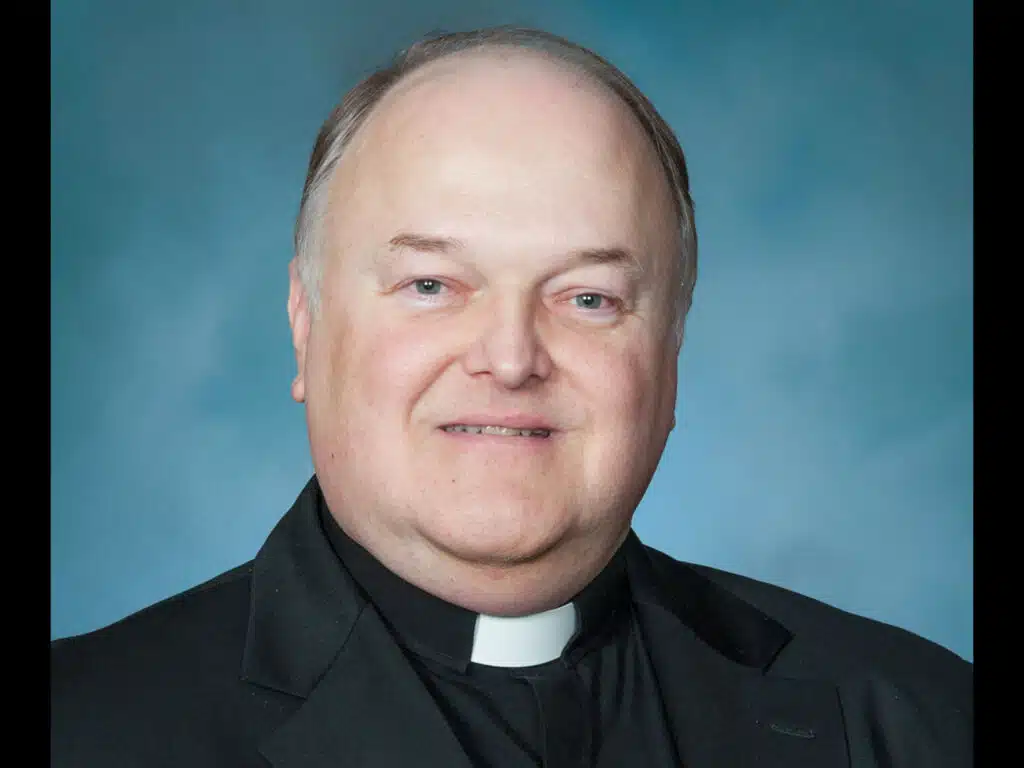
Msgr. Paul F. deLadurantaye, diocesan chancellor, helps explain how to practice this devotion.
What is the Liturgy of the Hours?
According to the Catechism of the Catholic Church, the Liturgy of the Hours — also called the “Divine Office” — is the “public prayer of the Church.” (CCC 1174) The purpose of the devotion is to sanctify the hours of each day to God. The devotion has deep roots in church history.
“This is a very, very ancient custom. We find it even in Jewish history and the Old Testament,” Msgr. deLadurantaye said.
The Divine Office is subdivided into prayers for different periods of the day. The day begins with the Office of Readings — “Matins” in Latin — Morning Prayer (Lauds), and Daytime Prayer, which can be further divided into Midmorning (Terce), Midday (Sext) and Mid-afternoon (None). The day ends with Evening Prayer (Vespers) and Night Prayer (Compline).
Msgr. deLadurantaye added that the seven daily prayers can be traced to Psalm 119:164: “Seven times a day I praise you, because your judgments are righteous.”
“So, seven in the Bible is the perfect number. So, the Liturgy of the Hours is designed to sanctify the different periods of the day, from morning all the way through the evening,” Msgr. deLadurantaye said.
The early church followed the Jewish tradition of setting aside certain times of day for prayer. Later, Msgr. deLadurantaye said, “they carried it with them when monastic life began to develop in the church, when the monks began very intensely to order their day around prayer.”
The church formally compiled the Divine Office for seminarians and clergy following the conclusion of the Council of Trent in 1563.
Who can pray it?
While priests, deacons and religious orders are required to pray the Divine Office, Msgr. deLadurantaye said that the church encourages the lay faithful to join the devotion. The catechism affirms, “The Liturgy of the Hours is intended to become the prayer of the whole People of God.” (CCC 1175)
A simple way for the faithful to observe the Divine Office is by praying the major hours of the day — the Office of Readings, Morning Prayer and Evening Prayer. “The two most important hours would be Morning Prayer and Evening Prayer,” Msgr. deLadurantaye said. While the Office of Readings can be prayed any time of the day, Morning Prayer should be prayed in the morning before noon, and Evening Prayer in the early evening.
The catechism adds that reciting the Divine Office reminds the faithful of their baptismal identity in Christ. Through this devotion, “the faithful (clergy, religious and lay people) exercise the royal priesthood of the baptized.” (CCC 1174)
What are the spiritual benefits?
Praying the Divine Office helps to “remind us that while most of us are working hard at our jobs, taking care of home, family, children — what have you — our days are also a gift from God,” said Msgr. deLadurantaye.
Like the Mass, the Liturgy of the Hours is intended to unite the church in prayer. “Anyone who prays it is uniting him- or herself with the whole church in raising up our minds and hearts to God,” Msgr. deLadurantaye said.
Not only does the devotion unite Catholics around the world, but it also joins the faithful in a devotion practiced by Christ. Most of the 150 psalms are in the Divine Office, “so those would have been the psalms that Jesus himself would have known and would have prayed,” Msgr. deLadurantaye said.
The psalms depict a wide range of human emotions, from thanksgiving to sorrow, from grieving to rejoicing. Praying through these emotions unites Catholics with what other members of the church may be experiencing. For instance, while praying through a psalm of grief, “That may not be what I’m feeling at any given day, but it’s certainly what someone else may be feeling,” Msgr. deLadurantaye said. “We’re praying with the church and for the church.”
Where can I learn to pray the Divine Office?
Learning to pray the Divine Office can be a challenge for some.
Some may prefer to use a physical book, such as the one-volume “Christian Prayer,” which operates on a four-week cycle of prayers, or the four-volume series, which is often used by priests.
Others may choose to use an app, which can be more beginner-friendly. Some examples include iBreviary or the popular Hallow app.
Watch the video
Fr. Timothy A. Courtney, parochial vicar of St. Mary of the Immaculate Conception Church in Fredericksburg, and Fr. Alexander Diaz, pastor of Queen of Apostles Church in Alexandria, recorded tutorials in English and Spanish on how to pray the Liturgy of the Hours. Go to bit.ly/3WTmq9m (English) and bit.ly/3Qak5TF (Spanish).