What people remember the most about Mary Karen Read is her “infectious” smile, according to her father, Peter.
Read, a parishioner of St. Mary of Sorrows Church in Fairfax, pointed to a large button over his heart that bore his daughter’s happy face. “This is my daughter Mary who was one of those 32 students and faculty who were killed at Virginia Tech on April 16, 2007,” he said. The Virginia Tech shooting was one of the deadliest mass shootings in U.S. history.
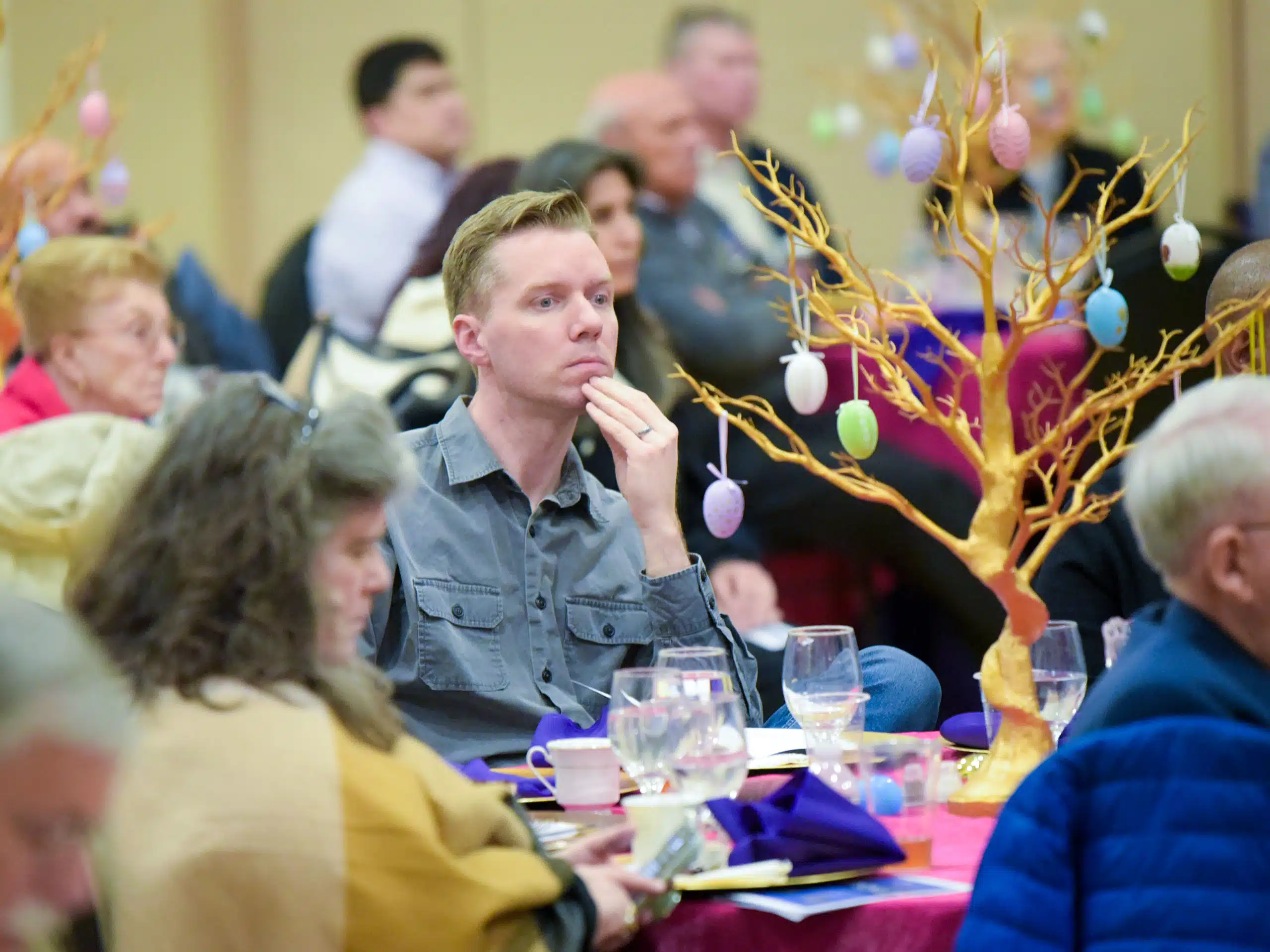
Read was among 180 Catholics who attended the annual Peace and Justice Conference, held at Nativity Catholic Church in Burke March 8, that covers different facets of Catholic social teaching. This year’s topic was “The Dignity of Life and Gun Policy.”
The conference began with a vigil Mass, celebrated by Bishop Michael F. Burbidge. In his homily, Msgr. Robert Cilinski, pastor of Nativity and diocesan episcopal vicar for charitable works, touched on the various topics that the conference had covered in the past. “I’m going to take a little risk and touch the third rail. I’m going to mention the word ‘politics,’ ” he said. “What we believe in our faith might also be a political issue, but it begins with our faith, and cannot be fully exhausted in just a political realm. There are often deeper moral questions that surface that politics alone do not cover or include.”
Believing in Catholic social teaching might cause others to place you in different political camps, he added. But having political disagreements with other Catholics is not inherently a bad thing, he added. “As long as we’re committed to building the kingdom of God and bringing our faith into the public square, we should do this always with respect for one another.”
Following Mass, conference attendees gathered in the parish’s Father Martin Center for dinner before a keynote talk by Michael O’Rourke, director of the U.S. Conference of Catholic Bishops’ domestic justice and human development office.
O’Rourke began by citing recent data on gun violence, gun policy and public opinion. Although assault weapons are widely associated with mass shootings, O’Rourke said, the majority of homicides and suicides are committed with handguns.
In 2023, 46,728 people died from firearm-related deaths; of those were 4,455 children and teens aged 1-19, O’Rourke said. In addition, 27,300 of firearm-related deaths in 2023 were by suicide. About 58 percent of suicides are committed with a firearm, O’Rourke added. “So, when we’re talking about gun violence and gun-related deaths, we’re not just talking about homicide,” he said.
According to the Pew Research Center, “49 percent of adults say gun ownership does more to reduce safety by giving too many people access to firearms and increasing misuse. And 49 percent of adults say gun ownership does more to increase safety by allowing law-abiding citizens to protect themselves,” O’Rourke said. “So, it’s almost a perfect 50-50 split.”
When it comes to Catholic teaching, O’Rourke said the Catechism of the Catholic Church upholds the right to self-defense, so long as the person attacked “repels force with moderation.” (CCC 2264) At the same time, he added, the only mention of firearms in the catechism is with regards to “those who legitimately hold authority.” (CCC 2265)
Citing a 1975 USCCB document, O’Rourke said the conference has honed in on handguns over the past 50 years, since “most homicides are not the result of criminal design, but rather, they are the outcomes of quarrels and arguments among spouses, friends and acquaintances. In these situations, it is the ready availability of handguns that often leads to tragic and deadly results.”
The USCCB has called for measures to control the sale of and regulation of handguns, O’Rourke said. But in addition to that, the bishops have called for other ways to prevent gun violence. One way is for local governments or other groups to reclaim abandoned lots and rehabilitate abandoned buildings, which often are the breeding grounds for gun violence. Another is promulgating education on safe storage of firearms. O’Rourke said that several surveys showed less than 50 percent of gun owners practice safe storage, which involves leaving a gun “unloaded in a safe or with a gun lock.”
Following the talk, O’Rourke took questions submitted via text message. Attendees were not afraid to make their opinions known. “Wouldn’t it be safer to arm law-abiding citizens, so they can protect themselves, rather than legislate restrictions that will get guns out of the hands of these citizens?” one attendee asked.
O’Rourke responded that USCCB proposals do not aim to take guns away from “law-abiding citizens,” but even so, “there is some research about unrestricted common-carry and that being associated with an uptick in violence.”
Others asked what Catholics could do to ensure gun safety, to which O’Rourke encouraged them to sign up for alerts from the Virginia Catholic Conference to stay informed on local legislation. “There are really dedicated people who are trying to track these issues,” he said.
Following the Q&A, Bishop Burbidge thanked O’Rourke. “We talked a lot about data tonight, a lot about statistics, but as we heard in Michael’s talk and in his voice, what really gathered us tonight is persons, individuals, individuals we know who have lost their lives because of gun violence, families who are suffering because of that, those we worry about who may not be protected,” Bishop Burbidge said.
Reflecting on his daughter’s legacy after the talk, Read said that he hopes Catholics will fight against gun violence just as they do for other pro-life issues.
“There are tens and hundreds and thousands of victims of gun violence, and all their families have gone through this,” he said. “What we did tonight was so powerful because we need to radically reduce the impact of gun violence — (for) individuals who are killed, who are injured, who are traumatized, and their families and communities. That’s why I came tonight.”