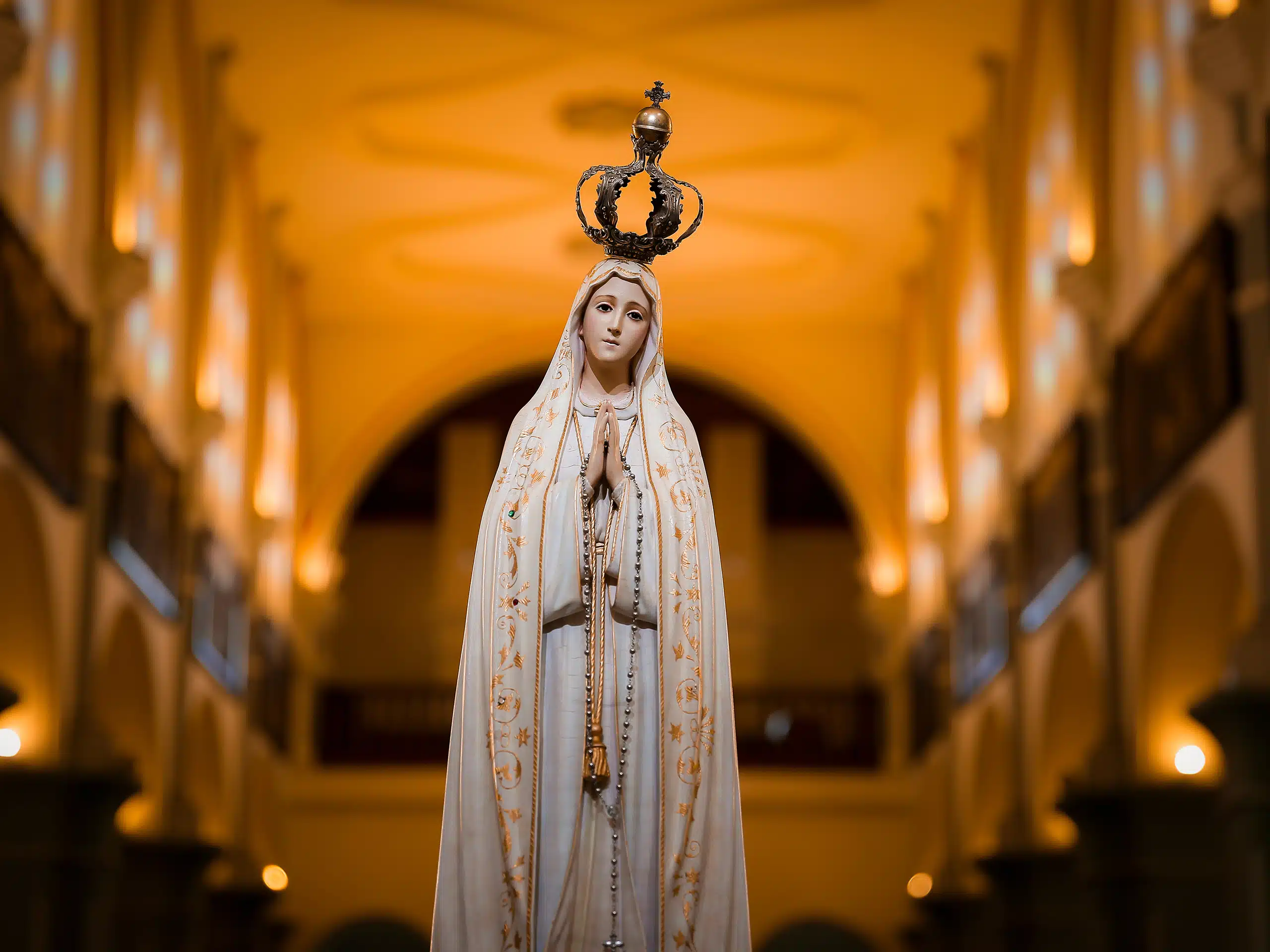
The Season of Advent is always the backdrop for the Solemnity of the Immaculate Conception, commemorated Dec. 8.
What truth does the church convey about the Immaculate Conception? That Mary of Nazareth, who would become the ever-virgin mother of Jesus Christ, the Son of God, was preserved from every stain of Original Sin.
During his catechesis on the mother of God that occurred during his weekly General Audiences from 1995 until 1997, Pope John Paul II delivered 70 discourses concerning various dimensions of Mary and her remarkable mission. On June 12, 1996, the Holy Father offered a glimpse into two facets of the mystery of the Immaculate Conception that may be often missed.
First, is Our Lady the only one to have been preserved from Original Sin at the very moment of her conception? (Of course, Jesus never was defiled by Original Sin, given his sacred divinity.) Pope John Paul exclaimed: “Granted ‘by a singular grace and privilege of almighty God,’ this preservation from Original Sin is an absolutely gratuitous divine favor, which Mary received at the first moment of her existence. The dogmatic definition does not say that this singular privilege is unique but allows that it be intuited. The affirmation of this uniqueness, however, is explicitly stated in the Encyclical Fulgens Corona of 1953, where Pope Pius XII speaks of ‘the very singular privilege which was never granted to another person,’ thus excluding the possibility, maintained by some but without foundation, of attributing this privilege also to St. Joseph.” (There is a tradition that St. Joseph and St. John the Baptist were freed from Original Sin in their mothers’ wombs, meaning that they were born without Original Sin but possessed it when they were conceived.)
Second, was Mary “redeemed” at the moment of her Immaculate Conception? Pope John Paul II said: “The text of the dogmatic declaration does not expressly declare that Mary was redeemed, but the Bull Ineffabilis states elsewhere that ‘she was redeemed in the most sublime way.’ This is the extraordinary truth: Christ was the Redeemer of his mother and carried out his redemptive action in her ‘in the most perfect way’ (Fulgens Corona) from the first moment of her existence. The Second Vatican Council (Sacrosanctum Concilium, 103) proclaimed that the church ‘admires and exalts in Mary the most excellent fruit of the redemption.’ ”
One can only conclude that Mary’s holiness is unsurpassed among all human persons. And for that reason, the Feast of the Immaculate Conception reminds us of our pressing but joyful obligation to venerate the Maiden of Nazareth who uttered her fiat (“let it be done”) to God in the presence of the Archangel Gabriel.
A well-known way to honor Our Lady is by consecrating oneself to her. Many of the seminarians of Mt. St. Mary’s Seminary in Emmitsburg, Md., either consecrate or reconsecrate themselves to Mary annually on the Feast of the Immaculate Conception. They follow the example and program outlined by St. Louis Marie Grignion de Montfort (1673-1716) as presented in his acclaimed “True Devotion to the Blessed Virgin.” In his admirable work, St. Louis Marie highlights the unparalleled sanctity of the ever-virgin, which draws us to her divine son.
One translator of the original French edition of True Devotion was Father Frederick William Faber, D.D., (1814-63), the Anglican convert who became a Catholic priest of the Oratory of St. Philip Neri and is also warmly remembered for having written the text of the inspiring hymn, “Faith of Our Fathers,” which was penned in memory of the Catholic martyrs of the period surrounding the establishment of the Church of England.
The Solemnity of the Immaculate Conception celebrates Mary’s preservation from Original Sin and her fullness of grace. We love her and imitate her conformity to her son, Jesus Christ.
Msgr. Mangan is on the faculty of Mt. St. Mary’s Seminary in Emmitsburg, Md.