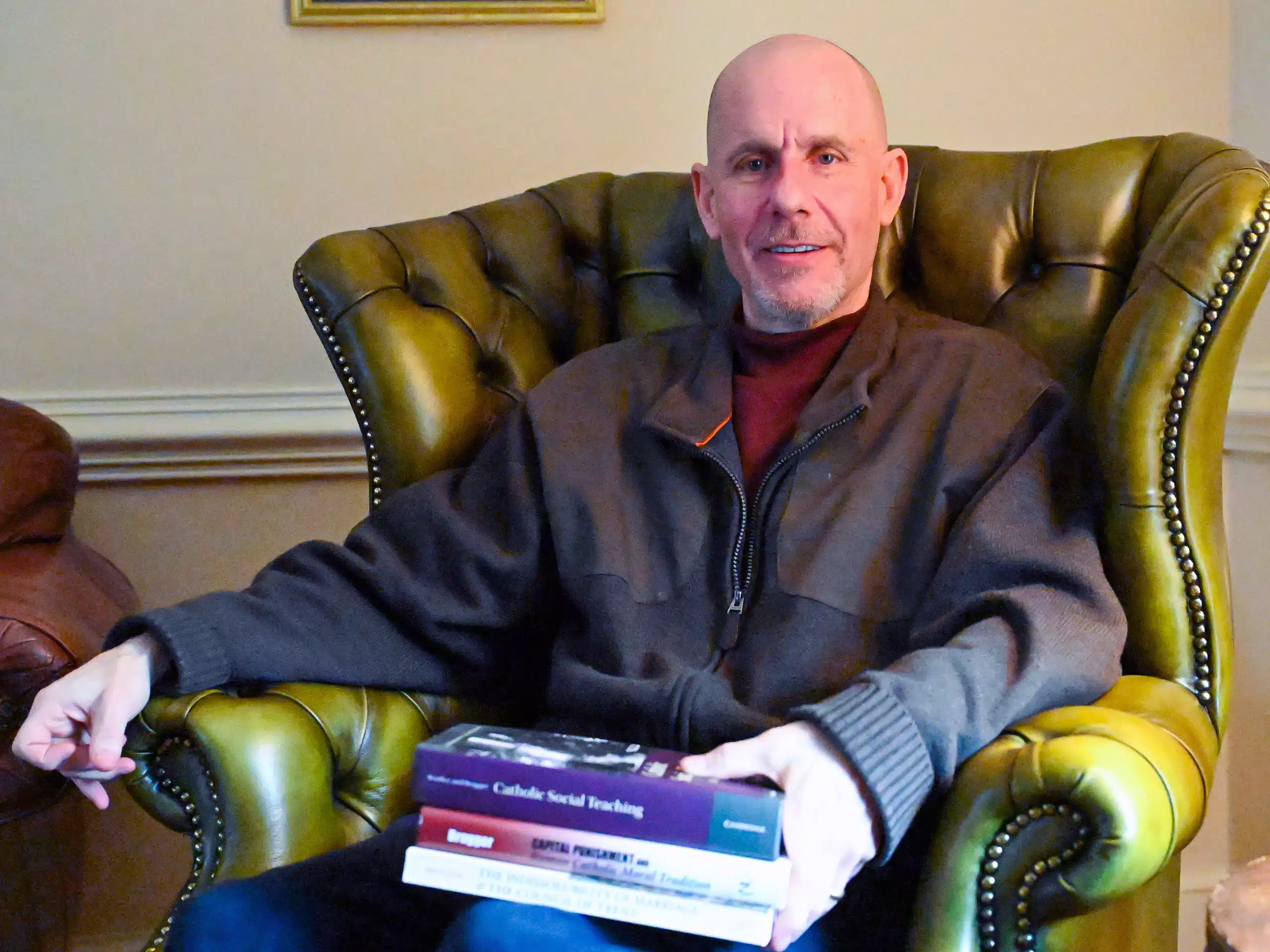
Moral theologian E. Christian Brugger ponders life’s toughest moral questions — seated around the hot tub with his adult children several times a week.
Brugger — who has three master’s degrees and a PhD in moral theology — regularly writes a column for the National Catholic Register on “Difficult Moral Questions,” from his Front Royal home. A parishioner of St. John the Baptist Church in Front Royal, he and his wife, Melissa, have five children and have moved 19 times across the globe. He specializes in bioethics, sexual ethics and issues of moral cooperation.
“Controversial moral questions tend to be related to those three,” he said. “There’s a lot of division within moral theology in the Catholic Church.”
While his column for the Register dates from 2018, his Q&A-style articles on moral and ethical issues go back more than a decade. Since the 2000s, he has responded to hundreds of anonymous reader questions for a number of publication platforms, including the now-shuttered Culture of Life Foundation.
Questions are often submitted anonymously. “I’ve done a lot of publishing on difficult moral questions over the years, and I’ve gotten many, many consults on questions pertaining to sexual intimacy,” many of which come from devout Catholic couples, Brugger said. Many of these questions pertain to natural family planning.
Responding to sensitive, personal questions is far from easy. Brugger said he once received a question from a woman struggling with irregular menstrual cycles and a health condition that would make pregnancy life-threatening. With her marriage on the rocks and a risky health condition, she asked if it would be morally legitimate to use contraception. Brugger said the difficulty in responding to such questions isn’t finding Catholic teaching on the topic, but in pastorally conveying these truths to a struggling couple. “The moral principle … is very clear: contraceptive acts render a sexual act as unethical. But saying that to a couple under those circumstances is not easy,” he said. “It becomes an effort to be pastorally sensitive and faithful to the truth.”
Brugger said he also receives questions about moral cooperation, or “material cooperation,” which is “when a person does something that’s not in itself evil, but it gives off an ambiguous example,” he said. One example can be found in a 2024 column published by the Register, “Should a Catholic attend an invalid wedding?” Other questions addressed issues of moral cooperation in the workplace: “ ‘Can I be a social worker in an office in which adoptions are being awarded to homosexual couples? Do I need to quit?’ Those are difficult questions,” Brugger said.
Brugger’s devotion to defending Catholic teaching stemmed from his conversion to the faith in high school. He entered the church when he was 18 and served in campus ministry at Rutgers University in New Jersey. “I came to know three things. One was helping people come to know God, especially Jesus Christ, better. Second, I learned to love public speaking, especially speaking about the faith. And then third, I grew to love learning about my faith, deepening my faith,” he said.
Brugger set out on a journey to pursue those three things. He earned a master’s in moral theology from Seton Hall University in South Orange, N.J., and a second master’s from Harvard University Divinity School. He earned his third master’s and doctorate in moral theology from Oxford University.
Brugger met his wife, Melissa, while studying at Seton Hall. “I met her at a singles prayer meeting on a Friday night,” he said. “I was giving a talk that night, and she was in the audience, and I remember many of the singles having glazed looks on their faces as I was speaking and being uninterested in my talk. But I remember she was on the edge of her seat,” he said. “Our first official date was skydiving … we’ve been falling ever since,” he joked. The couple married in 1994, and their oldest daughter, Rose, was born the next year.
Over the years, Brugger held academic positions at universities and seminaries throughout the U.S., including St. John Vianney Theological Seminary in Denver and St. Vincent de Paul Major Seminary in Boynton Beach, Fla. He has published several works, including “Capital Punishment and Roman Catholic Moral Tradition,” (2003) and “The Indissolubility of Marriage and the Council of Trent” (2017). He also edited a volume of essays on Catholic Social Teaching.
What Brugger has learned after years of answering sensitive questions is the importance of Christ’s message, “Whoever wishes to come after me must deny himself, take up his cross, and follow me.” (Mt 16:24)
“I have come across many people who have heavy moral crosses to bear, especially in their marital relationships,” he said. “Heavy crosses to bear can be faithful to the moral law and to the truths that the Catholic Church teaches and defends. And frequently, after repeating what those truths are, and what the church’s teaching is, I have to invite them to be courageous and to do what we’re all called to do with our various sufferings, which is to bear their cross in union with the Lord.”
Find out more
For “Difficult Moral Questions,” go to ncregister.com/author/e-christian-brugger.