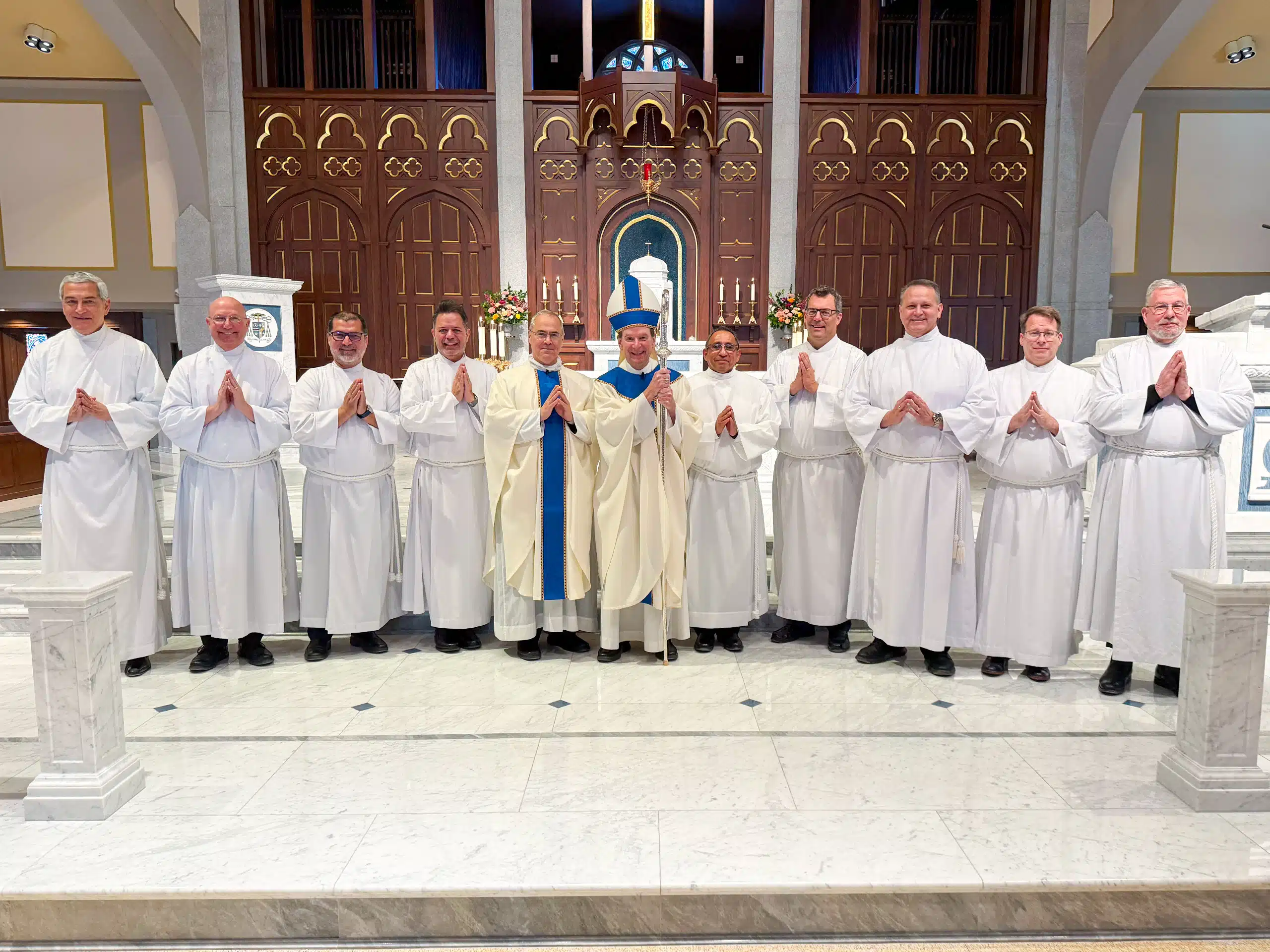
Nine men were instituted to the ministry of acolyte as part of their journey to the permanent diaconate at the Cathedral of St. Thomas More in Arlington Jan. 31. The men are: Matthew Chapman, Andres Colón, Michael Evans, R. J. Levin, Thomas Malanga, Arturo Matas, Kelly McKeague, Victor Mendez and Christopher O’Connor.
The Rite of Acolyte is one of several steps in a six-year process to become a permanent deacon. Permanent deacons assist priests on the parish level by proclaiming the Gospel, preaching homilies, conducting funeral services, preparing couples for marriage, and witnessing marriages, among other responsibilities. Previously, the candidates were installed as lectors last February during the Rite of Lector.
According to Episcopal Vicar for Clergy Father Paul D. Scalia, “The acolyte is officially entrusted with care for the Eucharist in certain situations. So, that is a step in the process to ordination, drawing a man more closely to ministry at the altar.”
Many of the acolytes’ new duties resemble those of altar servers or extraordinary Eucharistic ministers. “They should be more diligent in serving at the altar, assisting with the distribution of holy Communion, bringing holy Communion to the homebound, even on occasion exposing the Blessed Sacrament for adoration,” Father Scalia said. “This should be accompanied by a greater devotion to the sacrifice of the Mass, to the Real Presence of Our Lord in the Eucharist, especially by way of adoration, and then in the reception of holy Communion.”
For the remaining two years of formation, the acolytes will serve their parish communities as they prepare to be ordained permanent deacons in 2028.
In his Jan. 31 homily, Bishop Burbidge encouraged the candidates to follow the example of St. John Bosco, whose feast was celebrated that day. “At the center of your formation is your spiritual life, which is rooted in daily and fervent prayer. Most especially, this includes the time you spend with the Lord before the Blessed Sacrament as you speak with him, listen to him and rest in his presence,” he said. “St. John Bosco offers this encouragement: ‘Entrust everything to Jesus in the Blessed Sacrament and you will see what miracles are.’ ”
Bishop Burbidge thanked the candidates’ spouses, children and family for their support during the years of diaconate formation. He encouraged the soon-to-be-acolytes to rest in Christ as they take on their new duties.
“As you carry Jesus, the Bread of Life, to others be sure to let him carry you,” he said. “Strengthened today with the precious gift of his body and blood, go forth and heed St. John Bosco’s advice: Be happy; study and pray; do all the good you can, and embrace the Lord’s command to have childlike faith ever dependent upon your heavenly Father.”
The acolytes said while studies have been more challenging than ever, the rite filled them with jubilation.
“Last year, Bishop Burbidge encouraged us to become biblical scholars, so there has been a lot of reading, not just for class, but also to be prepared to read each Sunday,” Levin said. “I found that the more I read in preparation for each Sunday the deeper into the meaning of each week’s set of readings I got.”
O’Connor said he felt a deep sense of joy and gratitude during the rite. “Thanks to the Lord, my family, my formators and for all of the people, some of whom I do not know, who have been praying for my class and me. I was also very grateful that all ten of us who started the program are still going forward,” he said.
Levin said he had expected to be nervous, but instead, “I found myself to be in a calm, peaceful state, as if Jesus was there with us, his hand on our shoulders, ensuring that this was where we were supposed to be,” he said. The next day, “all the emotion I thought I would have had then came rushing up on me the next day when serving my first Mass as an acolyte at Holy Spirit (Church in Annandale).”
Colón said that he anticipates the next year of formation will better shape his understanding of the permanent diaconate. “The ministry of acolyte brings me closer to the Eucharist and, through that, closer to understanding what it means to give myself in service to others,” he said. “I see this next season as a time to deepen my trust in God’s grace, as he continues to form me as a servant of the church and teach me to respond more faithfully to his call.”