The Diocese of Arlington, in collaboration with The Catholic University of America in Washington, released a statement Feb. 19 calling for community assistance with a longtime archaeological project at the historical Brent Family Cemetery in Aquia.
Laura Masur, assistant professor of anthropology at Catholic U., led the project with diocesan Archivist Lindsay Alukonis.
The statement invites engagement from descendants of the Brents or the people they may have enslaved, and encourages them to come forward with any family trees, records or oral histories. It also states that Masur led an archaeological dig with archaeology students last year.
“Masur’s research, undertaken in close collaboration with the Diocese of Arlington, is now focused on identifying the persons who lived and are buried at the site in order to understand the history better,” the statement read. “Masur and the Diocese are now working to identify descendants of those buried on the Aquia, Va., land owned by George Brent in the 17th century, so they are part of the dialogue about how to move forward.”
The Brent family became the first Catholic settlers in Virginia when Giles Brent and his family moved from Maryland to the Aquia area in 1647. Giles’ nephew George Brent later moved from England to the region by 1670. At the time, the practice of Catholicism was prohibited in Virginia.
But the Brents also purchased or brought with them dozens of enslaved African American men and women. George Brent’s 1694 will names 25 enslaved persons, including a woman named Flora. Flora is buried within the cemetery walls, and a 1923 photograph by the George Washington Stone Corporation depicts her simple tombstone: “Flora, 1697.” Over the next century, the tombstone disappeared. Masur and Alukonis theorized there are dozens of enslaved people buried both inside and outside the cemetery walls.
According to the statement, burials in the cemetery potentially date from 1670-1775, and the Brent family owned the cemetery until 1841. The Diocese of Richmond purchased the property from private owners in 1924 before it came into the possession of the Arlington diocese in 1974.
The cemetery’s brick walls and altar are not original to the site. In 1927, the Catholic Women’s Club in Richmond took an interest in the cemetery. The next year, they funded the construction of a wall that enclosed a portion of the cemetery, and a large, 30-foot crucifix that stands beside Route 1.
In 2021, archaeological geophysicist Timothy Horsley conducted a survey of the cemetery using ground-penetrating radar, or GPR. The original goal of the project was to better understand the boundaries of the cemetery and its relationship with George Brent’s house, according to Masur and Alukonis.
According to the recent statement, the survey identified an anomaly within the cemetery walls, and some 60 burials and possibly 28 unmarked burials in the surrounding area. “Prior archaeological digs between 1995 and 2002 also identified unmarked graves both inside the brick wall and on a slope outside the wall that leads down toward a swampy area,” the statement read.
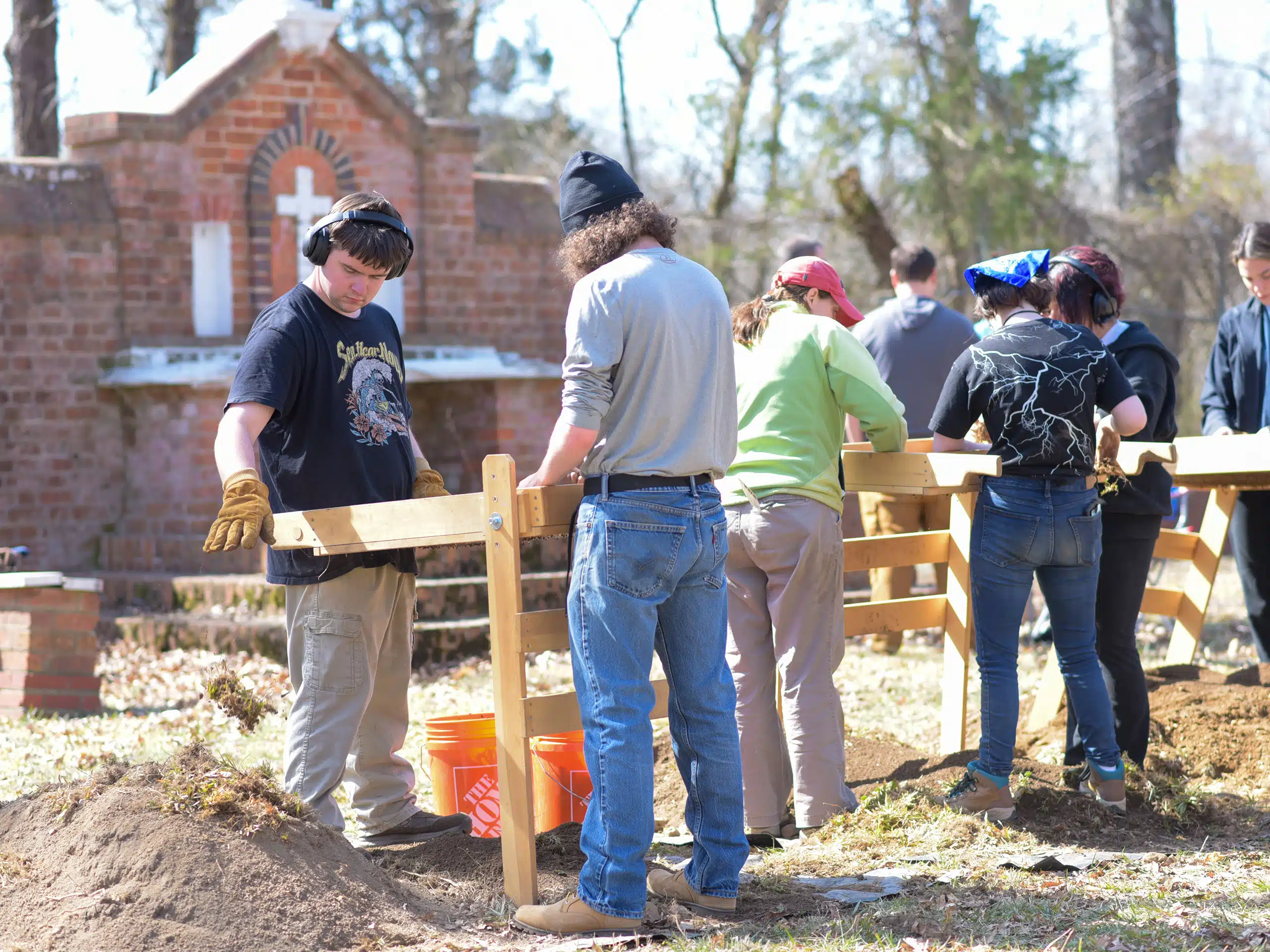
Last March, Masur led a group of archaeology students on a weeklong dig to investigate the GPR anomaly. At the time, she and Alukonis theorized that the anomaly may be the foundations of a building. The Catholic Herald joined Masur and the students on the third day of the dig March 12.
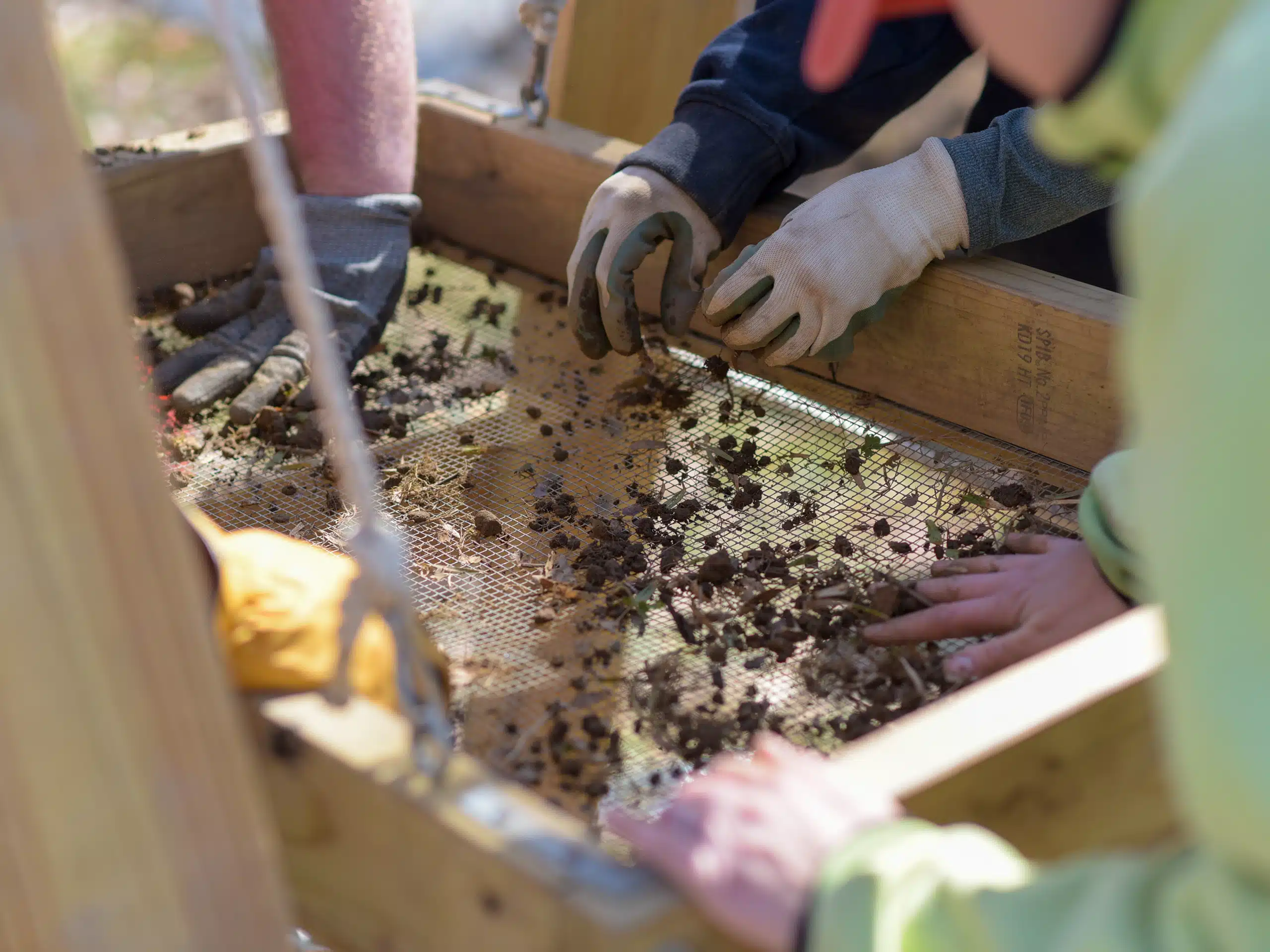
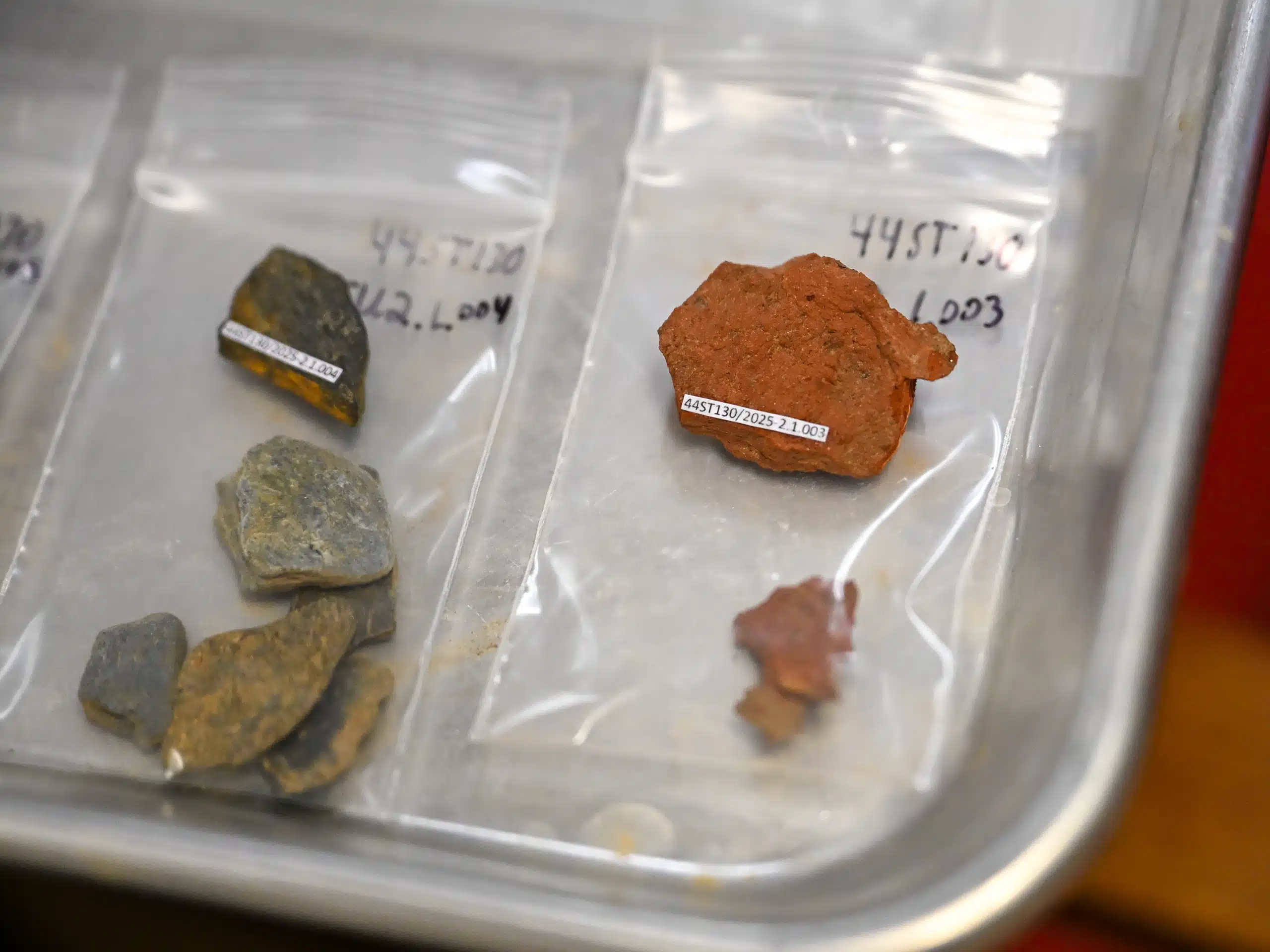
Masur and the students carefully removed the soil layer by layer, sifting it to look for artifacts. They found fragments of tobacco pipes, slate roofing tiles, 17th and 18th-century pottery fragments, and Native American tools, including a Savannah River projectile point, or arrowhead, dating around 2500-1200 B.C., according to Masur.
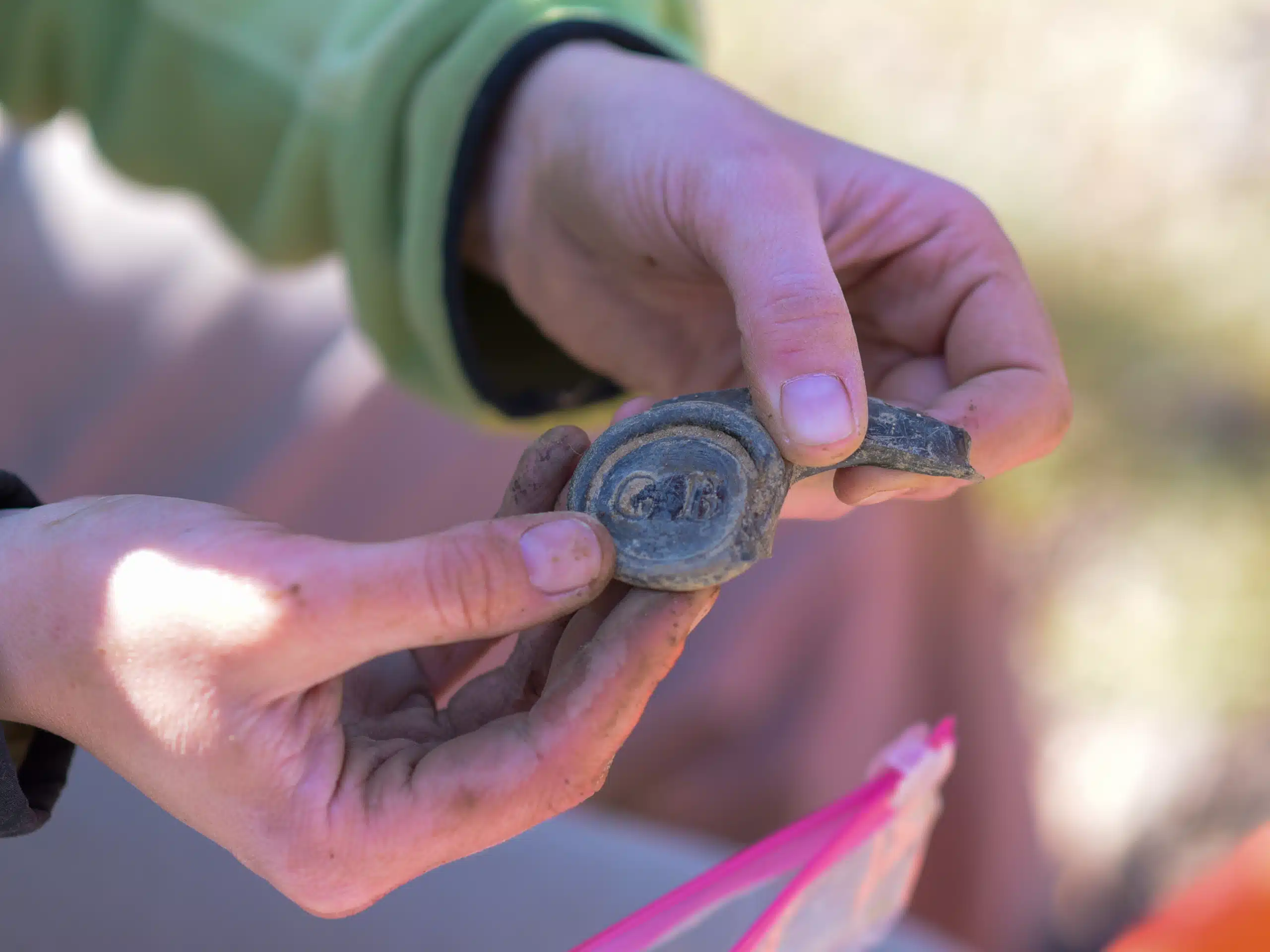
One artifact caught the attention of the group. Students discovered the remnant of a wine bottle, the glass seal bearing the initials “GB.” Alukonis and Masur said the initials could stand for “George Brent” or “Giles Brent.” Regardless, Alukonis said the seal is one of the few artifacts directly linking the Brent family to a nearby residence.
But the project unearthed evidence the group did not expect: five possible gravesites. Hardened sediment from a 1942 flood had settled on top of the gravesites, which GPR had identified as the anomaly. Carefully cut, upright stones with no inscriptions had been placed in the ground. One of the stones was located next to a shallow depression, which originally formed when the deceased’s coffin had decomposed and collapsed.
When it became clear that the excavations had reached graves rather than a building, the students stopped digging. Tarps were placed over the gravesites, as well as large stones, to prevent any future projects from disturbing the gravesites. Alukonis said that while they did not find the foundations of a building, the dig yielded something spiritually richer — the unknown gravesites of people who, for a time, were lost to history.
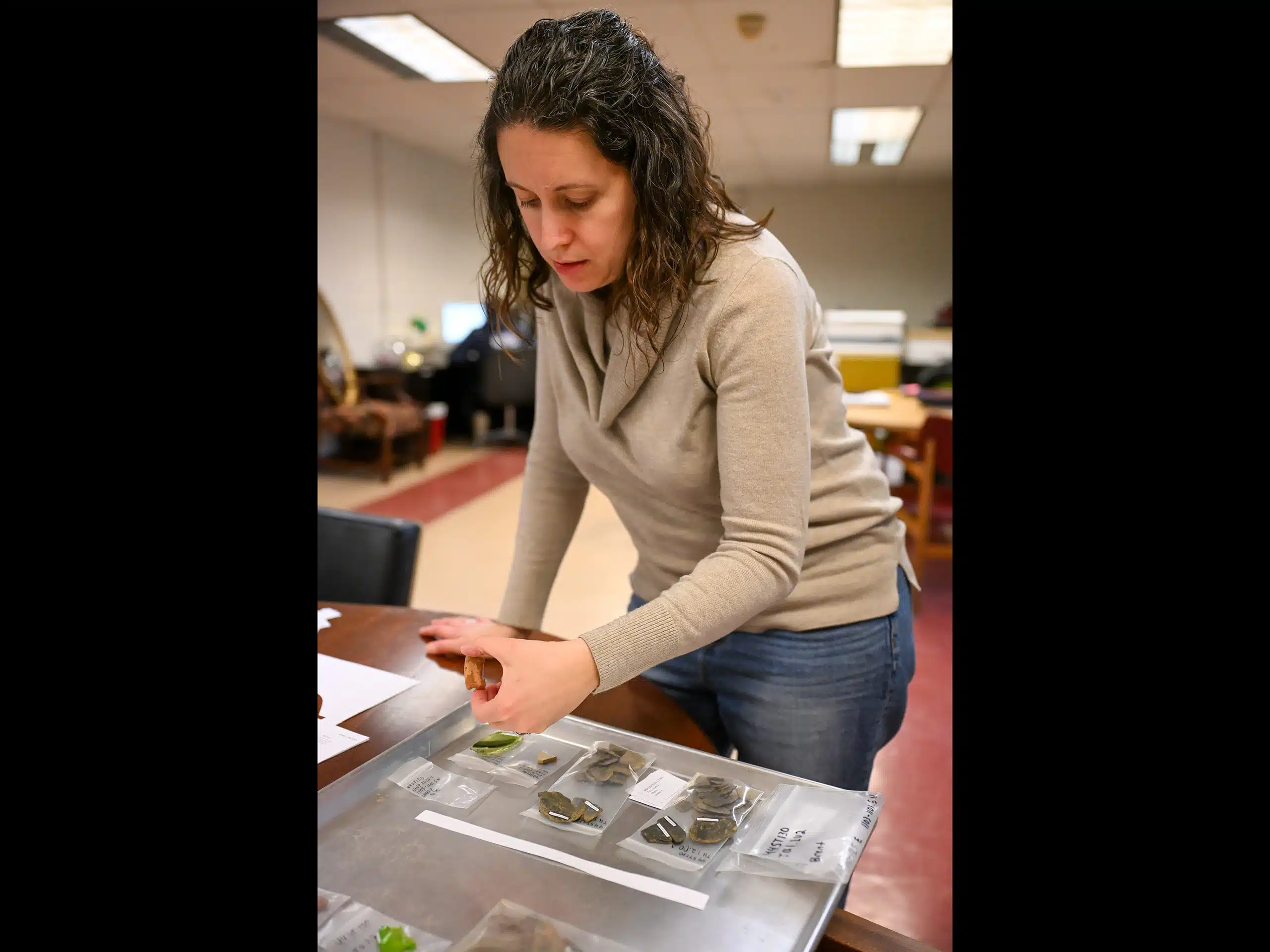
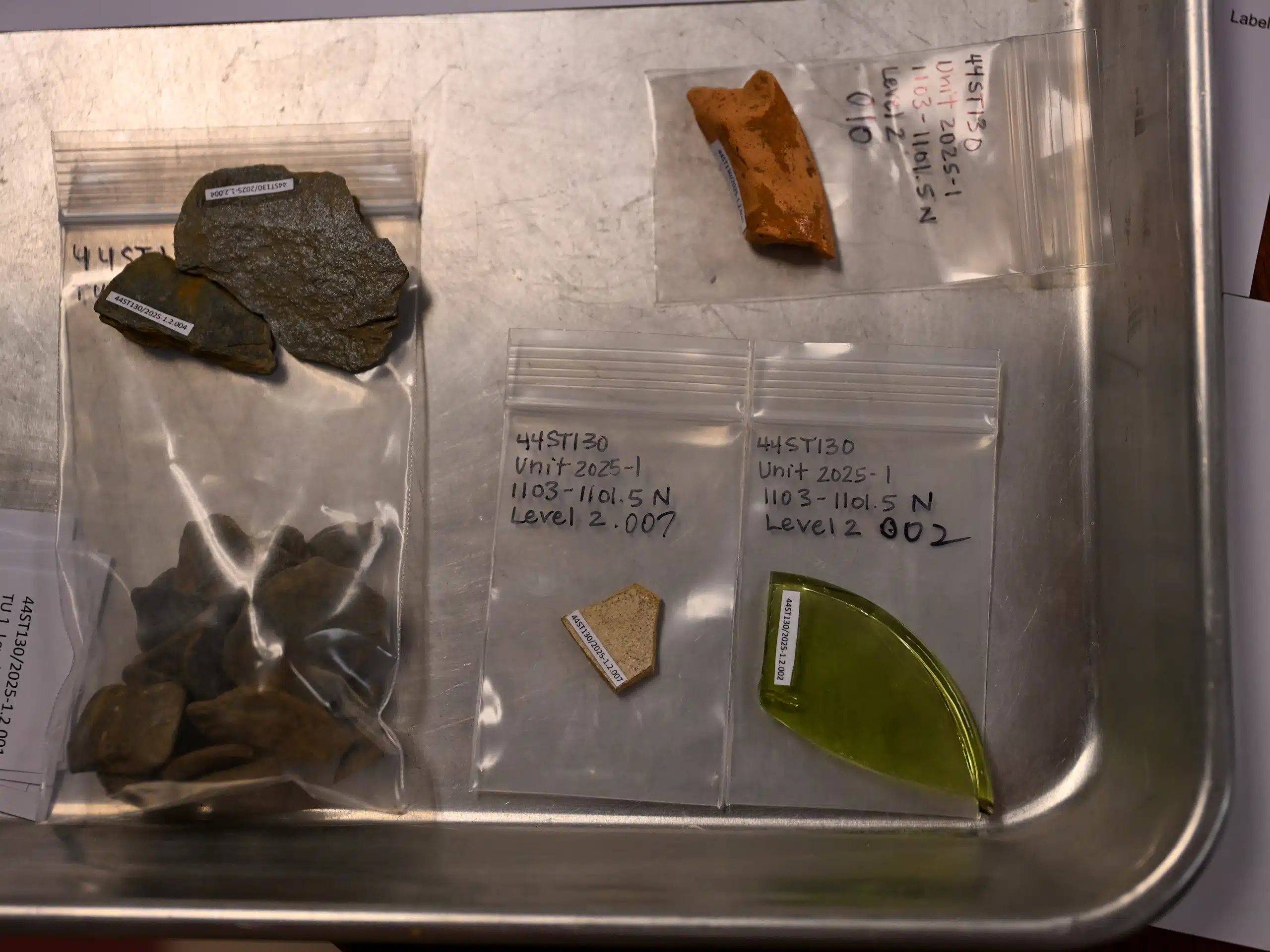
Since the dig, Masur and her students worked on preparing the artifacts for curation. At Catholic U. Feb. 6, three senior archaeology students carefully catalogued the stone and glass artifacts. Sierra Ellemberger attached miniscule paper labels to each artifact. Carl Caragine, who attended the 2025 dig, assisted while compiling project notes. Nate Erb, who also participated in the dig, sat at the computer using Photoshop to digitize field drawings from the site.
“It’s interesting to see the refuse of different eras,” Caragine said. “A lot of stuff is pretty recent; it’s not super old stuff. But then you’ll randomly come across things from the 1600s.”
Masur and Alukonis said that many of the recent artifacts were traced to field Masses celebrated at the cemetery in the mid-20th century. The field Masses began in 1929 and continued into the 21st century, the most recent celebrated in November 2022. Mary Vial, former president of the Catholic Women’s Club, said that she attended the field Masses for nearly 20 years. “I attended Masses every year after joining the CWC in 2003. We always went to the cemetery in late October. It was the most rewarding trip that I have ever experienced,” she said. “You felt like you were in a large cathedral, only outside on a beautiful day.”
Rumors and myths about the cemetery persist, even now, according to Alukonis and Masur.
One claim posits that George Brent’s aunt Margaret Brent, long considered one of the first female political leaders in Virginia, and Giles Brent are buried in the family cemetery. Alukonis said that she believes Margaret is buried somewhere in Aquia, but no physical evidence links her to the cemetery. And while no definitive evidence suggests that George Brent is buried at the site, the burials of George’s two wives, several of his young children, and Flora, who is listed in his will, allow for speculation, she added.
Masur said that certain histories written in the 19th and 20th centuries make allegations about the cemetery that aren’t based in primary sources. “Unless there’s a burial marker saying that someone is buried there, we can’t know,” she said. “You need to have concrete evidence to support any claim. Anything else is going to be speculation.”
Another debunked claim links the cemetery site to the Jesuit martyrs of Virginia, who were killed in the late 16th century. The narrative first arose in the 1930s, when a Jesuit priest from Mobile, Ala., traveled to Northern Virginia and concluded that the Jesuits’ mission was located adjacent to the cemetery site. A monument honoring the martyrs was even erected at the cemetery in 1935. But not even a decade later, the priest’s claims were disputed by two Jesuit scholars, who said that evidence links the martyrs’ mission further south near Yorktown and Jamestown, according to Alukonis. While historians today generally agree that the Jesuit mission was further south, the monument still stands at the cemetery, Alukonis said.
Another popular belief is that the Brents built a chapel by the cemetery. Alukonis said that while it is unlikely the cemetery featured a chapel in the conventional sense, “a priest may have come out and blessed the house, and it became a place of worship of its own.”
Masur said that since Catholicism was prohibited in Virginia in the 17th and 18th centuries, “you don’t want someone to come in and confiscate your property or burn your house down, right? So, it’s not typical for people to build churches.”
While the results of the 2025 dig did not locate the foundations of a building, a residence was located in the area outside the cemetery walls, according to Masur and Alukonis.
But due to the dozens of potential burials inside and outside the 1932-era brick walls, Masur is hesitant to conduct another dig without seeking community involvement first.
Many of the unmarked burials are likely people enslaved by the Brents, and it is vital to make contact with their descendants, according to Masur. “One of the things that I really want to ensure is that we sort of have a ‘big tent’ of dialogue going on about plans for the site,” she said. “It’s important that those community partners weigh in about what our long-term goals are, because we don’t just go out and dig. We decide where we dig in order to meet certain goals.”
For Gerard “Jerry” Cousin, a member of the diocesan Advisory Council on Racism, the cause is personal. “I know several of my great-great-great-grandparents were enslaved, and I would love to know about that history,” he said. Over the years he has traced his ancestors to the Diocese of Baton Rouge, La., but many of his ancestors’ graves are now covered by the Mississippi River. When it comes to searching for the resting place of loved ones, “I know how important it is to people,” he said.
Cousin said that reaching out to descendants is vital, “as people are becoming more aware and want to better understand their family histories,” he said.
Joseph A. Brooks Jr., chairman of diocesan Black Catholic Ministries, said that reaching out to descendants may help fill a gap in their family history. “For those folks who have relatives that are buried there, who are seeking their ancestry, I think it’s important for them to know that they have relatives that were in the area.” He shared his own example. “To me, personally, I do know that my seventh-generation grandmother was from Virginia. I’m originally from Louisiana,” he said. “For those who are looking to research their genealogy, this could be a tremendous step in helping them to close some of those missing gaps.”
A lack of records makes tracing ancestry difficult, Brooks said. “It’s very difficult for African Americans to trace their ancestry beyond the Civil War.”
Bishop Michael F. Burbidge has been following this story closely and said he is deeply grateful to Catholic U. for their partnership “as we seek to better understand the history of Brent Cemetery.”
“Every grave marks the final earthly resting place of a human person, known and loved by God, who came before us,” he said. “It is our great responsibility as a diocese to conserve, honor and steward Brent Cemetery as sacred ground.
“We pray that, in time, descendants of those buried at Brent Cemetery centuries ago may come forward so that together we may more fully honor the lives and legacies of these first Virginians, our brothers and sisters, created in the image and likeness of God and entrusted to our remembrance,” he said.
Alukonis emphasized that the goal is to be “equitable across the board on behalf of everybody who is buried there. This is a project I’m working on, but it is their family,” she said of the descendants of the enslaved persons. “My project takes a backseat to those who actually lived it and have a history with it.”
Donofrio can be reached at [email protected].
How to help
Those with records, family trees or oral histories of relating to the Brent family, or ancestors enslaved by the Brents, are encouraged to reach out to diocesan Archivist Lindsay Alukonis at [email protected] and Catholic U. professor Laura Masur at [email protected].
To read the statement, go to bit.ly/4aHu90A.
This article has been updated.