After attending Franciscan University of Steubenville for two years, Justin Orr looked into his heart and faced the truth about his future.
“I love Franciscan, it’s a great place, lovely people,” he said. “My problem was that I couldn’t find my niche. Everything that I tried, I just ended up feeling like, this isn’t what I want and isn’t going to get me where I want to go.”
Orr didn’t have to look far for his next move. He enrolled at the College of St. Joseph the Worker, a unique college that opened in 2024, less than two miles from the Franciscan campus.
“What really drew me to look at St. Joseph the Worker is the way they integrate the Catholic environment and instruction with real-world labor,” said Orr, who grew up in the diocese and attended Holy Trinity Church in Gainesville. He credits his experience at diocesan WorkCamp the summer before his senior year of high school for planting the seeds of pursuing a trade.
“I learned at WorkCamp that I really enjoyed working with my hands,” he said. “I never really wanted a desk job, but I didn’t know what a career in the trades would look like.”
According to a Bloomberg report, the U.S. will be short 550,000 plumbers and pipefitters in 2027, while other data indicates massive gaps with only one person entering the trades for every five who retire, projecting up to 5 million open positions in the construction industry. The diocese has responded by conducting a study to determine the feasibility of a vocational school.
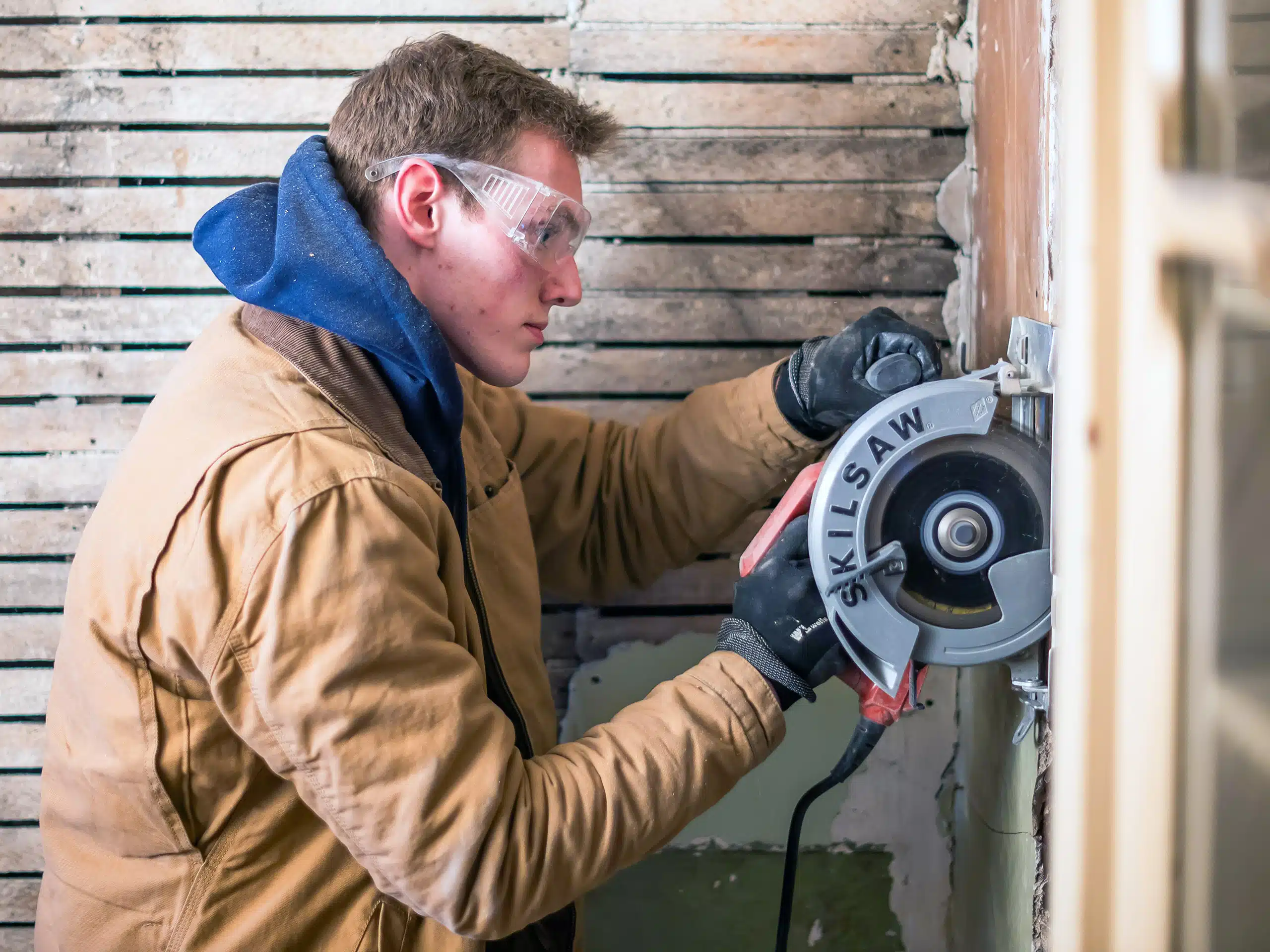
Students at St. Joseph’s get their hands dirty with shop classes in their first semester, in addition to coursework in Catholic theology and philosophy as they earn a bachelor of arts in Catholic Studies. By their second year, students have selected their trade with an eventual goal of reaching journeyman status post-graduation. “We do a bit of everything,” said Orr, 21. “We’ve had a week of electrical training, a week of plumbing and a week of HVAC.”
Training men for the skilled trades is a form of Catholic education that goes back centuries, said Justin Sofio, director of regional development at St. Joseph’s. “The monasteries founded some of the first universities, and higher education meant working in the field and praying,” he said.
“They were glorifying God through the trades, through architecture. So, we really want to instill both the traditional building methods, such as timber framing, along with the conventional building methods in our students. We don’t want to just be another institute of higher education. We want to reclaim it by offering a model that does not yet exist.”
One of the biggest attractions is the unique tuition structure that is designed to ensure that students don’t graduate in debt. Beginning in their sophomore year, students get paid to work. “We pay them for on-the-job training, so they have the opportunity to make above the $15,000 annual tuition,” said Sofio. “Nobody else is doing that. The idea that you must take out $100,000 worth of loans and graduate with crippling debt to serve God is simply not a Catholic idea.”
Orr knew he had made the right decision to transfer immediately after beginning classes in the fall semester. “They had these instructors come in and you could see in their eyes, in their body language and the way they talked that they’re passionate about the mission,” he said. “They really want to help us learn and go out in the world as Catholic tradesmen.”
With 63 students from 26 states enrolled at St. Joseph’s, including two women, Orr believes there’s a significant change happening in the way young people are thinking about college. “A lot of people go to college not knowing what they want to do and they spend a lot of money to get a degree they can’t do anything with,” he said. “With this, you’re being prepared to go into the workforce. There’s an actual direction and you know where you’re going.”
The big moment for Orr came when he was learning the art of timber framing. He realized how the work of his hands was meant for something greater than himself. “We’re building a whole house from the ground up,” he said. “That house is going to be used by a family that doesn’t have one. Being a part of that is just a feeling of great fulfillment — of realizing that I have the power to help people in extraordinary ways. We’re building something that is a testament to God.”