The best way to see the Italian Renaissance artist Raphael is to fly to Rome and tour the Vatican Museums, braving the jostling crowds to stand in the presence of this great painter’s works.
However, from now until June 28, there is a more convenient option. The first comprehensive exhibit of the master’s work in the United States, “Raphael: Sublime Poetry,” is on view at the Metropolitan Museum of Art in New York, and Virginia Catholics would do well to go see the 170 works by Raphael and many paintings, drawings, engravings and ceramic pieces by his teachers, contemporaries and disciples.
Raphael has special meaning for Catholics. One reason is the scope and beauty of his work in the Vatican and Roman churches. At the Vatican, that includes the four rooms he frescoed for two successive popes between 1508 and 1520, the tapestries he designed for the Sistine Chapel, and the Loggia decorated under his guidance with Biblical stories that became the template for Bible illustration all over Europe — not to mention the altarpieces now in the Vatican Pinacoteca, including his final masterpiece, “The Transfiguration.”
Another reason he is beloved by Catholics is his series of devotional images of the Virgin and Child, no two alike, always capturing in his unique way the simultaneous humanity and divinity of the subject.
Born in 1483 in the town of Urbino to a painter-poet father, Giovanni Santi, Raphael was an orphan by age 11.
He learned from artists who worked nearby, especially Perugino. At age 17, he was a full-fledged master, attested by an extraordinary loan to the exhibit of a two-sided processional banner from Citta di Castello.
By 1504, the 21-year-old prodigy was in Florence, where he soaked up the lessons of Leonardo da Vinci and Michelangelo. In 1508, he was called to Rome. After a prolific career, he died at the young age of 37 in 1520. He left behind a team of pupils and collaborators, a trove of drawings, and a standard of perfection that artists strove for three centuries to emulate.
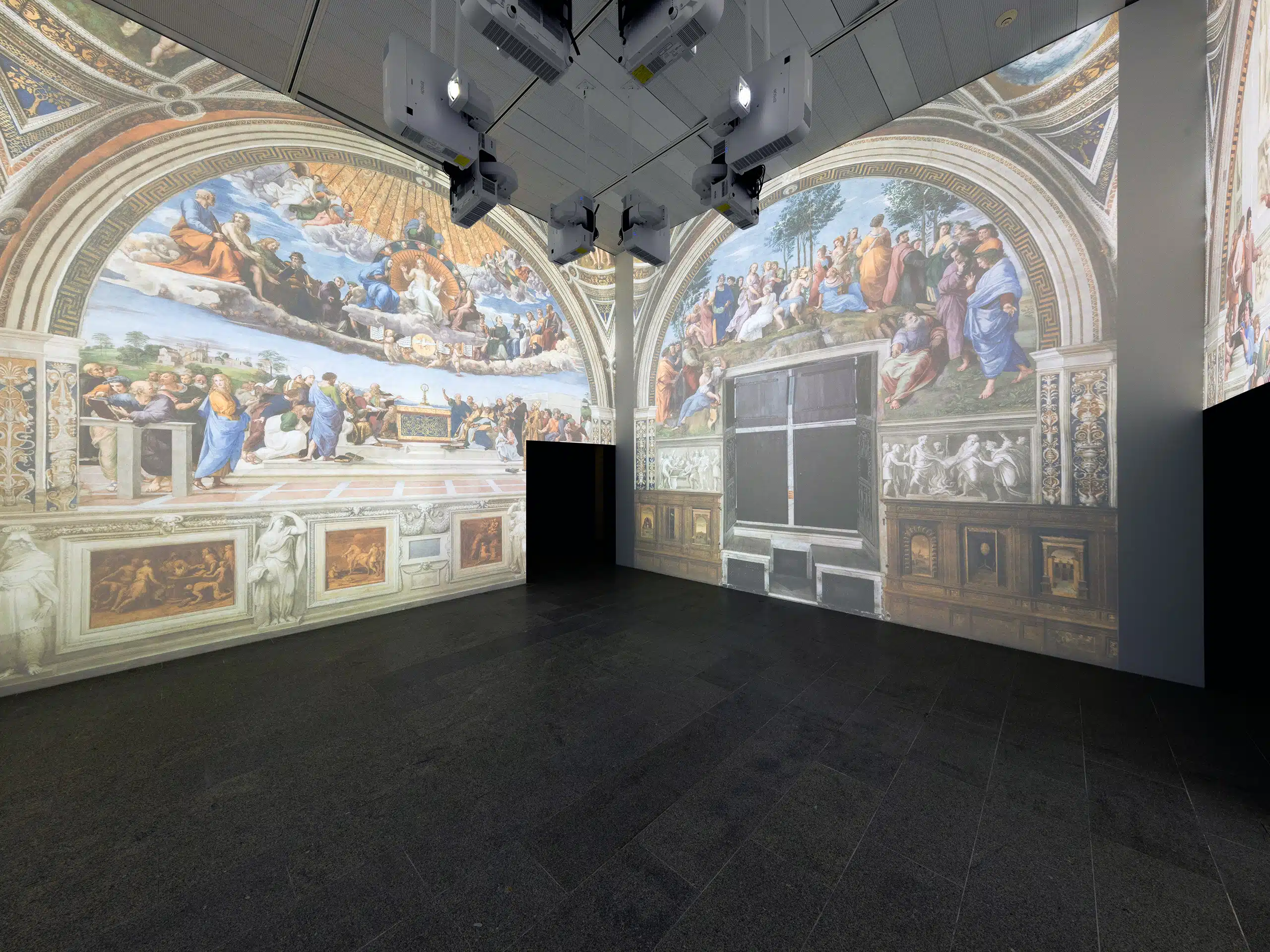
Raphael quickly absorbed the lessons of Michelangelo’s Sistine Chapel ceiling and applied them to the Vatican apartments, known as the Stanze. They don’t travel but visitors to the New York show can enjoy seeing these frescoes projected on the walls at 75% their actual size. In the most famous of these rooms, Raphael celebrated the church’s embrace of learning in all fields — science, law, theology and the arts. In the other Stanze, he portrayed great moments in Judeo-Christian history, including the liberation of St. Peter from prison and the expulsion of the invader Heliodorus from the temple in Jerusalem.
His next great project for Pope Leo X was to complete the decoration of the Sistine Chapel. In 1482, a team of artists from Florence had painted murals on the walls of the life of Moses and the life of Christ, showing the old and new covenants facing each other. Then in 1512, Michelangelo completed the ceiling with the stories of Genesis.
Now Raphael was tapped to complete the story of salvation by depicting the Acts of the Apostles as they founded the Christian church on earth. He made large-scale designs, called cartoons, to be woven into episodes of the lives of Peter and Paul after the Gospels. Three of the tapestries, woven from the same designs in the mid-16th century for the King of Spain, are on display in New York. They had never left Madrid.
Raphael painted the Virgin and Child dozens of times, no two alike. The three Madonna pictures from Washington’s National Gallery are on view with the drawings he made in preparing them. His portrayals of the beautiful young Madonna and her chubby infant are especially poignant given the stratospheric level of maternal and infant mortality at the time — he had lost his own mother and baby sister in childbirth when he was only 8.
Raphael used a model from Byzantine art, the Madonna of Tenderness (Eleusa) as the taking-off point for his images of Mary embracing Jesus cheek to cheek. The series culminates with the “Alba Madonna,” on loan from the National Gallery of Art. In a round format, Raphael portrays Mary seated in a landscape with baby Jesus and toddler John the Baptist. Mary and John gaze into each other’s eyes as Christ seizes the reed cross proffered by his young cousin.
At any moment, the viewer imagines, Jesus will take that cross and begin a journey through the lush landscape, previewing his road to Calvary as an adult. Raphael’s genius lay in merging a normal childish impulse — wiggling out of an adult’s embrace — with a profound theological truth.
Hamerman is a freelancer from Reston.