If the words on the page don’t make sense, it could be dyslexia. One Bishop Ireton High School student who struggled with that reality and has since graduated from a tutoring program active in the diocese, has important advice for parents.
“It doesn’t hurt to get tested, because when you’re younger and everyone else is still learning how to read, it’s really easy to prevent more struggles along the way,” said junior Alyssa Podoff.
The Yale University Center for Dyslexia & Creativity estimates dyslexia affects 20% of the U.S. population and represents 80–90% of all those with learning disabilities. It’s the most common of all neuro-cognitive disorders — resulting in trouble matching letters with the sounds made by those letters and combinations of letters.
“A lot of my friends who have dyslexia didn’t find out until middle school. They had a harder time in the tutoring process,” Podoff said. “So, it doesn’t hurt just to get tested for it at a young age.”
She speaks from personal experience.
“When I was diagnosed with dyslexia, my parents were looking for a good program to help me because I wasn’t really learning how to read in school, so I needed some extra help,” Podoff said. “And then my parents found Dyslexic Edge.”
For the past 10 years, Dyslexic Edge has provided tutoring in a specialized methodology designed for Northern Virginia children with dyslexia, as well as enrichment activities in a variety of science, technology, engineering and mathematics or STEM fields. It is staffed by dedicated tutors, volunteers and mentors. Krista Gauthier, founder and president, was also Podoff’s first dyslexia tutor.
“I actually tutored Alyssa probably three times a week,” Gauthier said. “I caught her up to the original cohort. She joined the after-school program in the fall of 2017 and then graduated with that class in December of 2018.”
While Podoff says she still has challenges “here and there,” she said “the program really helped me to just do things on my own, and work around it.”
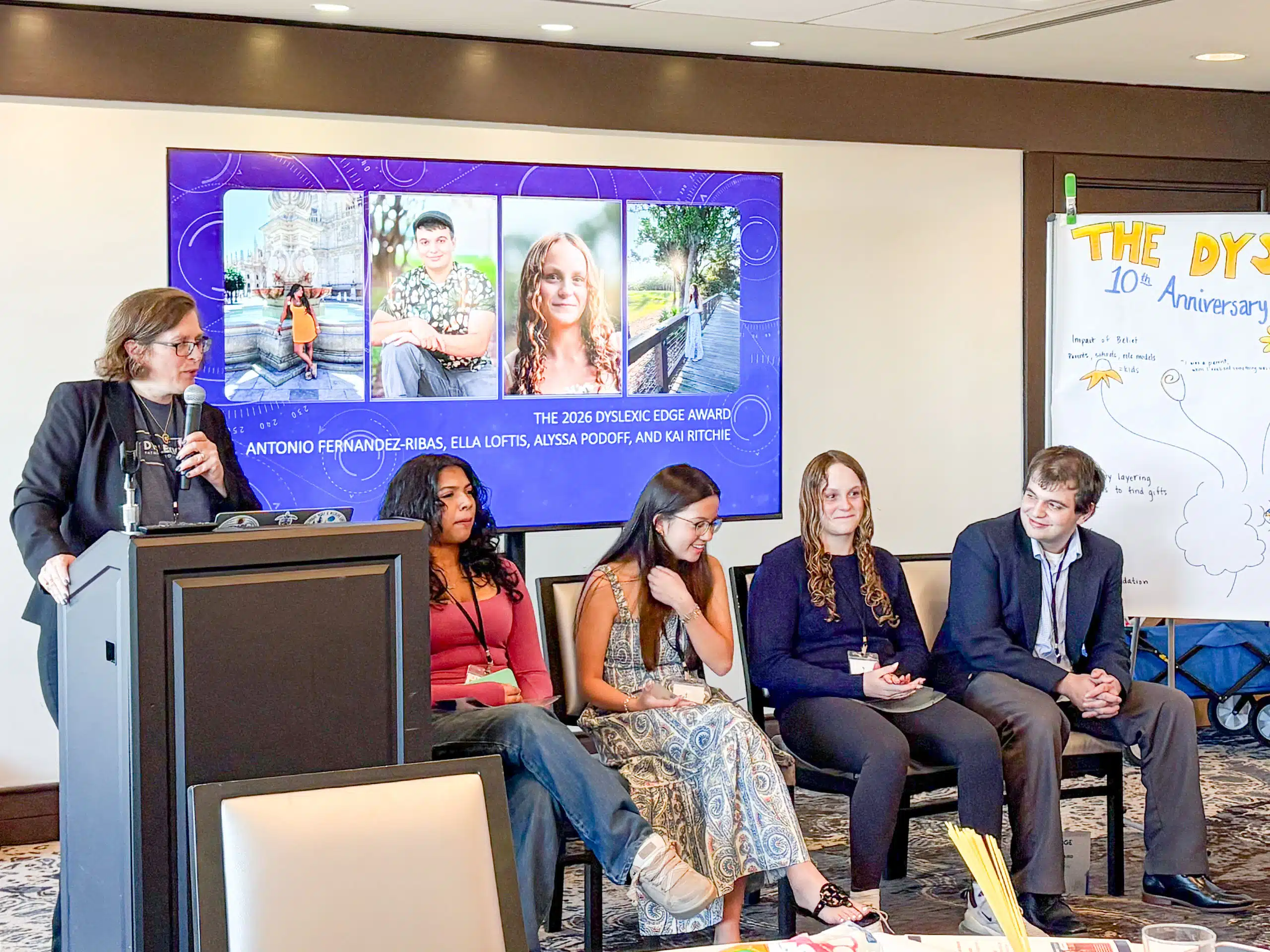
And it motivated her to give back to the dyslexic community, which is why she received the Dyslexic Edge Award at the organization’s annual breakfast May 12, celebrating both its 10th anniversary and its first graduating class.
“What Alyssa did was extraordinary,” Gauthier said. “She started a volunteer club for Ireton students to work in our centers.” Now, upward of 20 Ireton students volunteer.
Dyslexic Edge partners with Affordable Homes and Communities in Arlington, providing their after-school program free of charge at four sites. Using an online scheduling system, Podoff “makes sure that volunteers are at each site. On any given day, there’s probably at least four Ireton kids at one of our sites,” Gauthier said.
Podoff’s achievements haven’t escaped the notice of Kathleen McNutt, Ireton’s head of school.
“We are so proud of Alyssa and her dedication to service above and beyond any school requirement or project. Alyssa’s personal connection to Dyslexic Edge and her desire to help her neighbor have been catalysts for her growth in community leadership,” said McNutt.
“Not only has she led and organized large numbers of volunteers, she does it with humility and grace, and always with a smile,” McNutt added. “Bishop Ireton is blessed to support her on her academic journey, and we look forward to seeing all that she will accomplish in her senior year of high school.”
Dyslexic Edge also offers its services at St. Bernadette School in Springfield.
Podoff’s volunteer work, and her own experience, have inspired her choice of a future college major and profession.
“I really enjoyed volunteering this year and I was thinking I’d want to maybe do something in education,” she said.
Her word of encouragement for others dealing with dyslexia: “In the beginning, it’s always hard because you might be seen as different. But just know that it gets better.”