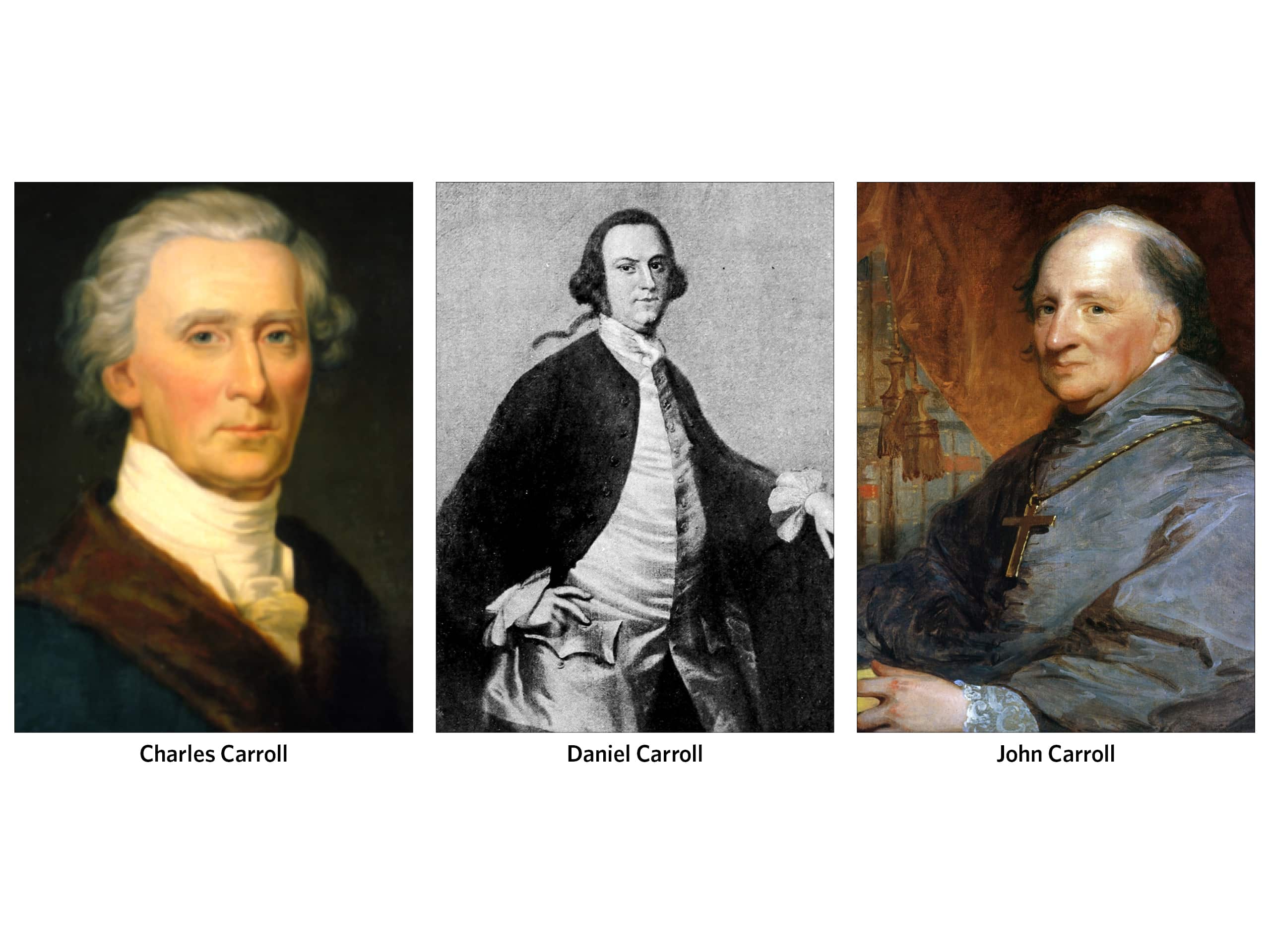
Long before they shaped a new nation, three young Catholic boys from Maryland boarded ships for France. Daniel Carroll, 13, — followed by his brother John and cousin Charles — crossed the Atlantic on a dangerous, two-month journey to a boarding school. As the United States celebrates its semiquincentennial, the legacy of the Carroll family offers a profound window into how an outlawed faith helped forge American independence.
For residents of the Washington metro area, the name Carroll is part of the geography with a county in Maryland and a town and Metro stop — New Carrollton. But as the nation marks the 250th anniversary of the signing of the Declaration of Independence, the depth of this Catholic family’s legacy remains hidden in plain sight. From signing the Constitution and the Declaration to founding Georgetown University, the Carrolls did not just live through the birth of the U.S. — they built its literal and spiritual foundations.
Flash back to 1742, when because of the suppression of Catholic schools in the American colonies and England, Daniel was sent from his home in Upper Marlboro, Md., to the Jesuit boarding school in Saint-Omer. A few years later, his brother John and his cousin Charles made the same journey to join him.
If these names sound familiar, they should. Daniel Carroll of Rock Creek was one of five people who signed both the Articles of Confederation and the U.S. Constitution. John, who became a Jesuit at age 18, was the first Catholic bishop in the U.S. in Baltimore and founded Georgetown University. Charles Carroll of Carrollton was the only Catholic to sign the Declaration of Independence and he was the first U.S. senator from Maryland.
At the College of the English Jesuits, founded in 1593, the young boys received a classical Catholic education. Just two decades later, because of the suppression of the Jesuits, the college was forced to move — first in 1762 to Bruges, Belgium, then to Liège, Belgium, in 1773, and some 20 years later to Lancashire, England, where it was renamed Stonyhurst College. It remains a co-ed Jesuit institution with nearly 500 students.
In October 2017, Baltimore Archbishop William E. Lori and a contingent of dignitaries, media and descendants of the Carrolls made the trip to Saint-Omer to celebrate the camaraderie between the two cities and the collaboration that continues through the Saint-Omer Foundation for Transatlantic Values.
A Friendship Mass was celebrated at Saint-Omer’s Notre Dame Cathedral Oct. 15, 2017. In his homily, Archbishop Lori said, “One cannot study the founding of the United States without acknowledging the critical role played by France. During the American Revolutionary War, in 1778, France recognized and allied itself with the United States and sent its army and navy to fight on the side of this fledgling nation.”
Archbishop Lori pointed out that, “As subjects of the British Empire in the 18th century, they were not free to practice their Catholic faith. Among the laws enacted to suppress the Catholic Church during this period was one that prohibited Catholic schools.
“It’s for this reason that families such as the Carrolls made the sacrifice of sending their children abroad for their education, with the full knowledge that they might never see them again,” he said.
The Carroll family entrusted the Society of Jesus with the education and formation of their sons, Archbishop Lori said. “It was here at Saint-Omer that these young men, who would go on to play such important roles in the early days of my country, received a splendid education, rooted in an authentic Christian humanism, capturing the wisdom of ancient Greece and Rome, while transforming it through reasoned faith of the medieval masters.
“His formation at Saint-Omer helped make (John Carroll) a wise and astute leader and to this day we are building on the foundations he so carefully laid. As a successor to John Carroll, I came here to Saint-Omer to express my deepest thanks,” he said.
The descendants of the Carrolls are numerous and many still call Washington, D.C., their home.
An eighth-generation descendant of Daniel, Charles Carroll Carter Jr., said that for him there are two key phrases in the Declaration of Independence: “life, liberty and the pursuit of happiness” and “our lives, our fortunes and our sacred honor.”
In an interview in his Washington apartment, the parishioner of St. Matthew’s Cathedral said the founders intentionally repeated the triple pattern toward the beginning and the end of the document. “It just is so clear to me that they knew exactly what they were doing. They didn’t know how it was all going to turn out, but they knew what they were doing because they trusted each other, they worked together.”
His father and namesake wrote a book, “Creating Capitol Hill: Place, Proprietors and People,” published by the U.S. Capitol Historical Society. The book details what is considered the “untold story” of the Carrolls of Maryland and their work in building the capitol.
Descendants of Charles include Harper Wright, who recently moved from England to New South Wales, Australia. He was born in Maryland and recalled attending Mass at Doughoregan Manor Chapel in Ellicott City, Md., where Charles is buried. The tract, much smaller than the original, has been owned by the Carrolls since it was acquired in 1717, making it the only ancestral home of a Declaration of Independence signer under continuous family ownership, according to American Aristocracy.
“Everything I’ve read about (Charles) has always been about his piety and his trying to live a good life, for the benefit, not just for himself, but for the benefit of his whole family and the community,” Wright said.
Wright has a number of items in his study connected to “the Signer,” and so he is “regularly reminded of his accomplishments and what he risked 250 years ago.”
However, he noted, it is important to remember the Carrolls’ values and work in the context of their times. “They were ordinary human beings with faults and flaws. Principles such as justice and equality were challenged then and are still challenged today. It can be as difficult today, as it was years ago, to stand up for ‘self-evident’ principles while maintaining a perspective that encompasses the wider community,” he said.
For all the good the Carrolls did, their role as slave owners cannot be overlooked. Some reports indicate that Charles was the largest slave owner in the colonies and that he bequeathed them to his heirs. The fact that Bishop Carroll owned slaves might also figure into why he was never put on the path to sainthood. Daniel also owned slaves, many of whom worked on his tobacco plantations.
“Life, liberty and the pursuit of happiness” are part of the American fabric. The semiquincentennial is an opportunity to reflect on what the founders, settlers and enslaved peoples endured to build this nation.
Contributing to this article was Christopher Gunty, editor and associate publisher of Catholic Review Media in Baltimore.