Janice Ellinwood, chairman of the department of fashion
design and merchandising at Marymount University in Arlington
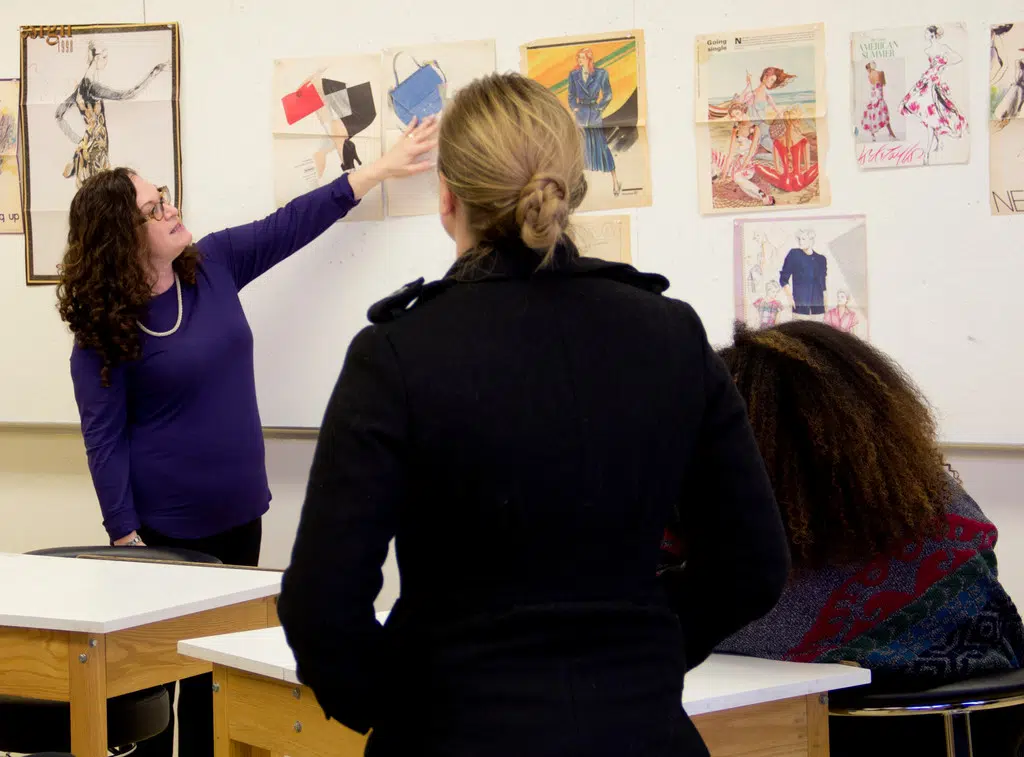
since 1987, started her Friday illustration class by asking
her students to “champion and critique” each other’s spring
collections. The six fashion design majors tacked their
drawings and inspiration boards to the wall and, one by one,
discussed each other’s influences – angler fish, Art Deco,
Scottish heritage dress – and techniques, from drawing styles
to swatch layout. Ellinwood, a professional fashion
illustrator and former Fulbright scholar, complimented bold
choices, careful research and attention to detail, while also
challenging students to explain why their collections might
appeal to consumers.
At Marymount, such discussion-based classes are the norm,
even in fine and applied arts programs. Ellinwood pointed out
that fashion design majors learn more than design, and
fashion merchandising majors learn more than business and
marketing. Forty percent of fashion majors’ classes are in
non-fashion departments, including the six credits in
theology and six credits in philosophy required of all
majors.
The fashion department’s most glamorous event of the year,
Portfolio in Motion, unites the talents of both design and
merchandising majors. A campus tradition since 1989, the
event enables future designers to collaborate with future
buyers and public relations professionals to produce a juried
show from start to finish. Students design outfits, select
models, work out the choreography, decide on set design,
manage ticket sales and more.
But while the work is entirely student-produced, it is
professionally critiqued. Oscar de la Renta, Michael Kors and
Carolina Herrera are on the list of respected industry guests
who have visited campus in the past to provide feedback. Last
year’s Designer of the Year at Marymount was menswear
designer Jhane Barnes.
Outside of Portfolio in Motion, students have other chances
for professional development. As the only university offering
fashion design and merchandising programs in the Washington
area, Marymount students have unique access to local cultural
resources and opportunities. Students regularly visit
Smithsonian museums for inspiration, and alumni who stayed in
the area have designed for the Washington National Opera,
among other performing arts companies. The department also
organizes field trips to New York and Magic, an international
fashion trade show in Las Vegas.
Ellinwood credits the success of the fashion program to
Marymount’s intimate community. Because the
student-to-faculty ratio is low, students have a chance to
build relationships with full-fledged professors rather than
graduate teaching assistants.
“Their study of the liberal arts builds character,” said
Ellinwood. “Here, we have a cross-pollination of the liberal
arts with the arts, which might be minimized at other schools
with fashion programs. At Marymount, we have an obligation to
teaching the humanities and ethics across the curriculum.
When tough things come up, I have to address them.”
In fashion, tough issues may include the industry use of
sweatshops or the environmental impact of sourcing materials.
Whether studying how to rid fashion illustrations of wax
bloom or the media employed in vintage Lord and Taylor
catalogs, Ellinwood said “there are lots of great things that
come out of (the university’s) Catholic association.”
One of them just happens to be couture.
Find out more
To learn more about Marymount University’s fashion program,
visit
marymount.edu/Academics/School-of-Arts-Sciences/Undergraduate-Programs/Fashion-Design-amp;-Merchandising.
Stoddard can be reached at [email protected].