Often there’s an assumption that all or most Catholic
immigrants in the United States hail from Latin America and
speak Spanish. But that does a disservice to other immigrant
groups whose struggle to assimilate and observe their faith
in a new land may be misunderstood or even go unnoticed,
explained William Dinges, a professor of religion and culture
at Catholic University in Washington.
“There is no universal Catholic experience,” said Dinges,
pointing out the variations of Catholic faith expressions
throughout the world.
Dinges said that many Catholic immigrants in the United
States not only face language and cultural barriers; they
face devotional barriers because their liturgical norms may
not perfectly match those observed in the United States.
One such immigrant group is the Cameroonian community, whose
unique Catholic traditions have been influenced by tribal
customs and have evolved over Cameroon’s complex history.
Cameroon is centrally located on the west coast of Africa.
After World War I, the League of Nations divided Cameroon
between France and Britain without regard for the country’s
ethnic and tribal factions. After a long struggle for
independence from both European powers, the Republic of
Cameroon was formed in 1984. French and English remain the
country’s official languages (despite the dozens of tribal
languages spoken nationwide), and the European influence of
Christianity also remains.
Today, the country’s Catholic population is more than four
million people strong. Christianity is the dominant religion,
though Islam and tribal animism, an indigenous belief system
centered on earth spirits, also are widely observed. Cameroon
recently made international headlines because of the ongoing
Christian genocide by Boko Haram, a radical Islamic terrorist
group active in the northern part of the country. Boko
Haram’s violence has forced thousands of Christian refugees
from more turbulent neighboring countries, particularly the
Central African Republic, to flock to Cameroon.
In the United States, Cameroonians enjoy a more peaceful
day-to-day existence. The largest Cameroonian immigrant
population is concentrated in the Greater Washington area,
with other sizeable communities in Houston, Atlanta, Chicago,
Los Angeles, Boston and Minneapolis/St. Paul. Here,
Cameroonian Catholics may worship without fear of Boko
Haram’s persecution.
“Nothing compares to being able to celebrate Mass with your
music and your traditions,” said George Nformi, chairman for
the pastoral council of the Cameroonian Catholic Community of
Virginia.
In the Arlington Diocese, the Cameroonian community observes
Mass once a month at Our Lady of Good Counsel Church in
Vienna. Until last summer, Arlington’s Cameroonian Mass was
celebrated by Father Eugen Nkardzedze, a priest in residence
at St. James Church in Falls Church.
Now, Father Ghenghan Bamenjo Mbinkar, also a priest in
residence at St. James, celebrates Mass for the community. A
native of Jakiri, part of the Diocese of Kumbo, Father
Mbinkar is currently studying canon law at Catholic U.
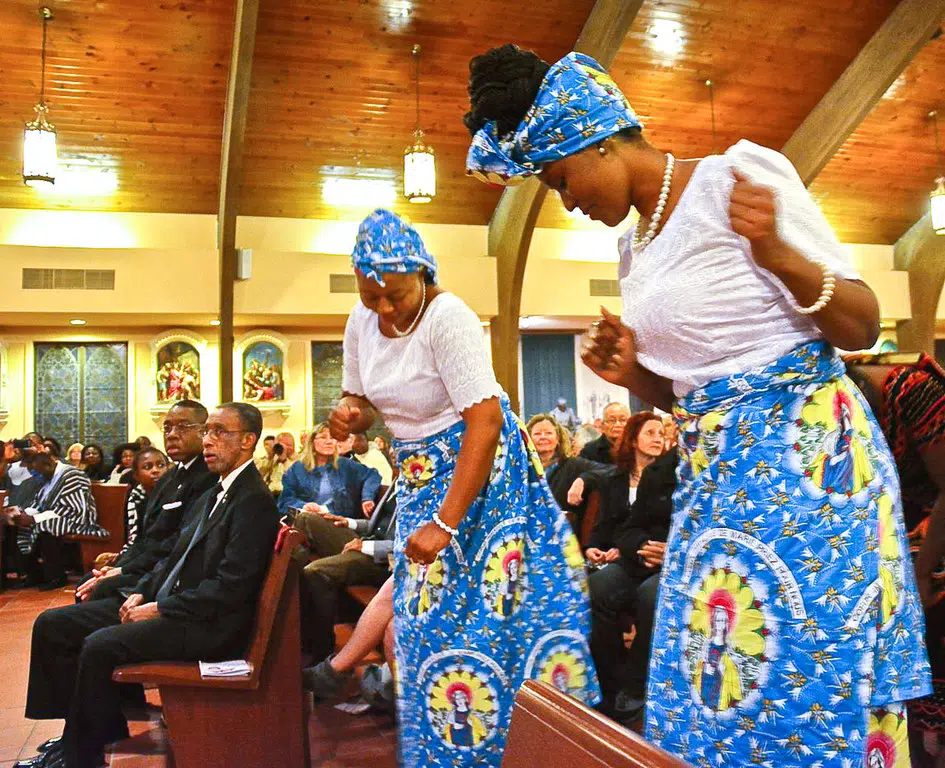
Father Mbinkar said that it is the Cameroonian musical
tradition that distinguishes Cameroonian Mass. Instead of
using the organ or piano, Cameroonian Mass uses the
xylophone, as well as drums, gongs and “other instruments
that are often difficult to get through the airport.”
“Whenever Cameroonians get together, there is always singing
and dancing,” said Father Mbinkar, “even when there is a
tragedy.”
As for Boko Haram, Father Mbinkar said that the terrorist
group’s aim is not only to wipe out Christianity but all
things “related to Western culture.
“Because Boko Haram is not as active in Cameroon as it is in
its neighbors, refugees have fled there. Cameroon has always
been relatively stable (compared to some African countries),”
said Father Mbinkar. “It had no civil war. And the culture is
very welcoming. Even when people have little to give, they
give their guests the best that they have.”
“We are blessed to have Father Mbinkar, and are happy to
continue our relationship with our brothers and sisters from
Africa,” said Father Patrick L. Posey, pastor at St. James
Church.
Cameroonian Mass is made possible due to the support of the
diocesan Office of Multicultural Affairs, headed by Corinne
Monogue. Monogue’s office provides resources for immigrant
communities who wish to celebrate Mass in their native
language and according to their native traditions. Other
African communities that work with the Office of
Multicultural Affairs include Ghana and Sierra Leone. Since
2012, the office has organized an annual Unity Mass to
celebrate Arlington’s black communities, both African and
African-American.
At the second Unity Mass in 2013, Father Nkardzedze quoted
St. John Paul II’s 1986 address to the Aborigines and Torres
Strait Islanders as words of encouragement to Africans and
African-Americans:
“Your culture, which shows the lasting genius and dignity of
your race, must not be allowed to disappear. Do not think
that your gifts are worth so little that you should no longer
bother to maintain them. Share them with each other and teach
them to your children. Your songs, your stories, your
paintings, your dances, your languages must never be lost.”
Monogue upholds the same opinion for cultural preservation,
and welcomes non-Cameroonians to learn more about Cameroonian
traditions.
“If you’ve never been to a Cameroonian Mass, you have to go
because it’s such a beautiful, vibrant experience,” said
Monogue. “It might just give you a new way to explore your
faith and bring you closer to Christ.”
Find out more
To learn more about Arlington’s Cameroonian Mass, go to arlingtondiocese.org/multicultural/mass.aspx.
To learn about Cameroonian immigrant community news, go to leffortcamerounais.com.
Stoddard can be reached at [email protected].