
In its 2000 statement on immigration, “Welcoming the Stranger
Among Us: Unity in Diversity,” the U.S. Conference of
Catholic Bishops wrote, “The church of the 21st century will
be, as it has always been, a church of many cultures,
languages and traditions, yet simultaneously one, as God is
one – Father, Son, and Holy Spirit – unity in diversity.”
The changing face of the church and the role of immigrants in
that change were the topics of discussion at Arlington
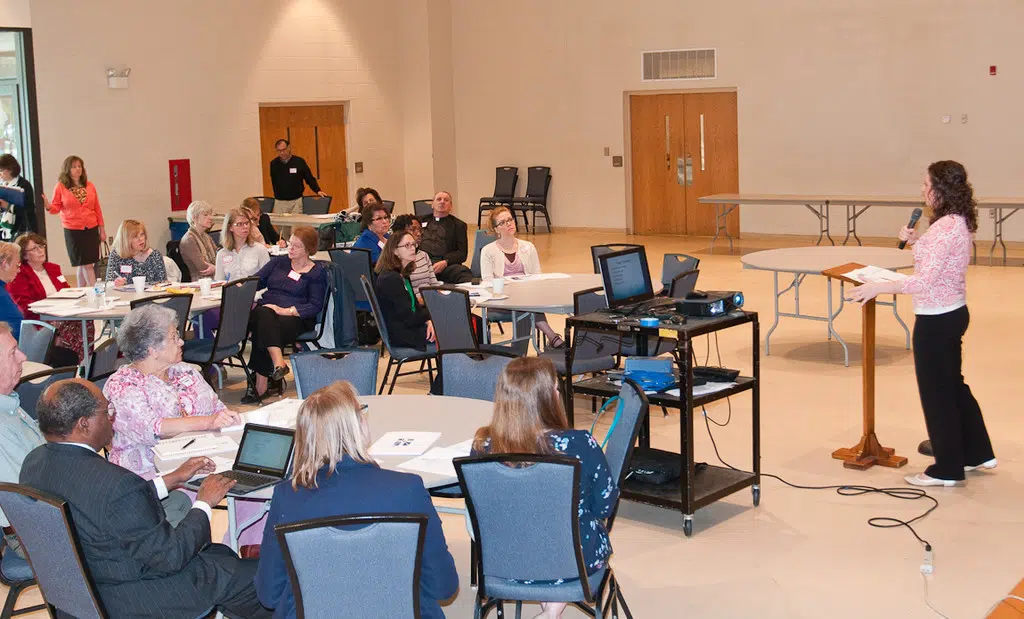
Diocesan Catholic Charities’ quarterly parish liaison meeting
April 22 at Our Lady of Good Counsel Church in Vienna.
In his opening remarks, Art Bennett, CEO and president of
Catholic Charities, said the way to help people on the
fringes of society is through love.
“(Jesus) liked to be with the wounded, the people on the
periphery,” said Bennett.
People are coming to this country because they are running
away from injustice, and they should not be treated like “a
stranger in a strange land,” he said.
Jessica Tappel, bilingual counselor, spoke next on the
challenges faced by immigrants. According to the U.S. Census
Bureau, by 2050, 30 percent of the U.S. population will
identify as Hispanic/Latino. The Latino population is growing
in the region with Hispanics making up 20 percent of the
population of Prince William County and 16 percent in Fairfax
County.
“They won’t be strangers much longer,” she said.
This increase in the immigrant population means demands for
mental health services also will increase. Many of the
emotional stresses come from issues surrounding ethnic
identity, acculturation and discrimination. According to
Tappel, this ethnic and acculturation issue is a result of
trying to reconcile the traditional, patriarchal and
collectivist cultures of Latinos with the egalitarian and
individualist cultures of Europeans and Americans. The
problem is that many Latinos with emotional issues do not
seek help because of the stigma involved; they feel
embarrassment and social discrimination.
Next, Brooke Hammond Pérez, program director for Hogar
Immigrant Services, spoke on their education and legal
services.
Hogar’s English for Speakers of Other Languages program
teaches English to more than 1,700 students annually, said
Perez. More than 800 volunteers teach in the ESOL program. In
addition, Hogar offers legal immigration and naturalization
programs and workshops. Perez said that parishes can help by
providing space for classes, recruit volunteers, provide
donations like laptops and help with outreach to the
community.
Stacy Jones, supervising attorney in Hogar’s Unaccompanied
Children Program, said that unaccompanied children are
fleeing Latin and Central American countries at an increasing
rate.
“Why would they make this dangerous journey?” Jones asked.
She said there’s no simple answer, but it could be a
breakdown in the rule of law in their country.
There were presentations by leaders of three parishes on what
their churches are doing to help immigrants.
Dick Quintana, the liaison from All Saints Church in
Manassas, said that 40 percent of his parish is Latino.
His ministry provides an opportunity for all parishioners,
immigrant and non-immigrant, to participate in the same
parish community. All are invited to parish activities, and
there are bilingual services offered at many events.
Francis is a member of the St. Vincent de Paul Society and
said the group offers legal help and bimonthly transportation
services to the University of Virginia Medical Center in
Charlottsville.
Francis shared his successes with the group. He said you need
to be in solidarity with the USCCB. You need to get to know
and become involved with your parish immigrant community.
Plus, you need to develop plans, get buy-in from the pastor
and seek partnerships in the diocese and community.
Father Gerry Creedon, pastor of Holy Family Church in Dale
City, said that his parish of 4,000 households has about a 50
to 60 percent Latino population. There is also a strong
African and Asian presence.
Father Creedon said that we need to show the immigrant
respect.
“Don’t hassle them,” he said. “(They) need to come out of the
shadows.”
Katie Esser from Good Shepherd Church in Alexandria shared
four things she believes will connect you to the immigrant
community: create trust, celebrate together, build a sense of
community and advocate together.
As participants left for the day, they shared their thoughts.
Christine Purtell from St. Matthew Church in Spotsylvania
said her parish does not have a large immigrant population,
but she found the workshop to be helpful, but intense.
Laura Paul, a parishioner from Blessed Sacrament Church in
Alexandria, was one of three representatives from her parish.
“The legal services portion was very interesting,” she said.
“We have a very active Hispanic community.”
All of the liaisons realized the impact of immigration on the
church.
Father Creedon said that some people balk at the change in
parish identity. One older man came to him and said, “I can’t
deal with all this transition. It’s making me sick.”
He told the man that change is coming.
“Our generation goes to funerals. Theirs go to weddings,”
said Father Creedon. “They’re renewing the church.”