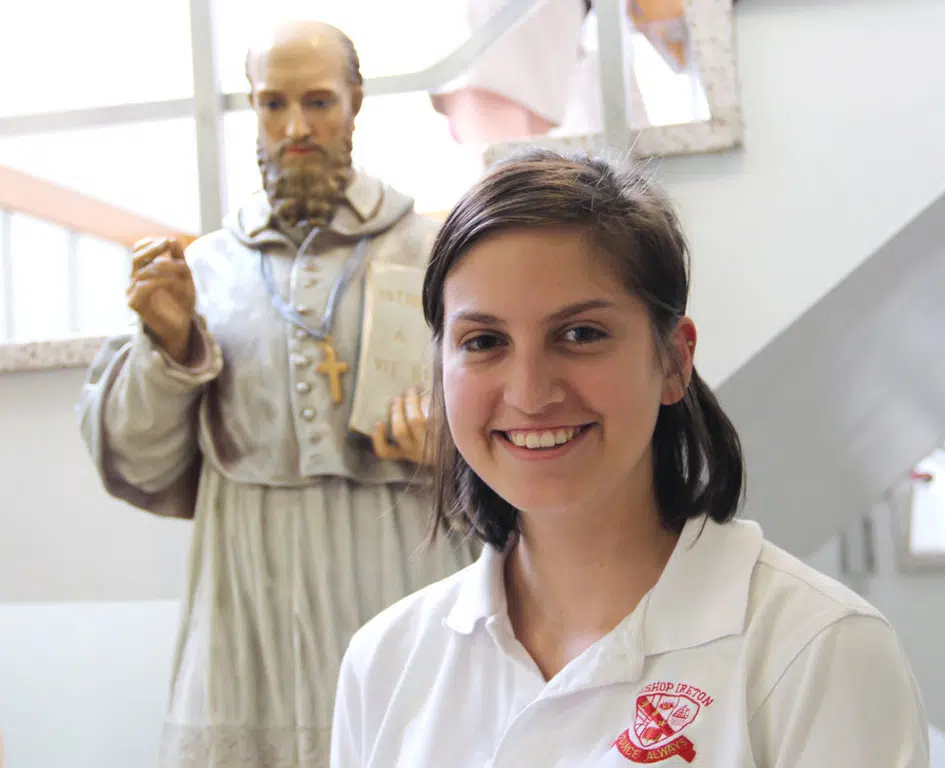
The fall of her sophomore year at Bishop Ireton High School
in Alexandria, Jessica Soto knew something was wrong. The
first sign greeted her from the bottom of the tub. Clumps of
hair – her hair – became a regular appearance, bigger and
thicker than she had ever seen. Afraid she had cancer, she
rushed to WebMD, the health news and information website, for
an explanation.
Doctor after doctor and pill after pill, Soto and her parents
still had no answer. It wasn’t until her father took her to a
hair specialist at Walter Reed National Military Medical
Center in Bethesda, Md., that the mystery was solved.
The specialist diagnosed Soto with the autoimmune disease
Alopecia areata, sometimes referred to as spot baldness.
Alopecia areata causes the hair to fall out in round patches
and affects about one percent of the population.
By the following summer, Soto had lost 70 percent of her
hair. She debated wearing a wig or hat but she said that
neither felt right. Instead, she shaved her head.
“When I came back to school in the fall, someone told me that
I was inspirational,” said Soto. “I hadn’t thought of it that
way, but I started to embrace (my shaven head.) My feeling
comfortable helped others.”
And her school volleyball team helped her, giving her “extra
strength” and “courage” when she felt physically and
emotionally weak. When students at other high schools teased
her at away games, Soto’s teammates stood up for her.
But bullying was not the worst she had to endure. The journey
had just begun.
Not long after Soto was diagnosed, her mother was found to
have Stage IV colon cancer.
“I divided my time between school, my doctor’s visits and my
mom’s doctor visits,” said Soto. “I tried to do work in
advance instead of getting behind. With Stage IV cancer, I
knew the doctors could prolong my mom’s life but they
couldn’t cure her, so I took care of her.”
Last April, during her junior year, Soto lost her mother. At
the time, she was taking two Advanced Placement and two
Honors classes, in addition to grade-level coursework,
preparing for final exams and undergoing experimental
treatment to restore her hair. Today, Soto is a graduating
senior set to study at West Virginia University in Morgantown
this fall.
“A lot of people were there for me, but I still felt alone,”
she said.
Soto lived with her grandmother, who emigrated from Paraguay
when Soto was little, and her father, who continued working a
demanding job during his wife’s illness.
After Soto’s mother was placed in hospice care, “It got to
the point where my mom didn’t recognize me anymore,” she
said.
“It happened so fast that I didn’t notice that she was
getting worse every day,” she said. “(Her suffering) makes me
want to help people. Not a lot of people my age have to go
through (such loss).”
After her mother’s death, Soto, a fluent Spanish-speaker,
went on a weeklong mission trip to Panama City, where she
witnessed extreme poverty and cyclical child abuse for the
first time. She said that seeing small boys and girls suffer
every day put her own suffering in perspective.
“(The experience) reminded me that God only gives the hardest
battles to His strongest soldiers,” Soto said.
After the mission trip, Soto returned to school ready to
confront a rigorous course load, her motivation being that
her mother wouldn’t want “my grieving to reflect badly on my
grades.”
“It’s hard graduating without Mom,” but she said that she
knows her mother would be proud of her.
Soto hopes to study biochemistry and spend her free time
enjoying West Virginia’s natural beauty.
“And sometimes I might just relax and watch Netflix,” she
said.
Stoddard can be reached at [email protected].