WASHINGTON – This fall the U.S. Archdiocese for the Military
Services plans to hold its first discernment gathering for
Catholic priests to encourage them to consider becoming
military chaplains.
The archdiocese regularly holds several retreats a year for
young men who are thinking about the priesthood and the
chaplaincy, but this will be the first event of its kind for
ordained priests, because there is a critical shortage of
military chaplains.
“The need for Catholic chaplains is enormous. We have
one-fourth of the military population and we only have 8
percent of the chaplain corps,” said Archbishop Timothy P.
Broglio, who heads the military archdiocese. “So there is a
tremendous scarcity of priests. This does not apply to all
religious groups, however. It really only applies to Catholic
priests and perhaps to a lesser extent to rabbis, but
otherwise most of the Protestant groups are covered.”
“For God and Country: A Call to Serve Those Who Serve” will
be held Oct. 5-9 in Washington. Interested priests can apply
for the all-expenses-paid gathering via the archdiocese’s
website, www.milarch.org. It is open to priests already
incardinated in a U.S. diocese or in a religious order and
currently engaged in pastoral service.
Attendees will stay in a Washington retreat house and the
agenda will include visits to Joint Base Andrews, which is
just outside of Washington; the U.S. Naval Academy in
Annapolis, Md.; and Fort Belvoir and the Pentagon, which are
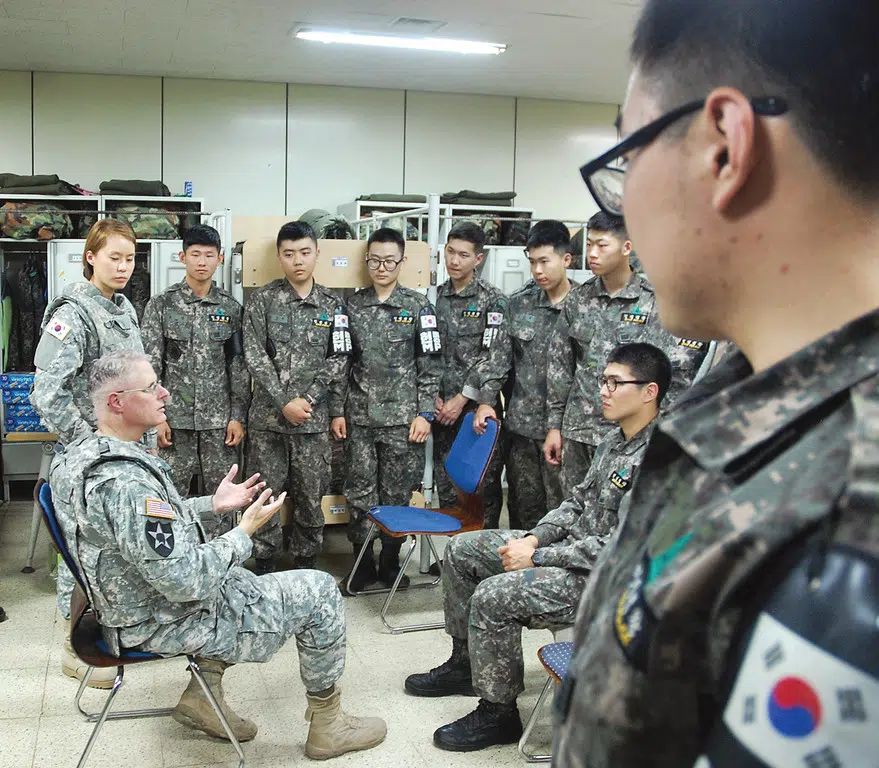
located in the Arlington Diocese. They will meet with
military officers, enlisted personnel and other chaplains and
have a chance to talk with them.
The priests also will concelebrate Mass in the Pentagon
Memorial Chapel at the 9/11 crash site.
A priest must get the permission of his bishop to serve in
the military. As chaplains in the armed forces, priests are
under the jurisdiction of the U.S. Archdiocese for the
Military Services, based in Washington.
The Arlington Diocese currently has three priests serving as
chaplains: Fathers Eric Albertson, Luke Dundon and Daniel
Mode. Two diocesan seminarians also are in a program that
will allow them to be released from diocesan ministry to
serve in the military four years after they are ordained.
“This upcoming discernment, it’s a moment of prayer, as
obviously any discernment has to be,” Archbishop Broglio said
in an interview with Catholic News Service. “And it’s also a
moment of information, where we’ll try to help them
understand what a chaplain does.”
“It’s the first time, really, the archdiocese is engaging in
this kind of an activity as an attempt to broaden our reach
and our contact with priests throughout the United States and
perhaps giving them an opportunity to explore this vocation
within a vocation,” he added.
In recent years, there has been a substantial decline in the
number of Catholic military chaplains.
A big part of it has to do with the military’s mandatory
retirement age of 62, which leads to many having to step down
from the role, even though there is often no one new to fill
it. Since the terrorist attacks of 9/11, the number of
active-duty chaplains has fallen from more than 400 priests
to 228. So now there is only one priest for every 1,300
Catholics in the U.S. military.
One way the archdiocese compensates for a shortage of
Catholic chaplains stateside, at least, is by using “contract
priests” as well as inviting personnel to go off base, if
they can, to a local parish,” if there is one close enough.
“Contract priests” are civilians who minister to Catholics on
military bases for a defined amount of time or on a need
basis.
“It’s a priority to get more priests to serve as chaplains
because we can still double the amount of priests in the
military chaplaincy” and still have a need, according to
Deacon Michael Yakir, archdiocesan chancellor.
Priests who seek to become a chaplain must meet certain
qualifications, such as being physically fit and able to pass
a medical exam, so as to be able to deploy with the troops if
need be. And according to military rules, they must be “under
a certain age,” which varies depending on the branch.
Both Archbishop Broglio and Deacon Yakir referred to the
military chaplaincy as “a call within a call” – answering the
call to serve God and the call to serve the troops.
Deacon Yakir told CNS he is always on the lookout for new
chaplains wherever he may be.
“If I’m on vacation and I’m at a Sunday Mass somewhere and
there’s a priest that I thought, ‘Wow, this guy’s really good
and I need to go talk with (him),’ I’ll stand on line for a
half hour and wait until I get to see him an then I’ll
introduce myself,” he said.
“For me it’s kind of real” because “my son is in the Army and
I’m a Vietnam vet from the Air Force,” Deacon Yakir
continued. “My son was deployed twice (and on) one of his
deployments he was on top of a mountain just a mile off the
Pakistan border and he got to see a priest no more than once
every six weeks.
“So he missed out on the Eucharist, he missed out on Mass, he
missed out on confession, he missed out on any kind of
counseling. And so he’s just one of those many, many of
thousands of those military people who are Catholics who are
not getting a priest.”
It’s not just the personal connection that’s an issue for
Deacon Yakir, but also about the good work they do.
“These priests really … connect with the people and they
really suffer with their people. I mean, I know one time a
priest had a Mass and confessions and then the next day one
of the people who was at that Mass was killed in action,” he
said.
“I know of another priest where somebody was injured,
severely injured, and he came in to do last rites on the
operating table in the war zone,” he said. “And just after he
(the soldier) died on the table, the nurse had taken the
rosary that was in his clothes and given it to the priest and
of course this was another man that he knew. And he actually
went outside in his Humvee and cried.
“I’m working with the best people in the world. … It’s an
honor to help them do their work,” added Deacon Yakir.
Archbishop Broglio said the military conflicts of recent
years may have dissuaded some priests from considering being
in the military as a chaplain. The archdiocese has no
shortage of priests in ministry at Veterans Affairs
hospitals. “They don’t shoot at priests who work in the VA,
as a general rule,” Archbishop Broglio said jokingly.
Besides providing spiritual, pastoral and sacramental care of
Catholic military personnel on active duty and their
families, the archdiocese cares for Catholic patients in
about 170 Veterans Affairs hospitals, Catholics in the
reserves and National Guard, and Catholics in government
service overseas in 134 countries.
The ongoing threat of the Islamic State and the possibility
the United States could eventually have troops on the ground
to help countries fight the militants is “really a reason to
respond more abundantly with Catholic priests … so that the
spiritual needs of the men and woman” who may fight this war
“will be met.”