Ed Myers, a Sterling resident and a parishioner of Christ the
Redeemer Church, has a new, environmentally friendly vehicle
he uses to get to work.
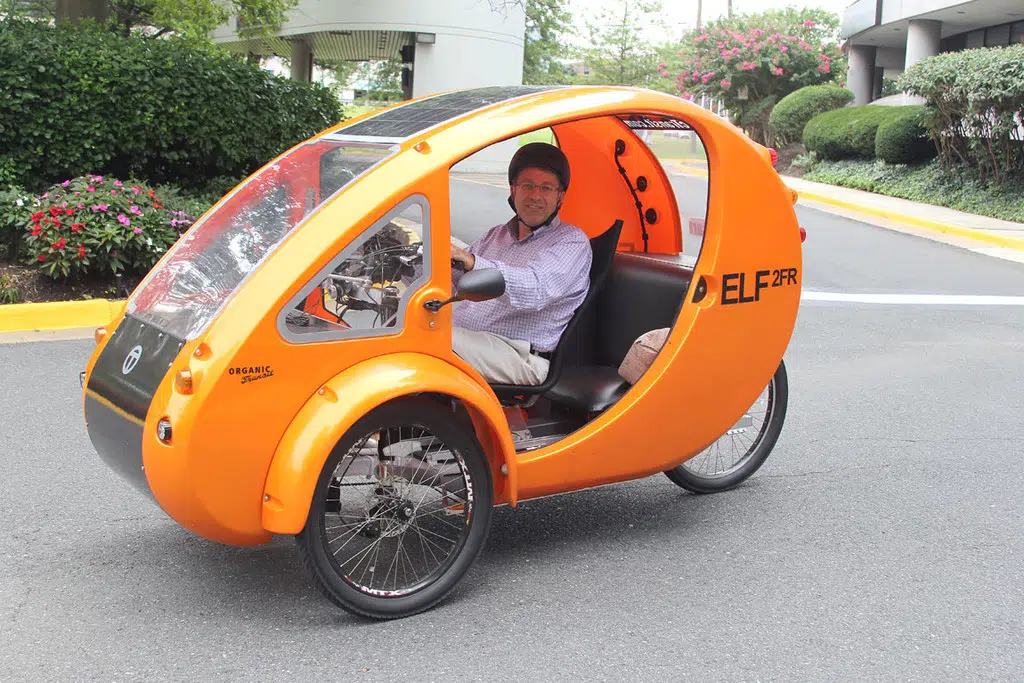
In May, Myers purchased an ELF FR, a low-speed electric
bicycle that seats two people and has a battery-powered
motor, which can be charged by a solar panel or an electrical
outlet.
The ELF is an American-made combination between a bike and a
car. Manufactured by Organic Transit, a Durham, N.C.-based
company, the ELF comes in three different models and all
include: an enclosed cab, three wheels, pedals, headlights,
brake lights, a 100-watt solar panel and a rechargeable
battery.
While made for short-distance commuting, Myers took a chance
on this little bug-like vehicle. After making some
modifications, Myers now commutes 17 miles from Sterling to
Tysons Corner, twice a day, three times each week.
“I (was) spending 35 minutes exercising on the treadmill and
then spending 40 minutes in the car to get to work, and if I
could somehow combine these two activities, I thought, hey
that’d be pretty cool,” Myers said.
Though Myers says he’s not a tree-hugger, he does realize the
good in driving his ELF to and from work. By combining his
weekly exercise with his transportation, purchasing the ELF
seemed like a good investment, and Myers has biked 900 miles
since.
Exercise and transportation were not the only two objectives
in Myers’ decision to test out this new vehicle. God played a
role too.
“We love and worship God by respecting His creation. We can’t
honor God while polluting this beautiful world and leaving
the consequences for the next generation, especially since
the harm falls mainly on the poor and vulnerable,” he said.
The ELF was not just a new toy for Myers, an engineer, to
play with, but also a creative solution and a way to channel
his faith.
“God is creative and through His Spirit helps us creatively
solve problems within our society,” Myers said.
Channeling his engineering side, Myers made modifications to
the vehicle to better suit his needs. There is a federal 20
mph speed limit restriction on electric-assisted vehicles,
but in Virginia it’s 25 mph, so Myers replaced the ELF’s
crank with a two-speed crank to get a better range of speed.
Myers also communicates with the manufacturer about problems
with the vehicle and works to find solutions. He said he’s
happy to help debug the vehicle and get it ready for larger
markets outside the United States.
Mechanical problems are not the only issues that Myers has
faced since buying the ELF. He had to map out a backroads
route to work. His research led him to the Washington and Old
Dominion Railroad Regional Park’s (W&OD) bike path. But
recently, the W&OD told Myers he is no longer allowed on
the bike path because his vehicle is not a bicycle, though
under federal law it is classified as a bike.
Since electric-assisted bicycles are fairly new to the
market, the laws are constantly changing. The decision is
pending, Myers said, after sending the W&OD his personal
analysis of the positive aspects of using an
electric-assisted vehicle on a bike path. He has yet to
receive a response if he will be allowed back on the bike
paths.
“I get a lot of thumbs-up from people while driving down the
bike path and a lot of people get excited – they go ‘hey
that’s a great idea,’ but there are a few people who say
‘wait, the bike path is ours and we don’t want to share it
with vehicles like that,'” Myers said. “Imagine if our top
transportation issue was too many bicyclists.”
Although the ELF is expensive, costing about $6,000 to
$8,000, it provides another alternative for people who don’t
have a car or a license.
A quiet man, Myers does not use his ELF for attention and
head-turning. For him it’s about serving God and protecting
His creation.
Raynor can be reached at [email protected]
Find out more
To learn more about Myers’ solar bike car visit solarbikecar.com.
To learn more about Organic Transit and the ELF vehicles
visit organictransit.com.