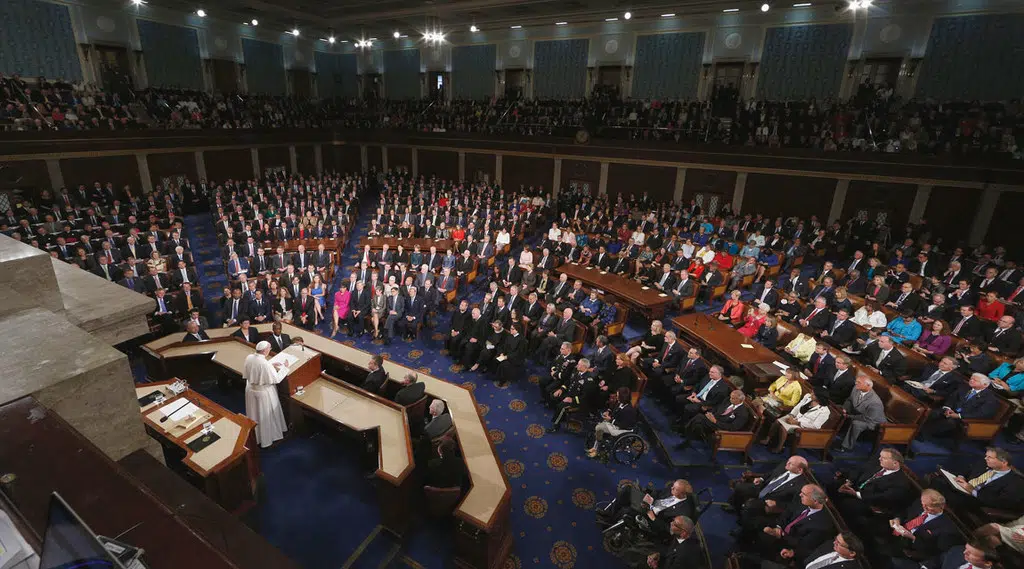
Pope Francis, in his historic address to Congress Sept. 24,
encouraged and prodded the most powerful nation in the world
to dig deep into its soul and act according to its greatest –
if not ever-present – convictions.
Using four figures from U.S. history, two of them
lesser-known Catholics, the pope covered a range of
politically charged topics, including immigration, climate
change, religious freedom, abortion and the death penalty.
Both Republicans and Democrats found things to feel
uncomfortable about and to cheer for.
Yet Pope Francis, the first pontiff from the Americas and the
first to address Congress, spoke through the lens of faith,
not politics, and to values that “endure forever in the
spirit of the American people.”
In accented but steady English, the pope said his talk was
directed at members of Congress, whom he called “the face of
(the country’s) people,” as well as the entire United States.
“I would like to take this opportunity to dialogue with the
many thousands of men and women who strive each day to do an
honest day’s work, to bring home their daily bread, to save
money and – one step at a time – to build a better life for
their families,” he said.
Last March, Rep. John Boehner (R-Ohio), speaker of the House,
invited the pope to address Congress. An emotional Boehner
and Vice President Joe Biden, both Catholics, sat behind the
pope during his speech.
According to the Pew Research Center, roughly one-third of
the members of Congress are Catholic.
Along with representatives and senators and their guests,
attendees included members of President Barack Obama’s
Cabinet and members of the U.S. Supreme Court. A number of
Roman collars and habits dotted the guest area of the
gallery, and outside the Capitol, tens of thousands of people
watched the speech on a giant screen.
Before drawing upon “the historical memory” of Americans, the
pope turned to the Bible. The life of Moses, he said,
provides lawmakers with a good synthesis for their work: “You
are asked to protect, by means of the law, the image and
likeness fashioned by God on every human life.”
Pope Francis repeated the term “dialogue” throughout his
lengthy speech, and nearly every call to action was focused
on protecting the most vulnerable, especially the young.
He offered Abraham Lincoln, Rev. Martin Luther King Jr.,
Dorothy Day – whom the church has named a “servant of God” –
and Thomas Merton as images not of perfection but of
America’s potential.
Lincoln illuminated themes of liberty, and King was used to
underscore the importance of “liberty in plurality and
non-exclusion” and those dreams “which awaken what is deepest
and truest in the life of a people.”
In his selection of Day, a social activist, journalist and
atheist-turned-Catholic, and Merton, a contemplative Trappist
monk and mystic, the pope introduced complex individuals who
underwent profound spiritual transformations.
Evoking Day’s work with the poor, he encouraged Americans “to
keep in mind all those people around us who are trapped in a
cycle of poverty; they, too, need to be given hope.”
In his high-profile remarks, the pope indirectly celebrated
the normalized relations with Cuba, in which he played a
critical role, and said it is his duty to “build bridges and
to help all men and women … do the same.”
Addressing religious freedom, the pope said we must strike a
“delicate balance” to combat violence perpetrated in the name
of a religion or an ideology while also safeguarding
religious, intellectual and individual freedoms.
“No religion is immune from forms of individual delusion or
ideological extremism,” he added.
In a direct but pastoral tone, the pope called on lawmakers
to embrace a spirit of cooperation in all their efforts, to
“move forward together, as one, in a renewed sprit of
fraternity and solidarity.”
Although he did not specifically refer to abortion, the pope
insisted that it is “our responsibility to protect and defend
human life at every stage of its development.”
Echoing his ongoing criticism of “a throwaway culture,” the
pope said we must “avoid the common temptation nowadays to
discard whatever proves troublesome.”
It is this respect for all human life that informs his
abhorrence of the death penalty.
“Every life is sacred,” he said.
Pope Francis called on America to remember the simple, albeit
difficult, “Golden Rule.” As the House erupted in applause,
the pope said: “Do unto others as you would have them do unto
you.”
“The yardstick we use for others will be the yardstick which
time will use for us,” he added.
With the family as the recurring theme of his visit, Pope
Francis said the family is “threatened, perhaps as never
before, from within and without.”
“Fundamental relationships are being called into question, as
is the very basis of marriage and the family.”
On immigration, a hot-button issue amid election year
punditry, the Argentine of Italian decent said that for
centuries “millions of people came to this land to pursue
their dream of building a future in freedom. We, the people
of this continent, are not fearful of foreigners, because
most of us were once foreigners.”
The pope drew liberally from his recent encyclical, “Laudato
Si'” (“Praise Be to You”), and called for “a courageous and
responsible effort to ‘redirect our steps’ and to avert the
most serious effects on the environmental deterioration
caused by human activity.”
In one of his most direct words to the lawmakers, he said
that “this Congress” has an “important role to play” in these
efforts.
Within his encyclical, subtitled “On Care for Our Common
Home,” Pope Francis is critical of unrestrained business
interests driven by greed. However, in quoting the same
document, the pope called business “a noble vocation,” and
said it “can be a fruitful source of prosperity …
especially if it sees the creation of jobs.”
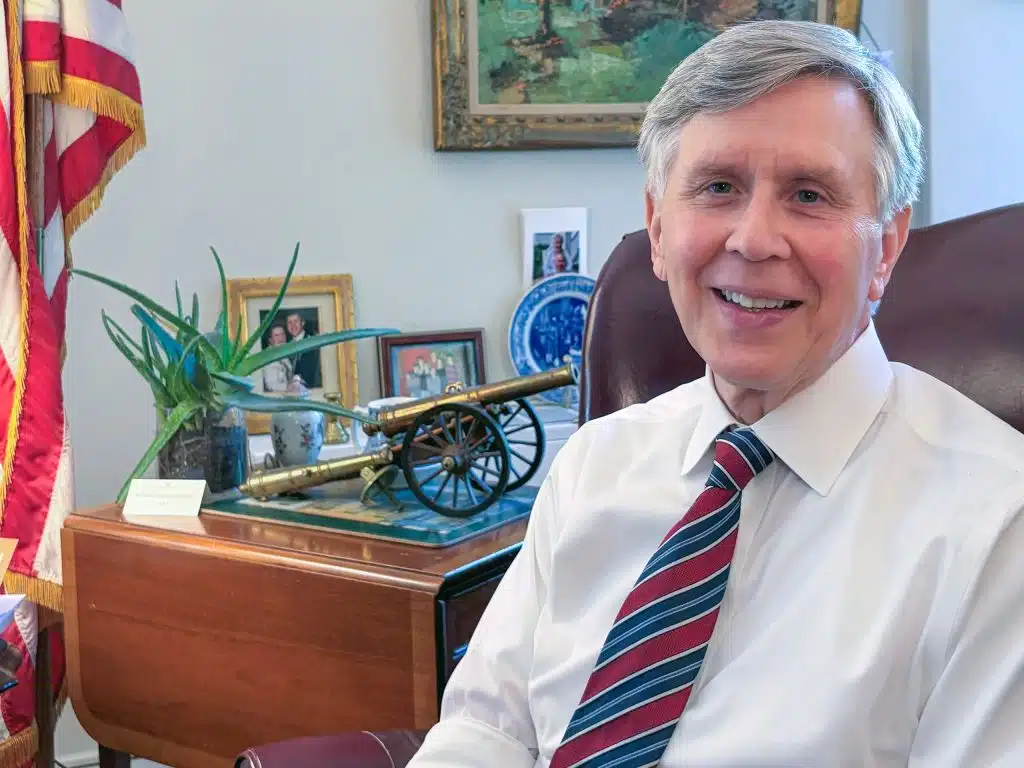
“It was a powerful address,” said U.S. Rep. Chris Smith
(R-N.J.), a Catholic, in an interview after the speech. Smith
is co-chairman of the Bipartisan Congressional Pro-Life
Caucus and has authored anti-human trafficking legislation
since the 1990s.
He said the talk built on past popes’ support for the
defenseless and unborn. “He calls us to protect all life –
the unborn, refugees, those with disabilities.
“Especially with regard to the unborn, he says it’s wrong to
remain silent; we cannot look the other way,” he said.
Catholic Senator Tim Kaine (D-Va.), who wiped away tears
during the talk, said it was “a very emotional experience”
listening to the address. Kaine worked with Latin American
Jesuits in the early 1980s and has been impressed with the
first Jesuit pope since his early papacy.
He liked that the pope anchored the speech in four Americans,
especially Day and Merton, whom he sees as rich sources of
spiritual wisdom. “He used all of them to help remind us of
our best selves,” said Kaine, sitting in his Senate office
moments after the pope left the Capitol to meet with
Washington homeless.
Kaine said the speech also set high expectations for
lawmakers, when, “frankly, we’re in a line of work where
people have low expectations of us.”
“We even have low expectations for each other,” he said. “The
pope was here to say … the world needs you to be great
leaders.”
“Foremost it was a pastoral speech,” said Father Edward J.
Bresnahan, chaplain of Bishop Ireton High School in
Alexandria, who heard the talk outside the Capitol with a
handful of Ireton students. He said he believes the pope’s
frequent use of the word “dialogue” is a summons to respond
to his challenging words.
It is now our job, said Father Bresnahan, “to find out how we
can answer this beautiful message of transformation.”
Scott can be reached at [email protected] or on
Twitter @KScottACH.