To meet the many challenges it faces worldwide, Catholic
education must imbue the spirit of the faith into all aspects
of academic life and form educators who know and share the
love of Jesus.
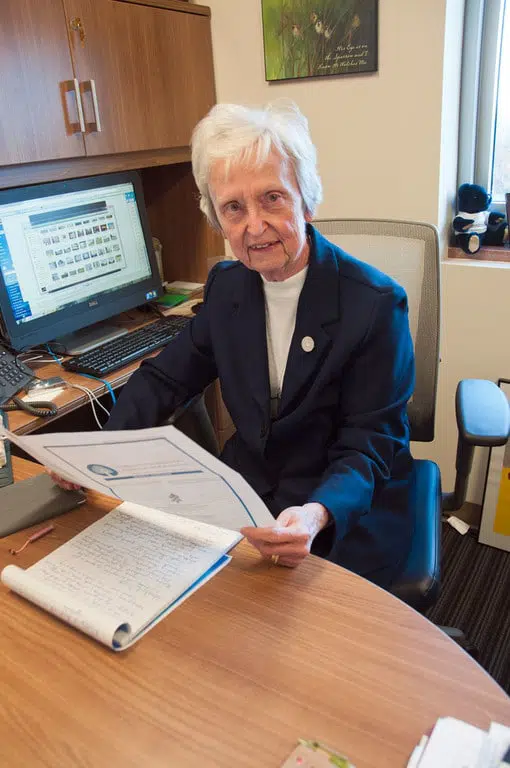
These were the themes that stood out to Sister Patricia
Helene Earl, a Sister, Servant of the Immaculate Heart of
Mary, who attended the first world congress on Catholic
education Nov. 18-21 in Rome.
“Being a Catholic institution can’t just be this nice phrase
we all say; we’ve got to break open for everyone what that
means,” said Sister Patricia, director of Marymount’s
Catholic School Leadership Program in Arlington and former
diocesan assistant superintendent for instruction and
personnel. “It means we are welcoming, while at the same time
we hold on to our roots.”
Sister Patricia was one of 1,500 people from around the globe
– 75 from the United States – invited to attend the congress,
entitled “Educating Today and Tomorrow: A Renewing a Passion”
and sponsored by the Vatican’s Congregation for Catholic
Education.
The event marked the 50th anniversary of the Second Vatican
Council’s Declaration on Christian Education (“Gravissimum
Educationis”) and the 25th anniversary of “From the Heart
of the Church” (“Ex Corde Ecclesiae”), St. John Paull
II’s apostolic constitution on Catholic universities.
A handful of delegates from the region also attended the
congress, including two from Catholic University in
Washington and Brother Robert Bimonte, president and CEO of
the National Catholic Educational Association. The opening
and closing programs were held at Paul VI hall in Rome, and
meetings took place at Castel Gandolfo, a town 15 miles
southeast of the Italian capital. The congress concluded with
an address by Pope Francis.
Divided into sessions for Catholic school leaders at
universities and elementary schools, respectively, topics
ranged from Catholic education in different social and
cultural contexts to how Catholic schools and universities
dialogue with other formation institutions. With delegates
hailing from India, China, South America and Europe, the
congress was a “beautiful blend” of different languages and
cultures, said Sister Patricia.
As the head of a program that shapes Catholic school leaders
and as chairwoman of Marymount’s Catholic identity committee,
two sessions were especially compelling for her – “The
Formation of Formators” and “Identity and Mission of Catholic
Education.”
A flourishing Catholic identity is one of the “major
challenges” for Catholic institutions, said Sister Patricia.
Marymount is diverse, with students coming from nearly 70
countries and a variety of religions. “We want to be
welcoming,” and interfaith events are important, she said.
Marymount offers ways for students to deepen their faith,
including a meditation room for Muslim students and
opportunities to attend Christian services at area churches.
“We want to be sensitive to their needs, but at the same time
being very certain we are authentic in promoting Catholic
identity,” she said. Identity is not just externals – a
crucifix in every classroom, a beautiful chapel. Those are
important, said Sister Patricia, “but it’s also helping
people understand the spirit of Catholicism in all we do. It
means not just teaching Catholic theology, but integrating
our faith in all disciplines, in service projects, through
Catholic ministry. Catholic identity is not a permanent thing
but an ongoing task.”
“Our Catholic identity doesn’t mean proselytizing,” added
Sister Patricia, “but imbuing our faith in everything.”
Congress attendees were encouraged to share the unique
charism of their institutions. “A Jesuit school is different
from that founded by the Religious of the Sacred Heart of
Mary (like Marymount),” she said, and a university’s unique
academic culture also shapes how it expresses the faith.
“There’s no one size fits all, yet the themes are the same,”
said Sister Patricia.
In “The Formation of Formators,” speakers discussed how to
help form educators. While in the 1950s and 1960s the
majority of U.S. Catholic school teachers and administrators
were priests and religious brothers and sisters, they now
make up just 2.8 percent of elementary and secondary Catholic
school staff, according to 2015 NCEA data.
“It is essential to help form lay people in knowing the faith
but also in how to impart it to our youth,” said Sister
Patricia. Part of this effort requires supporting educators’
relationship with Jesus and seeing Him “as a friend and guide
for their lives,” she said. “It is a continuous cycle of
sorts. As adults we need to grow in our spirituality, our
faith, our relationship with Christ. This in turn nourishes
us to be more passionate about nurturing and forming our
students, and as we help them, then again we are nurtured.”
Receiving an invitation to the congress was “humbling and
awesome,” said Sister Patricia. The highlight for her was
being in the presence of Pope Francis and hearing his classic
from-the-heart and off-the-cuff remarks. “He talks about the
Gospel of joy, and he radiates that joy,” she said.
During the closing address, the pontiff “spoke about how
education must pass through three languages – the language of
the head, heart and hands,” said Sister Patricia. “Think with
the head, feel in the heart and help others in service. All
three together must be in harmony.”
She said the world congress and the pope’s clear commitment
to education affirmed the importance of and raised awareness
about Catholic education. “We heard the challenges of today,”
said Sister Patricia, “and from those issues we need to look
at how we can be the educators of tomorrow.”