Over the course of the 2016 session, the Virginia General
Assembly considered more than 2,100 bills and passed a $105
billion budget in 59 days.
Throughout the session, the Virginia Catholic Conference met
with legislators, testified at countless hearings and spread
updates and alerts on social media.
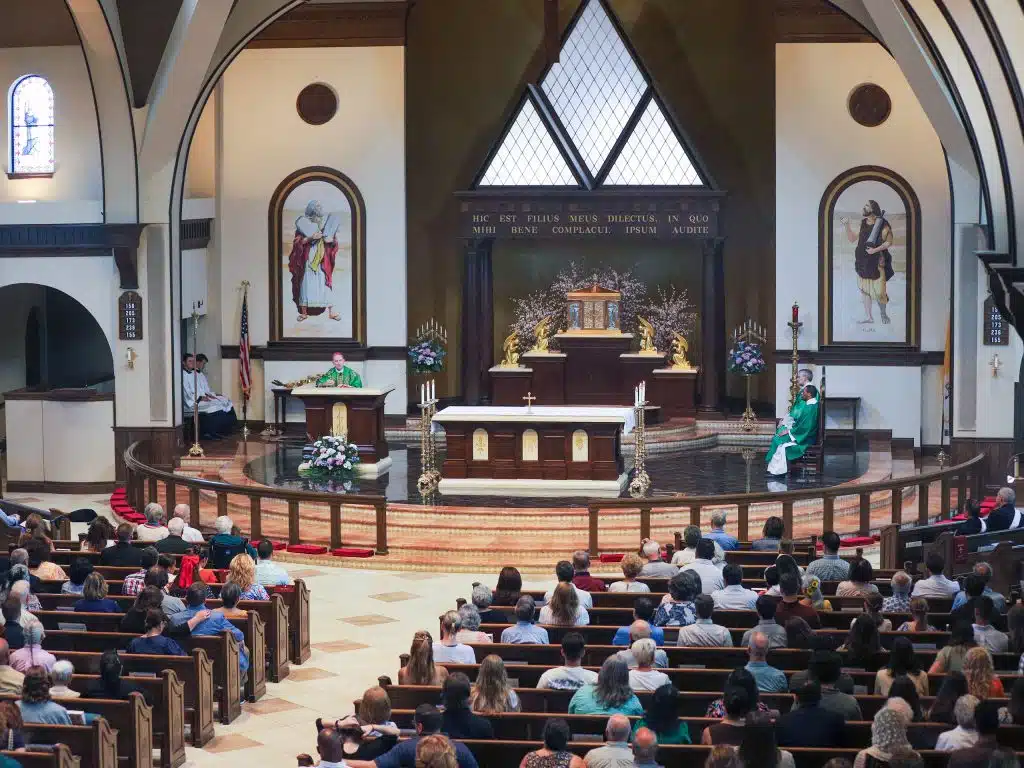
The VCC joined Arlington Bishop Paul S. Loverde and Richmond
Bishop Francis X. DiLorenzo midway through the session to
host the first-ever “Virginia Vespers: Evening Prayer for the
Commonwealth,” a liturgy to pray for the needs of the
commonwealth that included Governor Terry McAuliffe and the
first lady, as well as other state officials, legislators and
Catholics from throughout Virginia.
At session’s end, the VCC was instrumental in passing a
measure to deny funding to Planned Parenthood and the
abortion industry, blocking efforts to restrict refugee
resettlement and expanding conscience protections for
religious organizations that believe marriage should be
between one man and one woman.
The VCC also successfully advocated for budget amendments to
help unclog a waiting list for essential services for people
with intellectual and developmental disabilities; assist
youth who age-out of foster care; and expand affordable
housing options and assistance to families in need.
Unfortunately, a bill to expand use of the electric chair
also passed, though it was opposed aggressively by the VCC
and other anti-death penalty advocates.
Here’s a more detailed look at key 2016 legislative
priorities that consumed much of the VCC’s lobbying and
grassroots activities:
Defunding the abortion industry: The VCC and pro-life
advocates worked throughout the session to ensure passage of
a bill that would prohibit the state from contracting with or
providing grants to Planned Parenthood and other providers of
abortion on demand. The bill also would divert public health
funds away from the abortion industry and toward vital
community health centers. The measure sailed through the
House 64-35 and passed the Senate by a close 21-19 vote.
A growing number of state legislatures have moved to strip
the abortion business of state funds in the wake of horrific
videos released last summer that show Planned Parenthood
officials discussing the harvesting and sale of organs and
tissue from aborted babies. In Virginia, the bill awaits
action by the governor.
Expanded use of the electric chair: The VCC opposed a bill
that would require the state to electrocute death row
prisoners when the Department of Corrections certifies – “for
any reason” – that lethal injection drugs are not available.
The House passed the bill 65-34, and the Senate followed,
passing it with a 22-17 vote.
Electrocution is especially inhumane. The Department of
Corrections should not be given virtually unlimited
discretion to mandate use of the electric chair and make it
the norm for future executions. The Georgia and Nebraska
supreme courts have ruled the electric chair constitutes
cruel and unusual punishment. The bill now awaits action by
the governor. If he signs it, it is virtually certain to lead
to a court challenge.
Protecting religious liberty: In light of nationwide efforts
to chip away at religious liberty and conscience protections,
the VCC’s top religious liberty initiative this year was a
bill modeled after the USCCB-endorsed First Amendment Defense
Act currently before the U.S. Congress. Though the originally
introduced measure was not enacted, a modified version that
would still ensure that clergy and religious organizations
are not penalized by the government for following the
teaching that marriage is between a man and a woman passed
the House 59-38 and the Senate by a close 21-19 vote. The
bill now awaits action by the governor.
Caring for refugees: Consistent with Christ’s command to
welcome the stranger, the VCC opposed several bills that
would have prevented state agencies from providing assistance
for refugee resettlement unless the refugee has been
certified by multiple federal agencies as not posing a threat
to national security. Refugees already undergo an extensive
process of multiple background checks, screenings and
security clearances. Placing additional certification
requirements on the federal government would effectively halt
the efforts of several faith-based organizations that
currently assist refugees resettling in the commonwealth.
These bills were defeated in committee.
Scholarship tax credit program: The VCC supported several
bills to improve the Education Improvement Scholarships Tax
Credits Program, including a measure that would increase the
number of days scholarship foundations participating in the
program may use to process donations and convert donations of
marketable securities into cash. The bill passed the House
65-34 and passed the Senate 21-19.
Additional bills to expand the program also were considered.
One measure, to increase the current tax credit percentage
from 65 to 90 percent, was defeated in committee, while a
bill to allow qualified pre-K students to participate in the
program was carried over to 2017.
Here’s a look at how other top, though less time-intensive,
VCC priorities fared during the 2016 session:
Protecting unborn life
Preventing taxpayer-funded abortion on demand: In 2013, the
General Assembly passed legislation prohibiting health plans
operating on the health exchange in Virginia from providing
coverage for abortion on demand. This year, the VCC
successfully opposed bills seeking to undo this “abortion
opt-out” provision, thereby preserving this critical pro-life
gain.
Viewing an ultrasound: The VCC opposed measures, defeated in
committee, to remove the requirement that a transabdominal
ultrasound be performed at least 24 hours before an abortion
and that the mother be offered the opportunity to see the
ultrasound. This important informed-consent law ensures
Virginia women are provided a window into the womb before
making a potentially tragic and irreversible decision.
The Virginia Pain-Capable Unborn Child Protection Act: The
VCC again supported a bill to ban most abortions after 20
weeks’ gestation, based on substantial medical evidence which
shows that unborn children can experience pain at 20 weeks.
Unfortunately, the bill did not advance to a vote this year.
Immigrants
In an effort to promote public safety and encourage safe
transport of individuals to church, work and school, the VCC
supported common-sense legislation that would have allowed
the Department of Motor Vehicles to issue driver’s licenses
to applicants who currently are denied licenses due to their
federal immigration status. Several bills were introduced to
address various categories of immigrants that are currently
ineligible for a Virginia driver’s license. While a Senate
bill was defeated in committee, three House bills were
carried over to 2017 for further study.
Budget priorities
The General Assembly approved a budget to govern state
spending for the next two years. The budget bill now awaits
further action by the governor. The following are budget
items that were focal points for the VCC:
Prohibiting taxpayer-funded abortion on demand: The General
Assembly adopted VCC-supported language restoring
restrictions against abortion funding that had been in place
during the McDonnell administration. Governor McAuliffe had
removed these restrictions in his introduced budget.
Eliminating funding for “reproductive education”: Legislators
eliminated funding for a VCC-opposed program proposed by
Governor McAuliffe to aggressively promote and provide
“long-acting reversible contraception,” such as IUDs and skin
implants, to low-income Virginia women and teens.
Expanding access to health care: The VCC’s top healthcare
priority is to “cover everyone and protect everyone,” born
and unborn. Therefore, the VCC supports efforts to restrict
abortion funding to the greatest extent possible, while also
supporting efforts to expand access to health care for the
uninsured, whether through the expansion of traditional
Medicaid or via market-based alternatives. Unfortunately, the
General Assembly eliminated funding proposed in Governor
McAuliffe’s budget to expand Medicaid to some 400,000
uninsured Virginians. Expanding Medicaid eligibility would
help hospitals throughout the state that are struggling
financially. Moreover, it would provide a vital safety net
for those who lack access to affordable health insurance.
Disability waivers: The approved budget provides 1,210
Medicaid waiver slots to provide essential services to
Virginians with intellectual and developmental disabilities,
including housing, medical and personal care services. This
VCC-supported provision helps alleviate a long waiting list
for disability services.
Expanding services for children in foster care: The General
Assembly included funding for foster care services for young
adults up to age 21. This VCC-supported program will help
youths leaving the foster care system with housing and other
support services.
Health Wagon: Legislators included $200,000 over the next two
years for the Health Wagon, a nonprofit organization
providing mobile primary-care services to the medically
underserved in Southwest Virginia, as proposed by Governor
McAuliffe in his budget. Health Wagon is supported by an
annual collection in Richmond Diocese parishes and serves
thousands of patients, 70 percent of whom have no insurance.
Housing: The budget also includes a VCC-supported amendment
to provide $11 million for the Housing Trust Fund. This
much-needed funding will assist needy Virginia families in
securing safe, affordable housing. An additional $4.3 million
is provided for permanent supportive housing for Virginians
with mental illness and disabilities.
Increasing TANF benefits: Legislators included a
VCC-supported amendment to fund a 2.5 percent increase in
Temporary Assistance for Needy Families (TANF) benefits to
help low-income Virginia families with the rising costs of
living.
Increasing child support supplements: The General Assembly’s
approved budget includes a VCC-supported amendment providing
$4.8 million for a child support supplement of up to $100 per
month for families receiving TANF benefits.