Our freedom is wounded by sin, but the “healing power of
love” can be found in God’s mercy – received inwardly and
extended outwardly, said Baltimore Archbishop William E.
Lori.
“If God’s mercy finds a home in our hearts, we are not just
going to be recipients, but agents of compassion in a world
marked by broken relationships,” the archbishop said during
his May 19 lecture, “Religious Freedom in the Year of Mercy.”
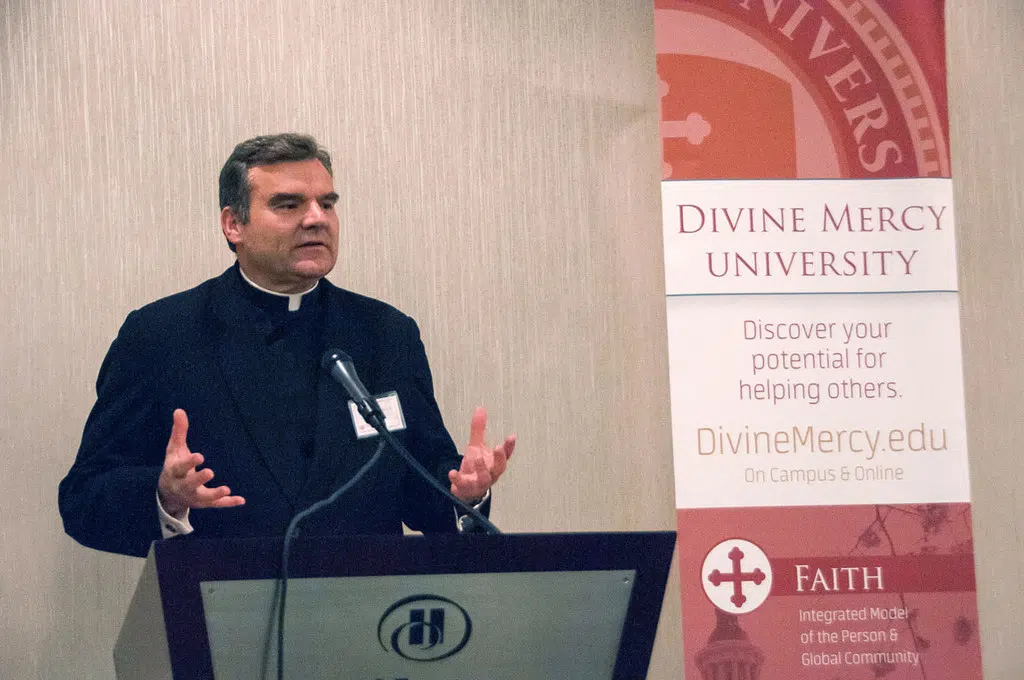
It was the fourth and final lecture of Divine Mercy
University’s Newman Lecture Series and part of the ceremonial
opening of the newly named and expanded graduate school. The
evening event included remarks by Legionaries of Christ
Father Charles Sikorsky, university president, and Thomas
Cunningham, chairman of the board of directors.
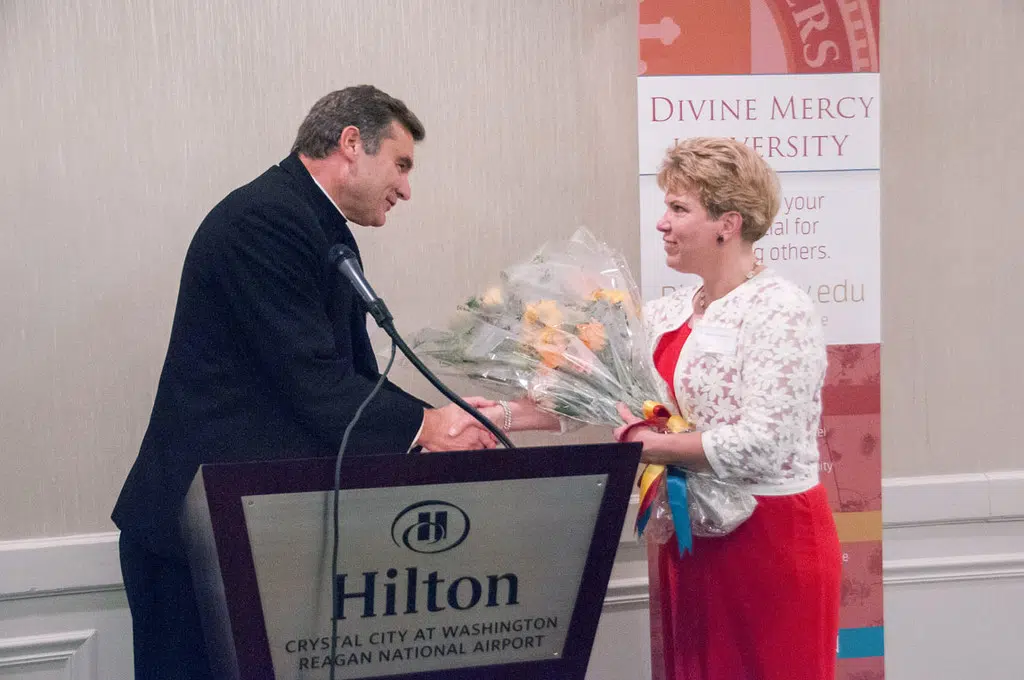
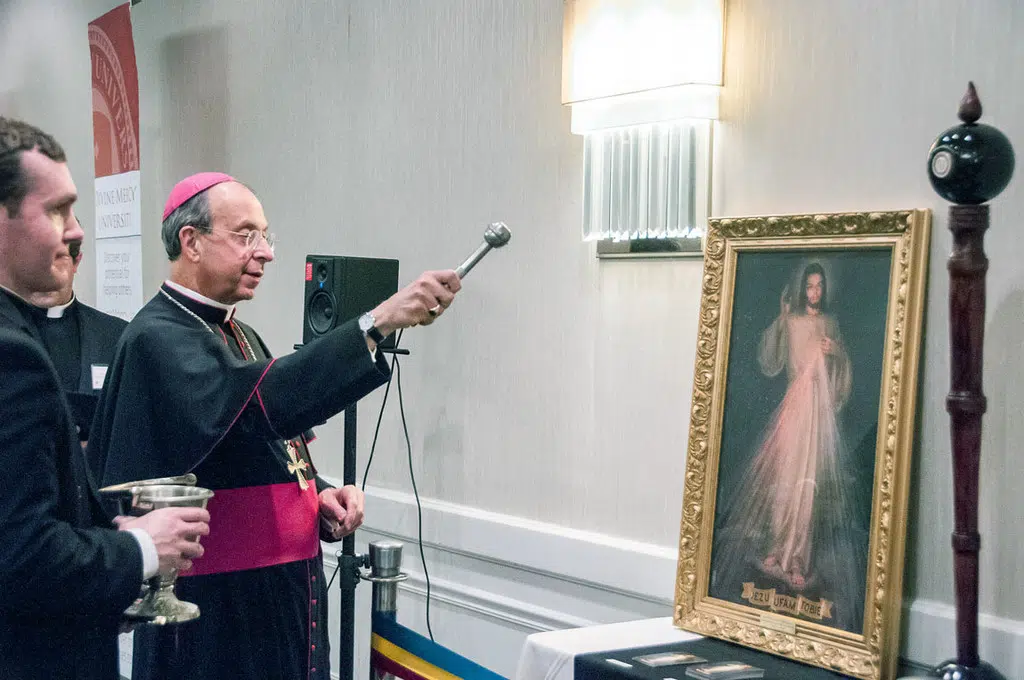
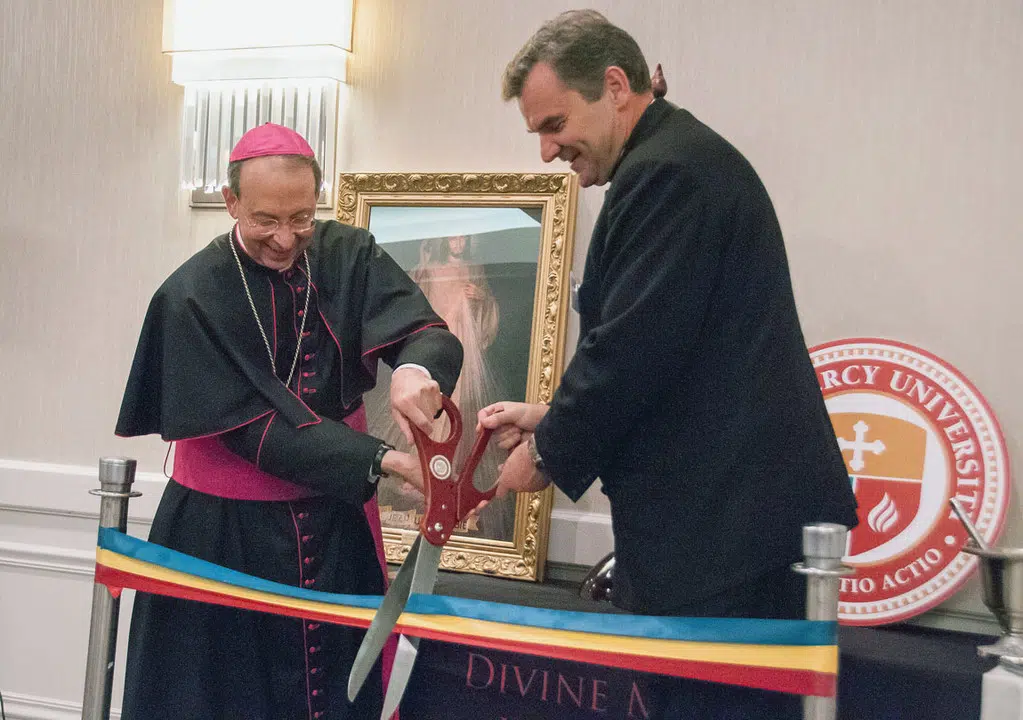
Before Archbishop Lori and Father Sikorsky cut a ribbon
marking the opening, the archbishop blessed a mace, an
ornamental staff carried during commencement processions; a
Divine Mercy image from Poland gifted by Susan Pawlukiewicz
of the Arlington Diocese; and the university’s new seal.
Founded in 1999 as the Institute for the Psychological
Sciences (IPS), the institute was elevated to the status of a
university early this year with the addition of a school of
counseling. The name change honors its mission to “reach more
of those souls who are in much need of help,” said Father
Sikorsky.
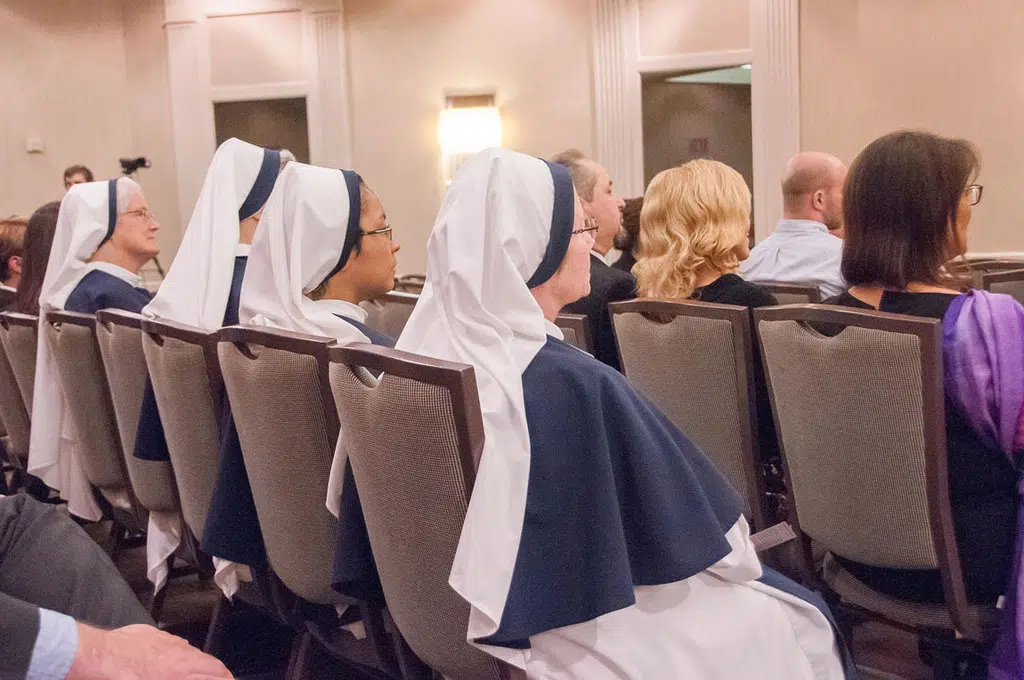
Held at the Hilton Crystal City in Arlington, the more than
90 guests included Washington Auxiliary Bishop Barry C.
Knestout, faculty, students and university supporters.
“What we are here for tonight is not really about us,” Father
Sikorsky said. “It’s about God; it’s about so many people who
are suffering.”
IPS, now a school within the university, will continue to
offer a doctoral degree in clinical psychology and an online,
nonclinical master’s in psychology. Starting this fall,
students can earn a master’s in clinical mental-health
counseling through the new school of counseling.
In his lecture, Archbishop Lori spoke about the Year of Mercy
in light of religious persecution around the world, and how
mercy heals freedom wounded by individual as well as
“structural sin” – the cumulative result of individual sin
that distorts true freedom and jeopardizes a flourishing
faith.
The Year of Mercy, “is not just a special program to be
implemented for 12 months and then forgotten, he said. “The
pope is using his jubilee year to call our attention to
something utterly fundamental to our lives of faith.”
“Nothing is more fundamental than God’s mercy,” he said. “In
Jesus, the Father, who is rich in mercy, bends down in
compassion to heal the wounds of human existence caused by
sin and injustice.”
Yet we must not only be recipients of mercy, said Archbishop
Lori, but also agents of mercy. The pope insists that all
church institutions, including parishes and schools, “not be
inward looking,” but share God’s mercy in concrete ways –
such as housing Middle Eastern refugees.
Turning to mercy in light of religious persecution around the
world, Archbishop Lori said that “we live in an age of
martyrs.”
“The 20th century was the bloodiest century in history,” he
said, and the 21st is shaping up to be equally bloody. “Let
us never forget those images of young men who, because of
their Christian faith, were about to be beheaded by (the
Islamic State group).”
Within such persecution, said the archbishop, “we glimpse
what a society without religious freedom looks like.”
While emphasizing that that the faithful should be outraged
by religious persecution, he cautioned that we “should not be
filled with the same kind of hatred that motivates such
violence. … We are called to love those who persecute
us.”
He pointed out that religious persecution is not always as
obvious as direct violence. Pope Francis says we are in
danger of “polite persecution,” which is carried out in
boardrooms, courts of law, government agencies and even
cocktail parties.
The assault on freedom is in part linked to our original sin,
Archbishop Lori said. Because of original sin, we misuse our
freedom, which in turn degrades our dignity.
“Often we reduce our freedom to freedom of choice – the
ability to do what we want so long as it’s legal or no one
seems to get hurt,” he said. People then start settling into
a lifestyle with God on the peripheries or void of Him
altogether.
As fewer people practice the faith, being religious becomes
countercultural and religious freedom in society begins “to
take a back seat,” he said, adding that when people lose
interest in the church, it’s often related to teachings on
sexuality.
Pastors must do a better job, he said, explaining these
teachings.
The pope is a model of mercy as we reach out to those who
have filled their lives in harmful ways, such as with
addiction, pornography or illicit sex, said the archbishop.
Pope Francis “avoids scolding us … but invites us to
consider the depth of God’s love for us.”
Freedom is not only wounded by personal sin, but also by the
structures of sin, he said. Peer pressure from media, broad
cultural disproval of Christianity, the exclusion of faith
from almost all institutions – these constitute structures of
sin and are an example of “polite persecution.”
Archbishop Lori said the institutions that are most vital for
human flourishing, where freedom is typically exercised and
virtue gained – the family, parishes, charities and
universities – are coming under assault in part through the
redefinition of marriage and family.
“These institutions that are under challenge are places of
mercy that seek to bring the healing balm of truth, love and
human skill to the spiritual, emotional and physical wounds
of human existence,” he said. Thus, “defending religious
liberty is itself a work of mercy.”
Archbishop Lori closed the lecture by thanking Divine Mercy
University for addressing the wounds of the world and
restoring “to those you serve a sense of freedom.”
“For yours,” he said, “is a work of both freedom and mercy.”
Find out more
Divine Mercy University is accepting applications to all
programs for fall 2016. To enroll or find out more
information, go to divinemercy.edu.