ROME – Thousands of permanent deacons and their wives began
their Year of Mercy celebration by cutting straight to the
heart of what it means to be a deacon, how the ministry
impacts their families and the challenge of explaining their
vocation to others, including bishops and priests.
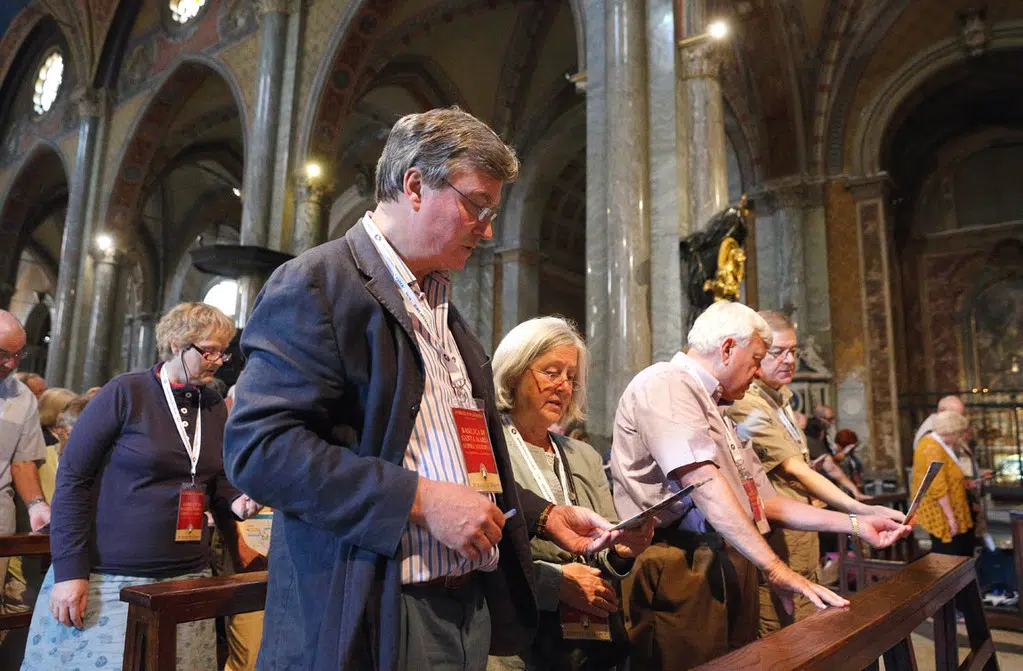
The pilgrims divided into language groups and hundreds of
English-, German- and Portuguese-speaking deacons and their
families gathered May 27 at Rome’s Basilica of Santa Maria
Sopra Minerva.
Whether alone or with their wives, dressed in clerical
collars or T-shirts because of the afternoon heat, they began
sharing experiences of formation, homiletics training and
ministry assignments even before the formal program began.
The Jubilee of Deacons concluded May 29 with a Mass
celebrated by Pope Francis in St. Peter’s Square.
In the informal conversations and the sharing afterward, the
women were active participants. Many of them had accompanied
their husbands to formation classes, and all of them are
directly impacted by their husbands’ ministries.
Deacon James Keating, director of theological formation at
the Institute for Priestly Formation in Omaha, Neb., said
deacons are born in families, most of them fall in love and
start families before discerning a vocation to the diaconate,
and they often are called upon to minister to other families.
Deacon Keating insisted that a deacon who has had proper
formation in prayer, theology and the sacraments “will become
a better husband,” his wife “will actually fall more in love”
because he will be converted to a closer relationship with
Jesus and a greater availability to others.
However, he said, that availability is not so much about time
and activity, as it is about “being” a deacon. It’s about
“relationships, not ministries,” Deacon Keating insisted.
Kimberly Norman, whose husband, James, is a deacon at Our
Lady of Sorrows Basilica in Chicago, said Deacon Keating was
right. Speaking of her husband, she said: “Yes, he is a
better man. Yes, he is a better husband.” The preparation and
ministry “has strengthened our marriage.”
Deacon Norman said his wife has changed, too, and is a
particularly good example and reminder to him to make more
time for prayer.
The jubilee for deacons began just two weeks after Pope
Francis told members of the International Union of Superiors
General that he thought it was a good idea to establish a
commission to study the role of New Testament deaconesses and
the possibility of women serving as deacons today.
The Normans said that was a great idea. “I’m very hopeful,”
Kimberly Norman said. Deacon Norman agreed, saying, “Clearly,
women have had leadership in the church, but it’s not
recognized by ordination.”
Deacon Anthony Gooley of the Archdiocese of Brisbane,
Australia, and a lecturer in theology at the Broken Bay
Institute, told the crowd that deacons were instituted in the
early Christian community to minister to people whose
particular needs were not being met by the disciples.
They have the same mission today to reach unserved or
underserved populations, he said. In fact, their potential
contribution to the new evangelization “is limited only by
imagination and by the will of those who engage in placements
and pastoral planning in the dioceses.”
“Too often a deacon is left to work out the details of his
own pastoral ministry,” Deacon Gooley said, and arrangements
are made with “a handshake deal with the parish priest.”
His remarks led to a ripple of agreement around the basilica.
Deacon Greg Kandra of the Diocese of Brooklyn, a popular
blogger and multimedia editor for the Catholic Near East
Welfare Association, focused on the ministry of deacons in
the workplace. Many of the almost 45,000 permanent deacons in
the world continue to work in secular jobs to support their
families even after ordination.
But a deacon is a deacon no matter where he is, Deacon Kandra
said. He is called by the church to be on the “front line.”
“The deacon is called to be a witness to compassion,” helping
those who are hungry or poor, whether materially or
spiritually. “They might work in the cubicle next to yours,”
he said.
As a witness to the dignity of work, Deacon Kandra said, the
deacon is called to stand up for just wages and decent
working conditions, but also to improve the workplace
environment by “quieting gossip,” listening to grievances,
speaking up for those without a voice.
“Some of the most important missionary activity in the world
today may begin in unlikely places, not in a jungle or desert
of some far-off country, but around the water cooler, or on a
bus, or over coffee in the company cafeteria,” he said.
“What began on the altar on Sunday,” Deacon Kandra said,
“continues in the world and in the workplace on Monday.”