Before they can fill their lockers with magnets or compare
class schedules with their friends, children in the Fairfax
County Public School system will be asked to sign a Student
Rights and Responsibilities document – an acknowledgement
that they understand the school’s rules.
But Elizabeth Schultz, a second term county school board
member and parishioner at St. Andrew the Apostle Church in
Clifton, believes the language in the non-discrimination
section of the document could prove problematic for people
who believe that gender is not a choice, but a biological
fact.
“Potentially, the way it’s written now, students could –
under the discretion of the faculty of the building – be
disciplined for not complying with gender identity pronouns
or acceptance,” she said.
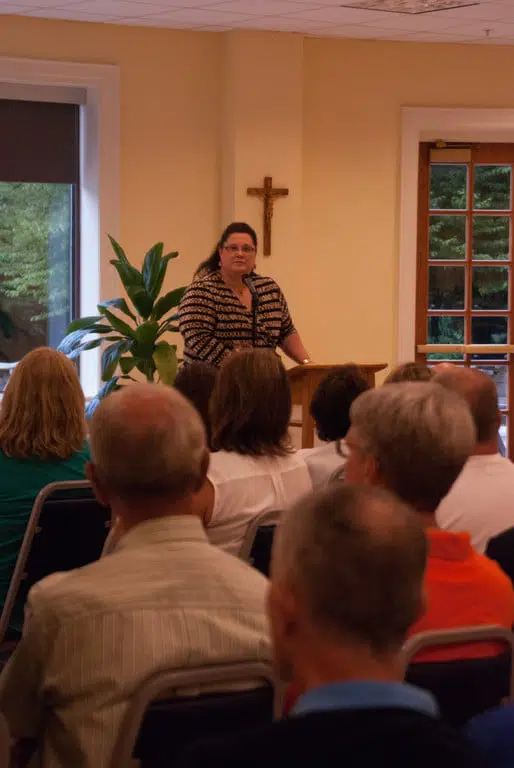
Schultz addressed about 150 Catholics at St. Raymond of
Penafort Church in Springfield July 26 to talk about the
progression of transgender policy both in the county and in
the United States. Fellow board member, the newly elected Tom
Wilson, also was present, along with pastor Father John C. De
Celles.
The Catholic church teaches that God created man in his own
image: male and female. Pope Benedict XVI, in a 2012
Christmas address, said, “This duality is an essential aspect
of what being human is all about, as ordained by God.
… When the freedom to be creative becomes the freedom
to create oneself, then necessarily the Maker himself is
denied,” the pope said.
In his recent apostolic exhortation, “Amoris Laetitia” (“The
Joy of Love,”) Pope Francis similarly decried an “ideology of
gender that ‘denies the difference and reciprocity in nature
of a man and a woman and envisages a society without sexual
differences, thereby eliminating the anthropological basis of
the family.’ ” He noted that “the young need to be helped to
accept their own body as it was created, for ‘thinking that
we enjoy absolute power over our own bodies turns, often
subtly, into thinking that we enjoy absolute power over
creation … An appreciation of our body as male or
female is also necessary for our own self-awareness in an
encounter with others different from ourselves.'”
Schultz believes that all students and school employees have
a right to profess this belief. It is not a form of
discrimination or of bullying, which should never be
tolerated. “(Transgender students) are sons and daughters of
Christ and nobody should be bullied,” she said. “But if our
children are exemplars of their faith and live by truth,
there’s nothing to be afraid of.”
The controversy over transgender policy began last year, when
the county school board added the words “gender identity” to
the county schools’ nondiscrimination policy. Schultz said
that she was shocked at how quickly the policy was changed,
with so little opportunity for parent or community
involvement. “When we looked at later start times (for
schools) it took 10 years, multiple consultants, (and an)
engagement processes (to reach a conclusion),” she said. “And
yet, within weeks, this went from appearing on the board’s
agenda to being passed on May 7 of 2015.”
Subsequently, the Family Life Education committee, which
writes the county schools’ teaching norms on sexuality, came
forward with proposed “sweeping changes to the curriculum,”
said Schultz. The issue arose again several months ago when
the county school board decided to insert language into the
student rights and responsibilities document codifying
non-discrimination on the grounds of gender identity.
Schultz said she also was concerned with the seeming
hierarchy of rights that was being established. If a
transgender student felt uncomfortable using a certain
bathroom, but a religious student objected to their invasion
of privacy from someone of the opposite sex, who would win?
Schultz asked. “Basically, what we’re being told is there is
a segregation of rights. Gender identity comes first,” she
said.
On May 13, 2016, the U.S. Departments of Justice and
Education released a joint “Dear Colleague” letter on
transgender policy. Among other things, it asserts that
public schools must treat all students according to their
gender identity, not their biological sex. Schools are
required to allow transgender students unfettered access to
the bathrooms and locker rooms of their choice. During
overnight trips, they should be placed with students of their
gender identity, not biological sex.
These policies upend many of the current arrangements created
by school districts for transgender students, including other
Virginia counties. Yet how to proceed is far from clear.
Twenty-one states have sued the federal government for this
interpretation of Title IX, muddying the waters for public
schools. The Supreme Court Aug. 3 stayed a decision regarding
transgender policy pending a full review of a school board’s
petition. The lower court’s ruling allowed a transgender
student to use the boy’s bathroom against the will of the
Gloucester County School Board in Virginia.
After debating new transgender language for the Family Life
Education curriculum this summer, the Fairfax County board
decided to pause further implementation of its transgender
policy until the U.S. Supreme Court makes a decisive ruling.
“Right now, we’re going back to what we were doing before,
which is to handle each on a case by case basis, meeting the
individual needs of that student in concert with the parents
and educators of that building,” Schultz said.
Until the courts decide, Schultz encourages parents to let
their voices be heard. She advises they opt their children
out of Family Life Education and encourage their children not
to sign the student rights and responsibilities document. She
also hopes parents can pressure the board to provide a
conscientious objector status for employees who do not want
to teach the new Family Life Education curriculum, when and
if it is implemented.
Many at the meeting supported Schultz’s message. “We need to
speak out about this,” said one mother. “It’s an
uncomfortable position to be in but we have to be the bold
ones to say, ‘This is wrong.’ ”
One father said neither his son nor his wife will be signing
the student rights and responsibilities document, regardless
of the consequences. “What will happen, will happen. I hope I
won’t be the only one,” he said.
The Fairfax County School system is the 10th largest in the
nation, with 187,000 children, 40,000 employees and a $3
billion budget. Though Catholic parents can avoid the system
by enrolling their children in Catholic schools or by
homeschooling, Schulz urged those gathered to consider the
other students. “Sooner or later, these are the children that
are going to make up our next society,” she said.
To learn more, visit Concerned Parents
and Educators.
Di Mauro can be reached at [email protected] or on
Twitter @zoeydimauro.