When you see women wearing saris at a Catholic Mass, you
might think they are Hindus visiting with Catholic friends.
But on a sunny April afternoon at St. Andrew Lutheran Church
in Centreville, families filling the pews were Catholics, not
Hindus.
“You are a beloved one of God,” said Father Tijo Joy
Mullakkara, a Syro-Malabar Catholic priest, during the
bilingual youth Mass the Indian community organizes every
month or so.
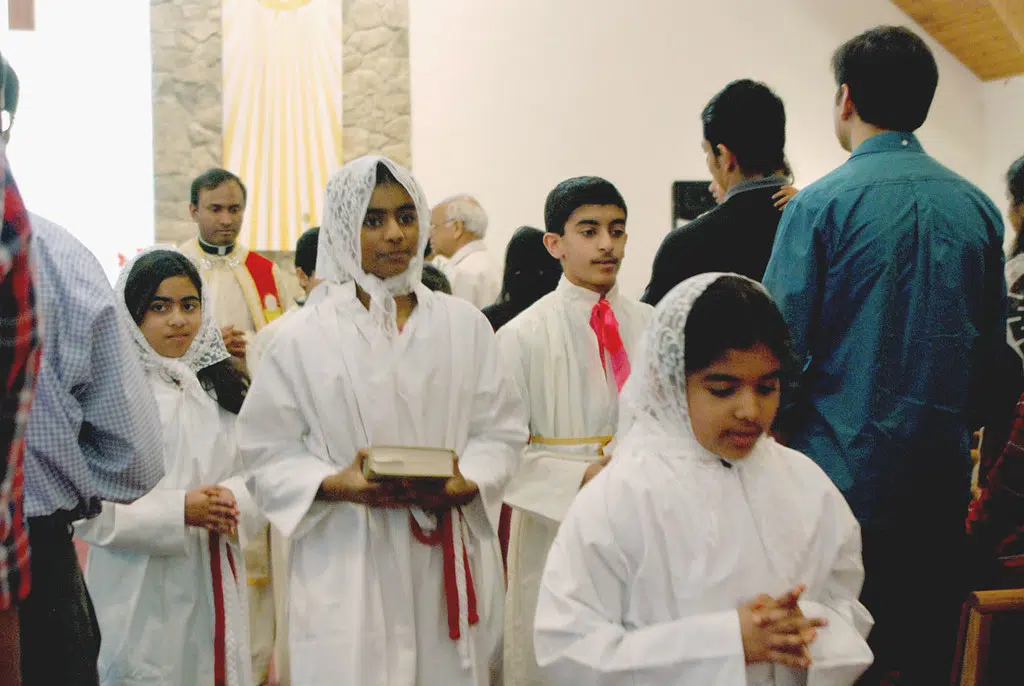
Throughout his homily, Father Tijo addressed the children,
asking them questions about David and Goliath. About a dozen
altar boys and so-called altar angels (young girls who take
charge of distributing hymnals and arranging flowers) were
just a few of the many little ones who shouted out their
answers.
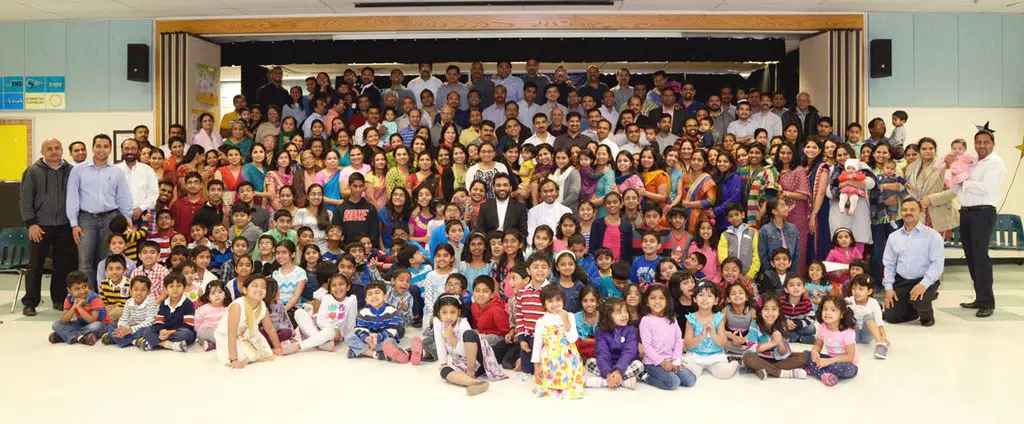
Pastor of St. Jude Syro-Malabar Mission in Centreville, part
of the St. Thomas Syro-Malabar Diocese of Chicago, Father
Tijo shepherds 120 registered families in Northern Virginia
and 40 in Richmond. Though the community has gathered since
2006, it was not recognized officially until 2011 when St.
Jude Mission was formed.
Headed by Bishop Mar Jacob Angadiath, the St. Thomas
Syro-Malabar Diocese of Chicago was established by St. John
Paul II in March 2001 and includes more than 30 parishes in
the United States and Canada.
Founded by the apostle Thomas in South India around 52 A.D.,
according to the St. Thomas Diocese website, the Syro-Malabar
Church is the second largest of the Eastern Catholic
churches. Today, there are about 3.8 million Syro-Malabar
Catholics around the world.
Corinne Monogue, director of the diocesan Office of
Multicultural Affairs, said that most of Northern Virginia’s
Indian Catholics are Syro-Malabar rite, but there are also
Roman and, to a lesser extent, Syro-Malankara rite Indian
Catholics.
“Bishop Loverde has given permission for this Epiparchy (and
its bishop) to establish a parish,” said Monogue. “They are a
different rite than our diocese … We post (their Mass)
on our webpage, as we (get) lots of questions (about the
availability of this rite in our diocese).”
And, for now, the group worships at St. Andrew Lutheran
Church.
Dennis Hagstrom, pastor of St. Andrew Lutheran Church, said
that his church’s relationship with the Syro-Malabar
community is “very simple.”
“On Sunday afternoons, St. Jude uses our sanctuary,
fellowship hall and some classrooms for Mass and Christian
Education,” said Hagstrom. “They also use our education wing
for a week of vacation bible school in the summer. In return,
they are happy to offer us a monthly financial donation.
There is also a friendly exchange of information when
needed.”
Christianity in India
On the morning of April 16, a fiberglass statue of the
Blessed Mother at St. Mary’s Church in Agra, India, was found
wearing a dog leash. Another statue had been smashed, a car
broken into, and the church doors nearly forced open. Agra, a
city in northern India, is the site of the Taj Mahal, a grand
mausoleum reverently known as “the jewel of Muslim art in
India.”
According to the Indian Christian Activist Network, since
December, at least six of Delhi’s churches have been
vandalized. A rash of seemingly anti-Christian hate crimes
included the rape of a 71-year-old nun last month.
Speculation over the motives behind this violence varies.
Last month, retired police officer, Julio Ribeiro, wrote a
column in The Indian Express, a national newspaper, stating
he “felt threatened, not wanted, reduced to a stranger” in
his own country because he is Christian.
Others, such as Delhi University professor Bharat Gupt,
believe “persecution” is not the appropriate word for recent
attacks against Christians because Indians are “accepted and
treated with equality.” He claims that “Indian and British
media has been misreporting and fudging the facts” because
political parties want Christian votes. He said Christians’
rights to open institutions “free from government
interference or supervision” are guaranteed and, in part,
government-funded, under Article 30 of the Indian
Constitution because they are a religious minority.
Father Tijo estimates that, though about 2 percent of Indians
are Christian, about 20 percent of the country’s social and
charitable institutions, from orphanages to homes for the
elderly, are run by Christian organizations.
According to Father Tijo, though Portuguese explorers came to
India in the 15th century for trade purposes, it was not
until the arrival of the British in the early 1600s that
Christianity was viewed by some as an “invasion” because of
colonization.
“Even now in some places in India, people don’t want to speak
English because of England,” said Father Tijo.
The irony is that Christianity hit India before it did
England, as Sumit Sarkar points out in his 2007 essay,
“Christian Conversions and Secularism,” published in Duke
University’s book, The Crisis of Secularism in India:
“… the origins of Christianity in one part of India
(Kerala and Tamilnadu) go back to the early centuries of the
Common Era, preceding, incidentally, the conversion of
England to Christianity and indeed the formation of most
living forms of Hindu traditions.”
Cassandra Collins, a non-denominational Christian who did a
weeklong mission in India through an ecumenical organization
earlier this year, observed that Indian Christians do not
openly evangelize Muslims and Hindus the way American
missionaries do.
“If someone is ethnically Christian in India,” she said, “it
is generally accepted that they will be Christian, even if
it’s in name only. What is unacceptable to many, though, is
any attempt by Christians to convert Muslims, Hindus or
Buddhists. Religion is viewed as central to culture and
identity. To change religion is to reject one’s family, one’s
heritage, almost the entirety of who one is in exchange for
something foreign.”
Collins, who is from Newport News, said that she met one
newlywed Christian couple – converts from Hinduism- who had
gone through with a Hindu wedding because of family
expectations but planned on holding a private Christian
ceremony a month or two later.
“Christians are definitely in the minority in Northern
India,” Collins said. “And Jesus seems, for many, but one
option among many other gods. It is offensive to suggest (to
non-Christians) that one God is the best, the only, option
for all of humanity and that He can be reached through Jesus
Christ.”
“While the Hindu is comfortable and satisfied with inherited
religion, or svadharma, the Christian practice recommends,
and for some denominations demands, proselytizing à la
(the evangelical nonprofit) Joshua project,” Gupt said.
Father Tijo said much of the violence – “persecution” or
otherwise – occurs against evangelical Christians, including
American and European missionaries, rather than heritage
Christians, such as the Syro-Malabar Catholics in southern
India.
“Muslims react most violently to Christian missionaries in
India and do not allow any change of faith,” said Gupt.
“Islam is a proselytizing religion and does not allow
competition.”
Father Tijo said that, despite recent attacks, “In general,
Indian people (of any religion) are welcoming.”
Yet misunderstandings remain.
Hindu-Catholic dialogue
Arlington’s Father Donald Rooney, director of the diocesan
Office of Ecumenical and Interreligious Affairs, is
co-organizing a talk between Catholic and Hindu thought
leaders at Durga Hindu Temple in Fairfax Station next month.
The May 23 talk, “Hindu and Catholic Traditions: Theological
Reasons for Mutual Respect and Reverence,” will feature three
Catholic speakers and three Hindu ones: Cardinal Jean-Louis
Tauran, president of the Pontifical Council for
Interreligious Dialogue; Arlington’s Bishop Paul S. Loverde;
Francis X. Clooney, Parkman Professor of Divinity and
director of the Center for the Study of World Religions at
Harvard University; Anantanand Rambachan, professor of
religion, philosophy and Asian studies at St. Olaf College in
Minnesota; Abhaya Asthana, president of Vishwa Hindu Parishad
of America; and Anuttama Dasa, chairman of the ISKCON
Governing Body Commission.
The future of St. Jude Mission
One of St. Jude Mission’s main goals is to pass the faith and
traditions on to the community’s children.
“It’s not easy to start a community with 100 families, but
people are committed,” said Father Tijo.
One of the biggest challenges is that “the children are
American, not Indian.”
“When they grow up, they feel American,” said Father Tijo.
“How can we bridge the gap?”
One solution has been making the faith accessible in English,
while still teaching the language – Malayalam – long part of
the church’s history and customs.
New York-based Father Joseph J. Palackal, founder of the
Christian Musicological Society of India, recently translated
many Syro-Malabar educational and liturgical materials into
English.
Another solution has been teaching songs, dances and other
forms of cultural expression central to Syro-Malabar Catholic
worship. The community will hold a family day at J. Michael
Lunsford Middle School in Chantilly May 2 from 4 p.m. to 10
p.m. to showcase a few of the performances the children have
learned, as well as other aspects of the faith and culture.
But a more concrete way of passing on the faith requires
building a parish in Northern Virginia.
Jophy Jose, one of the community’s first members, said that
worshipping at St. Andrew Lutheran Church has prevented St.
Jude Mission from worshipping as they would in India.
Logistics prevent them from adorning the altar according to
their traditions. Syro-Malabar churches in India have
curtains that separate the celebrant from the congregation.
The curtains are opened and closed at different points during
the Mass.
“The churches built by the British in India are old and
beautiful,” said Jose. “They’re painted and very ornate, but
we’re not sure if we will be able to get that done here (in
Northern Virginia).”
“We haven’t bought a place yet because we are still raising
funds,” said Father Tijo. “So pray for us.”
Find out more
To learn more about the St. Thomas Syro-Malabar Catholic
Diocese of Chicago, go to stthomasdiocese.org.To learn
more about “Hindu and Catholic Traditions: Theological
Reasons for Mutual Respect and Reverence,” call Sant Gupta at
703/980-7487 or email [email protected].
Stoddard can be reached at [email protected].