After Jesuit Father David Collins, 51, announced he would major
in history at the University of Virginia, his mother, Katherine, urged him to
minor in something practical. “He showed me,” she said.
Father Collins is a history professor at Georgetown University in
Washington and recently chaired its Working Group on Slavery, Memory and
Reconciliation that offered recommendations to Georgetown University President
John J. DeGioia to deal with the past slave ownership by Jesuits at the
university.
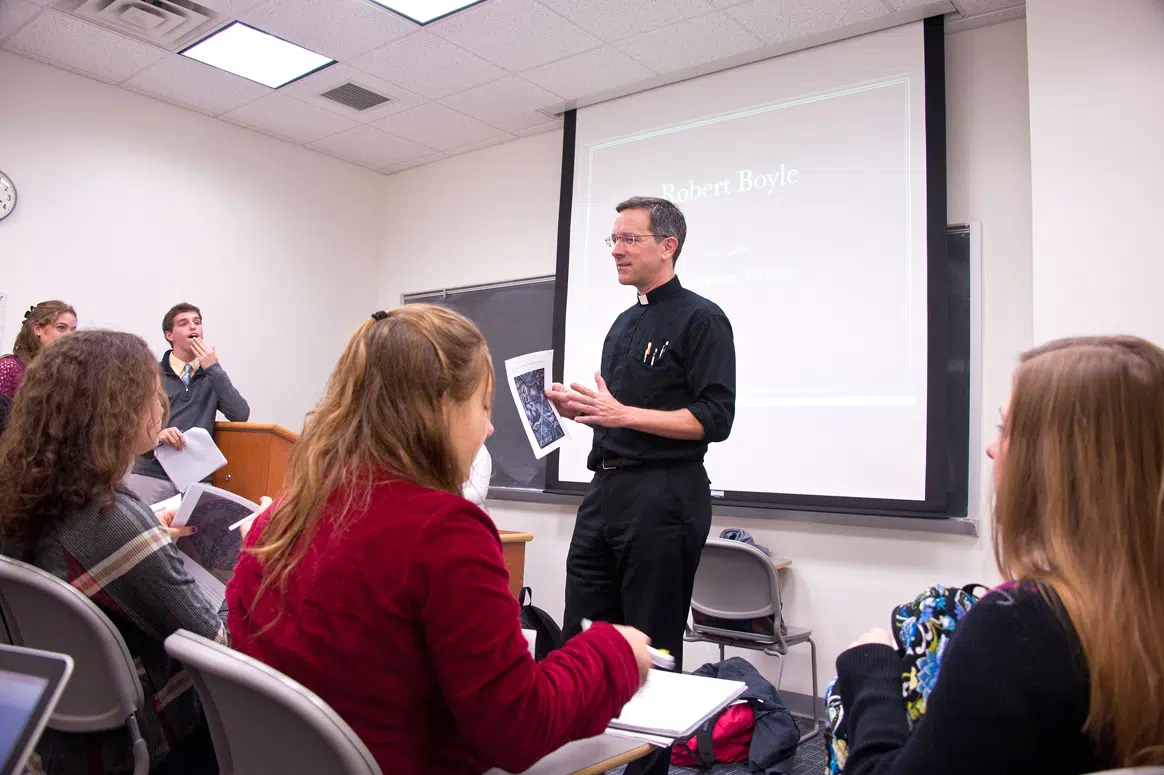
As a historian at Georgetown, Father Collins gives lectures and tours
for Jesuit novices. They meet every other year for 40 hours of lectures on the
history of Jesuits in North America.
“Part of that always included a segment on Jesuit slave holding,”
Father Collins said. “We consider the historical lessons in the 21st century. I
have always felt the slavery episode is worth very close study. It is an
extremely sad part of our history.”
DeGioia charged the committee with providing recommendations on
how to best deal with and acknowledge Georgetown’s historical relationship with
slavery. Father Collins said if you had asked him last year how long the report
would be he would have said 10 pages. The report, given to DeGioia this past
summer and released publicly in September, was 102 pages.
Several recommendations were provided, including a public apology
to the descendants of the 272 slaves sold by the Jesuits in 1838; renaming of
buildings that were named in memory of the two men who oversaw the sale; and
the establishment of an Institute for the Study of Slavery and Its Legacies.
Father Collins said he couldn’t have been happier with how
DeGioia received the report and made the general suggestions concrete.
“We had to realize as the descendants emerged that there is a
wide variety of reactions and interest,” he said. “Some were very interested
and already want to visit the university, others don’t have an interest.”
Father Collins said it is wonderful to see how people appreciate
the complicated nature of this undertaking. He said people from other religious
orders and universities are looking to Georgetown for advice.
People were intrigued by how a religious university can use
language such as atonement, reconciliation, forgiveness and sin, while a state
university has to deal with the same problems without being able to use the
same language, he said. “They have to look for different models.”
Father Collins was one of two Maryland Province Jesuits chosen to
be a delegate at the General Congregation 36 where Jesuit Father Arturo Sosa
was elected as the 31st Superior General of the Society of Jesus Oct. 14.
Because the slavery committee made national and international
news, many at the congregation asked Father Collins if he knew anything about
it. He said those conversations brought to light other resources and an
exchange of information. A Jesuit who works in Sri Lanka in a population where
human trafficking is prevalent heard Father Collins was an expert and sought
him out.
The church, according to Father Collins, has the interplay of
universal problems that manifest in local ways.
“This is an opportunity where expertises can intersect,” he said.
“At one level, the problems are distinctive to where we are at home, but we are
grappling with moral problems or humans being inhuman. Comparing the language
as a historian versus anthropologists there are ways of assessing the problem.”
History played a role in Father Collins’ family of origin.
He is the oldest of four children — two boys and two girls, born
to Katherine and David Collins. Katherine said her husband, who passed away
seven years ago, was a huge history buff. She said she was excited when the
children were old enough to go to Civil War battlefields so she could get out
of going.
Father Collins announced his decision to become a priest in a
letter to his parents his junior year at the University of Virginia. He entered
the seminary when the Maryland Province novitiate was in Warnersville, Pa., which
is now located in Syracuse, N.Y.
“I wasn’t shocked, but it was unexpected,” said Katherine. “David
always thought for himself and made his own decisions.”
He attended St. Ann School in Arlington. At Gonzaga High School
in Washington, he was involved in speech and student congress. In addition to his
bachelor’s in history from the University of Virginia (1987), he earned a bachelor’s
of philosophy at Hochschule fuer Philosophie in Munich (1991) and a master’s of
divinity at Weston Jesuit School of Theology in theology (1997).
He was ordained a priest in 1998. He earned a licentiate in sacred
theology from Weston Jesuit School of Theology in the history of theology (1998),
a master’s in history (2000) and a doctorate in theology (2004) from
Northwestern University. Father Collins joined the History Department at
Georgetown in 2004.
On the heels of the General Congregation and the release of the
Georgetown slavery report, Father Collins said he’s drawn on multiple sources
in light of his role in both.
“Both have called me to look for and call upon God’s grace in a
broken and sin-scarred world,” he said. “That very grace is what allows me to
be hopeful about the progress and outcomes of both projects.”
Read More
Pope Francis meets with fellow Jesuits at the order’s general congregation in Rome.