When Father Gerry Creedon first landed in the Dominican Republic
in 1991, he was acutely aware of the shortage of priests on the small Caribbean
Island. As the founding pastor of the new Arlington mission in Bánica, it would
soon be his responsibility to help bring more shepherds to tend the flock.
“The last priest that had resided in Bánica had moved to Haiti 20
years before, in 1971,” said Father Creedon, who immediately began working with
Bishop José Grullón to encourage local vocations.
“Because of a history of polygamy and other reasons, missionary
priests had never encouraged the idea that Dominicans should be considered for
the ministerial priesthood,” said Father Creedon. “Bishop Grullón changed that
perspective and built his own minor seminary.”
According to Creedon, many of the initial seminarians from Bánica
chose other vocations over the years, but a young boy named Pedro Mateo was the
exception and he would go on to become the mission’s first vocation.
Father Mateo was living with his family in the village of Pilon
when the Bánica mission began. Because of the village’s isolation, its access
to the sacraments and to priests was infrequent. It was a special event when
Father Creedon was able to visit Pilon in 1992.
“The first priest I met in my life was Father Creedon,” said
Father Mateo.
Even though he was only 12, Mateo was presented to Father Creedon
as the chief catechist.
“When he proclaimed the word he spoke with an authority that
belied his years and already prefigured his charism for leadership,” said
Father Creedon.
After their first meeting, Father Mateo was curious about the
priest with the Irish accent. He saw Father Creedon and other volunteers travel
across rough terrain to remote villages. During one journey the road was so bad
that the truck could go no farther. Instead of turning back, Father Creedon got
out with the other volunteers to fix the road and continued on. This impressed
the young man who began to wonder about his own vocation.
“I said, ‘OK, they are from another country and they are priests.
Can I become a priest? Because I’m from here and I can do the work that the
priests do.’”
Two years later, his community was visited by Bishop José
Grullón, who set up a council of 12 people to lead the village. Mateo, who was
14, literate and already active in the parish, was put on the council. He
remembers Bishop Grullón coming up to him and saying, “I think you can become a
priest.” But Mateo said “Oh no. No, I don’t think so.”
But the words of Bishop Grullón stayed with the young man.
“It was like he had put a little light in my heart,” Father Mateo
said. He looked into the process and entered the seminary in 1997.
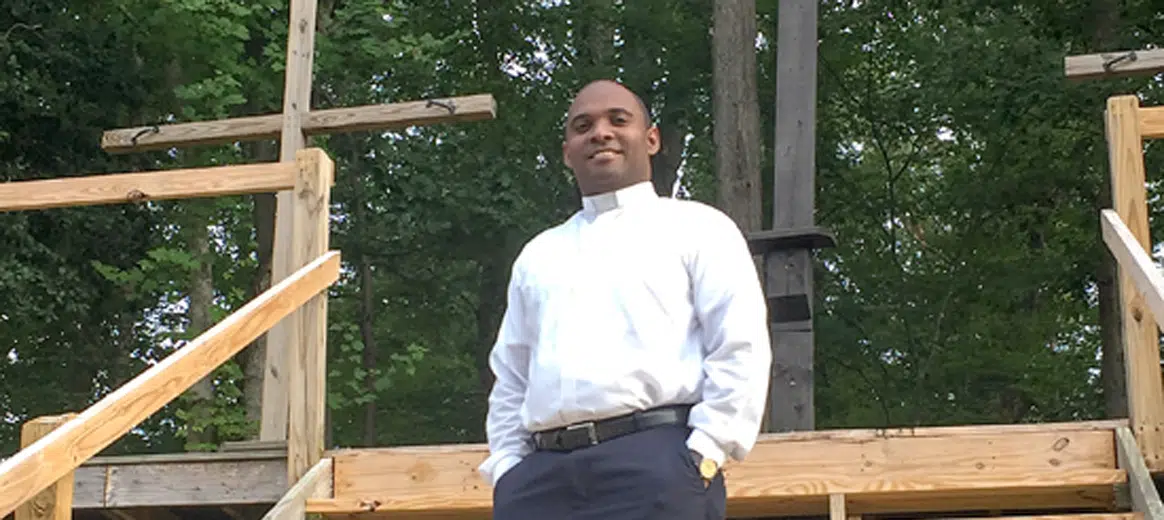
Father Mateo was ordained 10 years later, July 21, 2007, and
became Bánica’s first local vocation.
Since his ordination 10 years ago, he has served in four
different communities and is currently minister to a large congregation in
Azua.
“It is a different life after you become a priest,” said Father
Mateo.
Father Mateo enjoys being able to celebrate Mass in communities
that previously would only have access to the Mass once a month. He also
understands the people’s need for spiritual support and guidance.
“Catechetics is very important … it is the first step to
evangelization,” said Father Mateo. “When you have somebody you trust … you can
share your problems and difficulties with this person, (and) it is better for
you.”
While Father Mateo is the only local priest in the mission, he
won’t be for long. Five men are in formation to become diocesan priests and one
Franciscan friar.
“I think without the mission in Bánica it would be very different
in all aspects,” said Father Mateo. “The mission opened so (many) doors for the
Bánica youth. I’m so glad to be a fruit of the mission.”
Buyers can be reached at
[email protected]