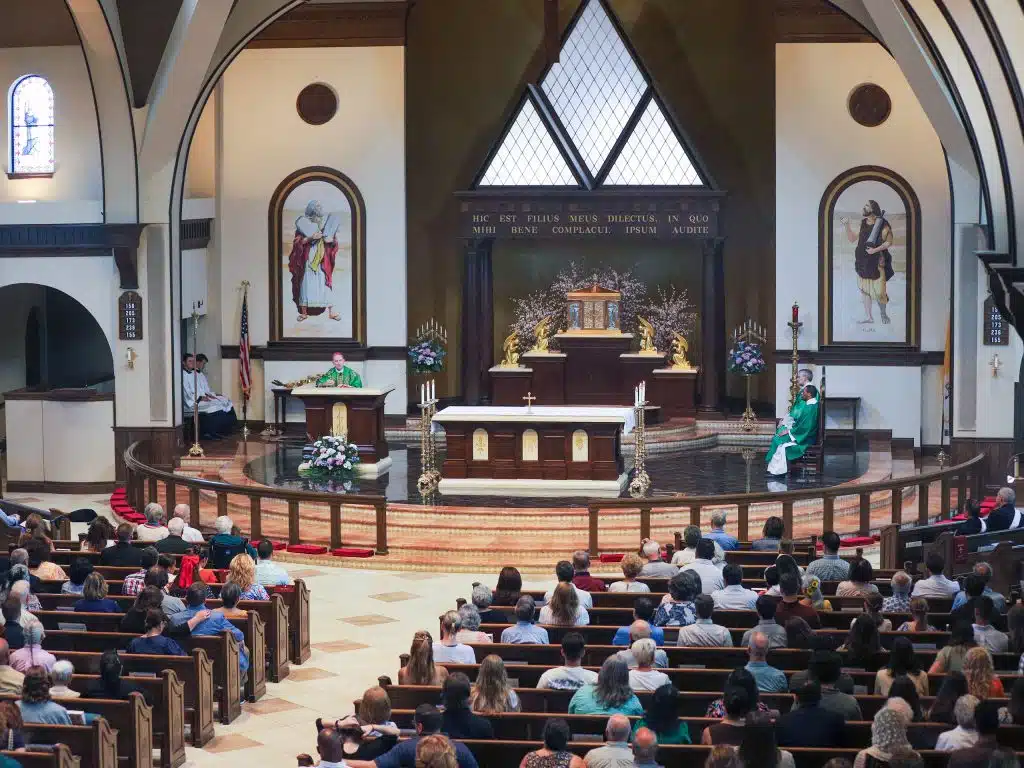
Brick by brick, a wall was erected in
the sanctuary, symbolizing sins of intolerance, division, abuse of power and
pride. One by one the bricks, made of clear plastic blocks covered with brown
paper, were removed, revealing a candle burning brightly. “Forgive us our sins,
as we forgive those who sin against us,” the congregation repeated after each
sin was named and a plea for forgiveness was given.
Arlington Bishop Michael F. Burbidge
joined Bishop Richard Graham of the Evangelical Lutheran Church of America, Bishop
Ted Gulick of the Episcopal Diocese of Virginia and Rev. Tom Joyce of the
Virginia Conference of United Methodist Church at Mt. Olivet United Methodist
Church Jan. 24 for the annual prayer service during the Week of Prayer for
Christian Unity. Father Don J. Rooney, pastor of St. Bernadette Church in
Springfield, was the homilist.
More than 100 people of various
Christian faiths came to work toward reconciliation with the theme, “Reconciliation — The Love of Christ Compels Us.” The Week of Prayer for Christian Unity, this year Jan. 18 -25, began 109 years
ago.
“How many churches
for how many centuries have been certain of their own rightness? And now not
only can’t recognize their sisters and brothers, can’t even identify the love
of the Father at work in front of them, not even a memory of his goodness?”
Father Rooney asked in his homily.
Father Rooney said nearly 1 million
Christians died in the past 10 years because they were Christian. He said that
they were all holy martyrs.
“Would we be less loving or show less
honor to any one of these, embracing them in their last moments on this earth,
because their faithfulness to Jesus to the point of death wasn’t according to
our expression of faith?”
Bishop Burbidge said in a statement
prior to the Week of Prayer for Christian Unity, “As this year marks the 500th
anniversary of the Reformation, our focus on reconciliation is all the more
needful.
“May the love of Christ compel each of
us to renew our active participation in this journey — this week and beyond,”
he added.
Roy O’Connor, a parishioner of St.
Bernadette Church in Springfield, said in the years since the Reformation,
people have become comfortable within their own congregation and worshipping
separately.
“I think what the churches are trying
to focus on is not what keeps us apart but what we have in common,” said his
wife, Lynn. “The more we see that we are pretty similar and the more we
understand one another, the more comfortable you are with it.”
Rev. Joyce said in advance of the
event that the message of reconciliation is more important than ever given the
environment in which we live.
“We are not trying to eradicate the
differences, but trying to affirm a common unity with our differences,” he
said. “It’s important to tear down walls not to eliminate the differences but appreciate
the differences in a cooperative spirit.”
Bishop Gulick said in an advance
interview that the week of prayer is a reminder that we have come a long way
but there still is more to be done. “We get together to worship in the ways we
can worship,” he said. He pointed to an ongoing and deepening relationship
between the Lutheran, Anglican, Roman Catholic and Methodist churches in
Virginia, as part of LARCUM.
Mairin Moriarty, a sophomore at
Marymount University in Arlington, helped build and tear down the symbolic
wall.
“I thought the event was a wonderful
time to keep in mind my friends who are not Catholic, but Christian, Muslim or
whichever denomination,” she said. “I want them to know spiritually that I care
about them and I accept what they believe.”
Bishop Gulick said the ecumenical
movement is turning into a joint effort to serve the world and as Christians evangelize
the world.
“There are things that are deeper than our
separation,” he said. “We have one baptism and the clarity that we’re all
brothers and sisters.”