
ALEXANDRIA — Not only are cemeteries — and Catholic cemeteries in
particular — a trove of history about the people who are interred there, but
two in the state of Virginia show they can have their own moment in the
spotlight.
The cemetery at St. Mary Church in Alexandria is the oldest
Catholic cemetery in the state. The parish, also the state’s oldest, was
established in 1795, and the cemetery started operations eight months later,
according to Father Edward Hathaway, pastor.
“St. Mary’s has a great connection with the founding of our
nation,” he said. “George Washington gave about the equivalent of
$1,200 for the founding of our parish. A close aide and a good friend persuaded
George Washington to contribute,” the priest added. “He lived just
down the road.”
The church moved about five blocks away in 1810. “Land is
crucial. Now we’re just about completely full in our cemetery,” Father
Hathaway said.
St. Mary is looking for space in the cemetery for a columbarium —
a room or building with niches for funeral urns to be stored. “We’re going
to urn burials because we don’t have any real estate for burial plots,”
said John Harchick, director of facilities for the cemetery, where 6,000 are
buried.
In nearby Fairfax County, the cemetery of St. Mary of Sorrows Church
in Fairfax Station also has a bit of history to share.
After the Second Battle of Manassas during the Civil War, also
called the Second Battle of Bull Run, Clara Barton visited the site, coming on
a train. Within three weeks, even though she was not trained in nursing, Barton
had set up a makeshift field hospital in Antietam, Md., following the Battle of
Antietam. Not long after that, Barton founded the Red Cross.
The land on which the cemetery sits was donated to the Diocese of
Richmond — which at that time oversaw all Catholic activity in Virginia and
what is now West Virginia — according to John Patrick Murphy, a member of the
parish’s cemetery committee.
Alexandria and Fairfax Station are part of the Diocese of
Arlington, which was established in 1974 and covers Northern Virginia.
While no soldiers who fought near Fairfax are buried there, 10
soldiers who either were killed or died of disease while stationed elsewhere
during the war were interred there for a time, Murphy said. In 1865, their
bodies were moved to national cemeteries.
“We have the traditional Labor Day picnic, which is on the
church and cemetery grounds,” Murphy said.
“We have significant visitation in the cemetery. The church is
active. We have Masses at the church. There are weddings, and we have funerals.
I myself have a burial plot.”
There may be up to 1,000 plots left at the Fairfax cemetery,
which Murphy estimated could last about five years. He said the Diocese of
Arlington has purchased land across a road from the cemetery that might be used
for an infant cemetery, but there has been no formal pronouncement yet.
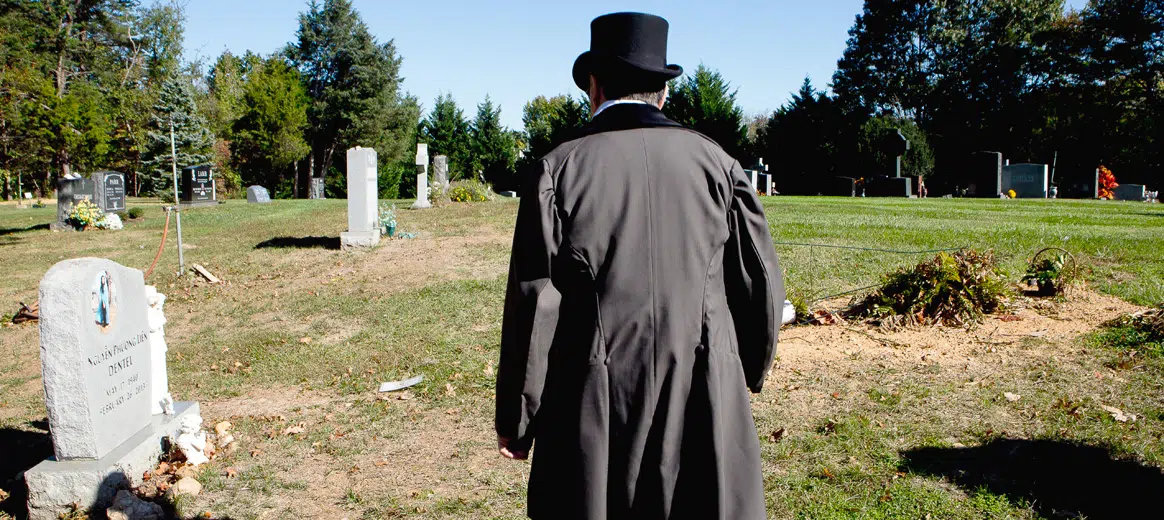
Having a cemetery makes a parish “rather unique,”
Murphy said. “When you don’t have a cemetery, the past is invisible. You
might see a few pictures on the walls, but you don’t have a connection with the
past. Here you can see the gravestones. … The history jumps out at you.”