In the fledgling days of the internet, Congress passed the
Communications Decency Act. Section 230 of that law was intended to provide limited
protection for
internet companies when a third party posted content to their website.
Since then, courts have interpreted Section 230 to provide absolute
immunity for websites — even when they are engaged in illegal activity. Now, courts,
local prosecutors and advocates for victims of human trafficking have come to
view Section 230 as a law that allows internet companies to benefit financially
from trafficking, and leaves no legal recourse for victims.
“We have a 1996 law being used to address a 21st century
problem,” said Mary Graw Leary, a professor at The Catholic University of
America’s Columbus School of Law in Washington. “It was passed before we knew
what the internet would be, and what sex trafficking would be, and before we
knew what a harmful combination they would be together.”
Leary has spent much of her law career fighting against the abuse
and exploitation of society’s most vulnerable. She and many victims groups are
advocating for a bill that would amend the Communications Decency Act. But she
fears lobbying from technology companies may result in an even worse law being
passed.
Protecting women and children
Leary, who lives in Alexandria, grew up in
Massachusetts and was raised in a Catholic family.
At her Catholic high school, she learned about the church’s
social justice teachings, which have inspired her throughout her life. “(We
were) encouraged to develop a moral conscience (and) embrace our obligations as
Christians,” she said.
After finishing her undergraduate degree at Georgetown University
in Washington, Leary spent a year serving homeless children at Covenant House
in New Orleans to better understand the people she would be working with as a
lawyer. She realized that while both the offender and victim have dignity and
deserve representation, she felt called to work for the latter. “The victims
really have no one to speak for them,” she said.
Leary returned to Georgetown for law school and went on to work
as a prosecutor in Cambridge, Mass., Philadelphia and Washington. The jobs,
which focused on victims of sexual assault and family violence, were difficult
and inspiring.
Acts such as those “tear at the American family. You can survive
but they stay with you,” she said. “(But) then you see tremendous examples of
strength and grace in the victims and in those who’ve helped them.”
As she had hoped, the work allowed her to make a difference in
the lives of marginalized children. Oftentimes, “when you’re doing a child
abuse case, all the adults in (the child’s) life — the people who are supposed
to protect them — haven’t, and often are harming them,” she said. “It’s very
gratifying (to see) justice is being done for that child, but you also see the
child, for the first time in their life, has reason to trust adults. It can
change the course of their life.”
Eventually, she took a job at the National Center for Prosecution
of Child Abuse and later at the National Center for Missing and Exploited
Children. In 2006, she began work at Catholic U.
While the law plays an important role in creating a safer world,
Leary believes in a holistic approach to stop these social ills. Catholics and
all those who believe in the innate dignity of every human being should
stigmatize sexual exploitation on every level, she said.
“We know it’s a continuum,” that ranges from the objectification
of women in movies, music, and television all the way to the buying and selling
of people, she said. The explosion of internet pornography, seen as mainstream
in much of the culture, has increased the demand for human trafficking; its
users are more likely to seek out prostitutes, who are often victims.
“We continue to normalize things that are bad for children and
women. We are all called to stand up to fight,” she said. “The resistance to
combating sex trafficking and pornography reveals how women are not perceived
as people with inherent dignity in many quarters of society.”
Section 230
Of the hundreds of minors sold for sex in the United States, two-thirds
are trafficked online, according to the research group Thorn. The plight of
several of these trafficked youths was profiled in a recent documentary titled,
“I am Jane Doe.” In these cases, a few of the young victims were reunited with
their families, and some of their traffickers were put behind bars. But the
websites where they had been sold, primarily Backpage.com, remained
untouchable.
Thanks to the documentary and other media attention, a movement
in Congress to amend Section 230 has gained traction. Testifying before the
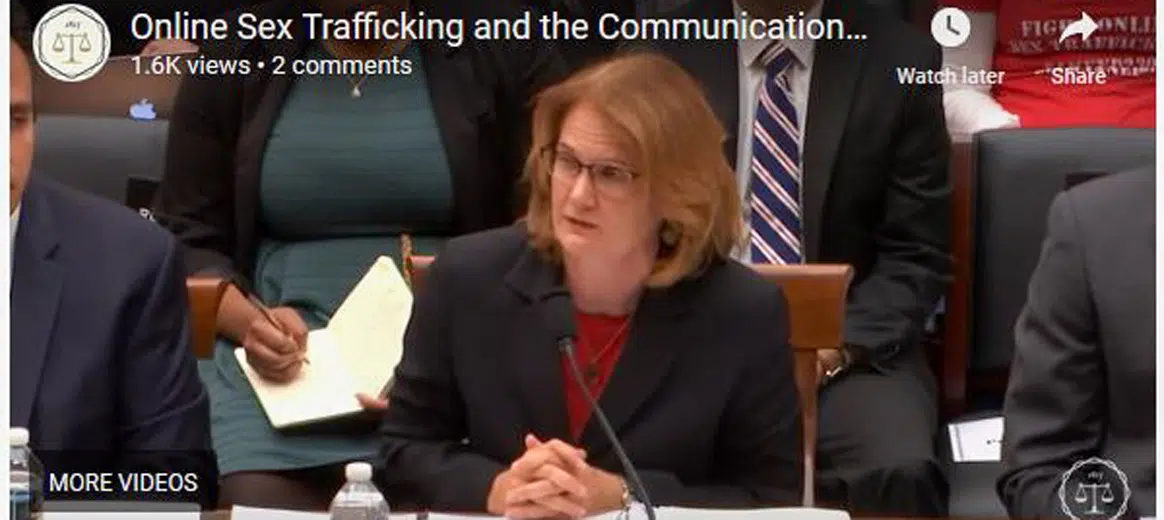
House Judiciary Committee in October, Leary explained, “Sex trafficking is on
the rise and one of the reasons is the well-intentioned Section 230. Sex
trafficking has flourished on the unregulated internet. The lure of low-cost,
high profit, no risk has brought traffickers to the web, and they have flocked
there to find unscrupulous service companies who are more than willing to
facilitate the sale of people.”
The bipartisan Senate Bill 1693 Stop Enabling Sex Traffickers Act
is supported by trafficking victims advocacy groups, said Leary. Unfortunately,
a House version of the bill, the Fight Online Sex Trafficking Act, took a different
approach that many believe leaves victims without legal options.
A letter signed by several anti-trafficking groups sent to the
House Judiciary Committee stated, “The Senate Commerce Committee recently and
unanimously approved legislation that directly
addresses the Section 230 issue, allows for civil and criminal liability,
and has the support of survivors, advocates, and the tech community. Our hope
is that the House can find a similar solution that will provide survivors with
the legal remedies they so clearly need.”
Leary encourages all to ask their legislators to support the
Senate version of the bill.
“Every argument against this reform by the tech community says,
‘We’re against sex trafficking but … and then they list some things they
claim will be threatened such as innovation
or small startups.’ When did business protection
somehow outweigh the selling of human beings?” she asked. “I
can’t help but think
about the arguments that were made in the 1800s apologizing
for slavery. These would include
statements such as, ‘Slavery is bad but… states’ rights are
important, or
textiles will be more expensive.’
At some point you
have to say the right not to be sold online outweighs these other commercial
interests, and I think that day has come.”
International Day of Prayer and Awareness against Human
Trafficking
The Pontifical Council for Justice and Peace and the
International Union of Superiors General have designated Feb. 8 as an annual
day of prayer and awareness against human trafficking. Feb. 8 is the feast day
of St. Josephine Bakhita, who was kidnapped as a child and sold into slavery in
Sudan and Italy. Once Josephine was freed, she became a Canossian nun and
dedicated her life to sharing her testament of deliverance from slavery and
comforting the poor and suffering. She was declared a saint in 2000.
On Feb. 8, Catholics all over the world are encouraged to host or
attend prayer services to create greater awareness about this phenomenon.
Through prayer, Catholics not only reflect on the experiences of those that
have suffered through this affront to human dignity, but also comfort,
strengthen and help empower survivors.