Karen DeVito remembers the joy on the
little girl’s face as she ran around her new house. As DeVito and the girl’s
father talked, she was bouncing throughout the small home, which her family was
able to live in through the assistance of CFH, formerly known as Catholics for Housing.
When the little girl returned, she had
already picked out her bedroom. “She’s got the biggest smile on her face,” said
DeVito, executive director of CFH. “It happens over and over — we put people
into housing and they get to change their lives.”
But for every individual and family CFH and
other affordable housing organizations assist, there are many more left
unaided. Localities in Northern Virginia are scrambling to provide more
affordable housing as the market trends toward pricier rentals and costlier
homes. Many believe the arrival of the 25,000 high-paying employees Amazon
plans to hire in its new Crystal City office will worsen the crisis.
A dwindling supply
The numbers prove what people living in
Northern Virginia have felt for years: it’s getting more expensive to live
here. From 2000 to 2018, the area median income increased 42 percent while the
average rent for a one-bedroom apartment in the City of Alexandria, for
example, increased 102 percent.
The City of Alexandria estimates a
renter needs to make $68,320 a year to rent a one-bedroom apartment there,
which is more than the average salary of Alexandria teachers, firefighters and
librarians.
Years ago, people with low incomes could
easily find a market-rate affordable apartment, that is, a dwelling place in a
privately owned complex that had relatively low monthly rent because of the age
of the building, lack of amenities or a less desirable location. An apartment
is considered affordable if people making 60 percent of the area median income
spend 30 percent or less of their income on rent.
Now, those market-rate affordable
apartments, also known as MARKs, are nearly gone. Officials in Arlington and
Alexandria say they have lost approximately 29,000 MARKs in the past 19 years
mostly due to rent increases. Alexandria estimates that only 8 percent of its
rental housing is affordable. Localities and charities have tried to compensate
for the loss of MARKs with more committed affordable units, also known as CAFs.
But it’s an uphill battle.
“The number of units we’ve been able to
buy and renovate or build new have not nearly been able to replace the loss,”
said John Welsh of AHC, a local affordable housing developer formerly known as
Arlington Housing Corporation. “If AHC or any of the affordable developers open
a new building and say we’ve got 100 new apartments for rent, you get 2,000
names on the list of people who are interested. The demand is huge.”
If more housing units aren’t built,
janitors, cooks, construction worker, waiters, hairdressers and other
low-income workers will be forced to move away and commute long distances to
their jobs, further taxing roads. “You’ve either got to build the units that
are affordable, or you’ve got to understand that the traffic is going to be
there,” said DeVito.
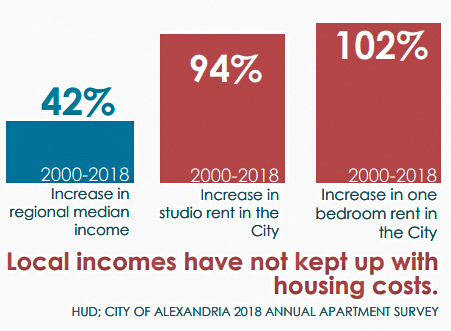
Information from Alexandria demonstrates the difficulties renters have finding affordable housing in Northern Virginia.
Amazon’s effect on the problem has yet
to be seen. “I think it is safe to say that the influx of new residents with
Amazon plus the existing affordable housing shortage does not equal an
improvement to the existing homelessness in this part of our diocese,” said
Veronica Roth, program director of the diocesan Catholic Charities St. Margaret
of Cortona Transitional Housing, a 12-unit apartment complex in Woodbridge for
families facing homelessness.
“I
know we live in a capitalist society, you can rent for as much as you can get,
I understand that,” said DeVito. “But at the same time, I also know housing is
a very basic need.”
Finding solutions
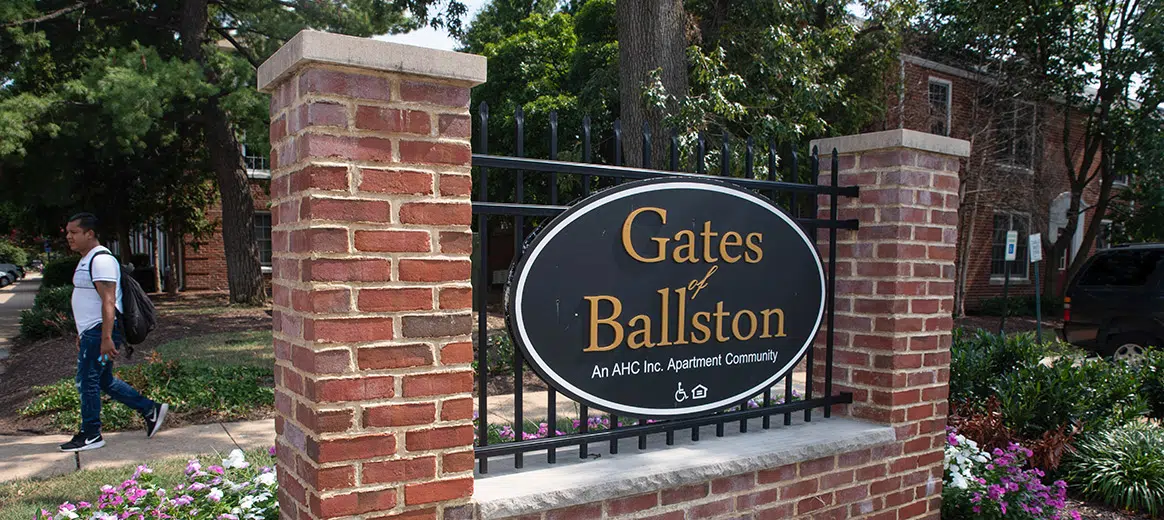
A stone’s throw from the Cathedral of
St. Thomas More in Arlington is the Gates of Ballston, a mixed-income apartment
complex owned by AHC. For many years, an absentee landlord neglected upkeep of
the buildings. “They just let the property go,” said Welsh. “It was so awful
before.”
After AHC bought the property, they had
meetings with the residents to understand their needs. One problem was serious
overcrowding, as the complex only had one- and two-bedroom apartments. During
the extensive renovations, AHC added three-bedroom apartments to the mix.
“I can think of a number of families who
were so enthusiastic about the renovation plans,” said Welsh. “(They were) finally
able to have a home where they really felt proud to raise their kids.”
Related story: Millennial Catholics discuss housing, parenting and faith
Local jurisdictions often partner with
non-profits to make CAFs such as those in the Gates of Ballston possible. One
way is through financing. “An affordable housing developer, typically (is)
combining (funds) with other financing (such as) the federal low-income housing
tax credit,” said Russell Danao-Schroeder, senior housing planner for Arlington
County. “But there’s always a gap in what it costs to build that project and
what they can get in loans from private banks, or in equity from the tax
credits. The difference in that gap is bridged by the county loan funds, which
are on more favorable terms than what a private bank would offer.”
The affordable housing ordinance lets
developers add more units than zoning would normally allow, as long as they
include some affordable units. For example, where Bergmann’s dry cleaner once
stood on Lee Highway in Arlington now is a 202-unit apartment complex with 11
CAFs within it. “As a condition of that approval, they committed to providing
11 units at an affordable rate. They were not an affordable housing developer,
but they were interested in getting additional density,” said Danao-Schroeder.
Even with government assistance,
affordable housing developers still have to find places to build. “You’ve got
all sorts of very high-end luxury apartment developers also out there wanting
to be in the best location. The only way to address the demand is to invest
more resources to be able to buy properties to compete with the market,” said
Welsh.
Recently, some affordable housing
developers have partnered with churches and fraternal organizations to get the
land they so desperately need. “On Columbia Pike, the Arlington Presbyterian
Church partnered with the Arlington Partnership for Affordable Housing to
redevelop affordable housing (on their property),” said Danao-Schroeder. “At
the Metro stop in Clarendon, there’s a Baptist church where (some) affordable
housing was built on top of the church.”
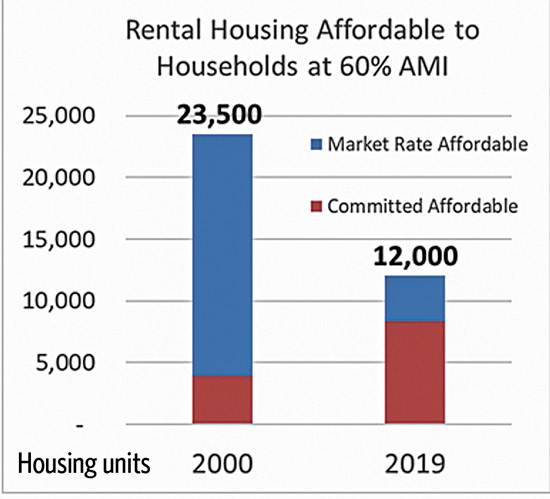
Information from Arlington County demonstrates the difficulties renters have in finding affordable housing in Northern Virginia.
Once they have the location, affordable
housing developers have another hurdle to overcome. “Construction costs are
going up and they’re going up exceedingly fast,” said Welsh. “We’re competing
for labor and materials to building the new building with those same luxury
developers.”
Needing all hands on deck
Many affordable housing advocates
believe that unless affordable housing is prioritized, the crisis will continue.
“I would encourage people to speak up, to write to their representatives,” said
Welsh. “When we have a socially, racially diverse community, we’re all the
stronger.”
The U.S. Conference of Catholic Bishops
notes that, “The Church has traditionally viewed housing, not as a commodity,
but as a basic human right. As the Vatican document on housing reminds us — ‘This
situation is not simply a fact to which those with responsibility in the field
and indeed all people are called to react. Rather, from an ethical point of
view, it is a scandal.’ ”
Not only is having enough affordable
housing compassionate, it’s practical. “In any community, for the economy to
function well, being able to house households of the full spectrum of incomes
is important,” said Danao-Schroeder. “We all depend on services that are
provided by folks working in construction, restaurants, hotels — these are
people needed to make things function.”
DeVito hopes people educate themselves
about the issues and help when they can. “A lot of people and nonprofits work
very hard trying to provide housing,” she said. “We can do what we can do, but
it’s not solving the issue — just putting Band-Aids on it here and there.”
What are local governments doing to help?
Arlington County’s 2020 budget added $1,521,872 in new affordable
housing funding. The budget now includes $16 million for the Affordable Housing
Investment Fund and $9.3 million for housing grants. They additionally created
a new position of housing coordinator to expedite affordable housing
development proposals through the approval process.
The City of Alexandria’s 2020 budget added $1 million in
new funding. Its budget now includes $8 million for the Housing Trust Fund.
Information provided by the Northern Virginia Affordable
Housing Alliance