
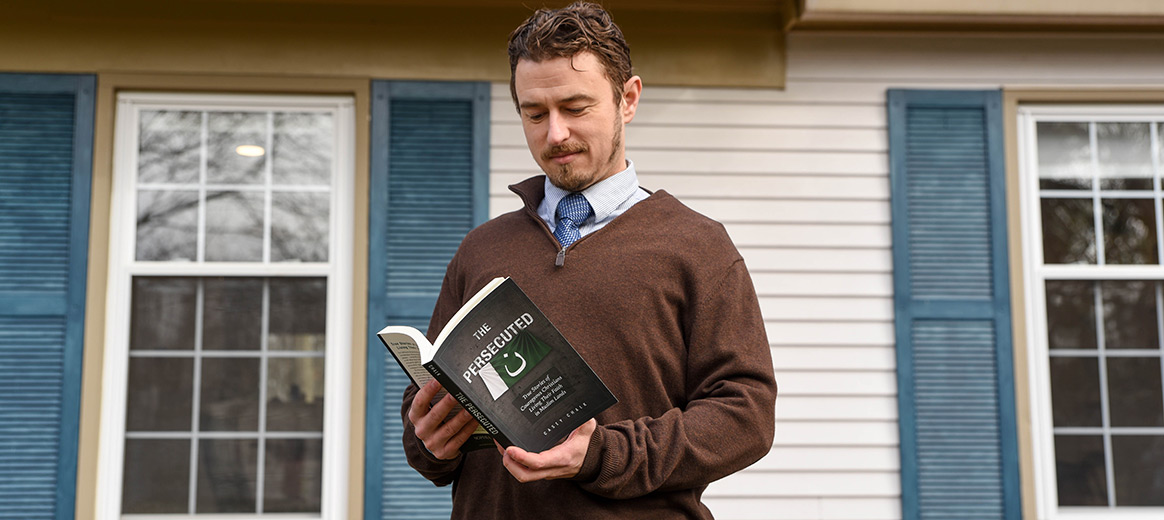
Holy Redeemer Catholic Church in Bangkok attracted all kinds of people: Thais, Western expatriates, Filipinos and West Africans. But the people who made the greatest impression on Northern Virginia native Casey Chalk were the Pakistani parishioners who had fled religious persecution. As he grew to know them, he learned about the violence and abuse they faced in their homeland, and the prolonged legal limbo and difficult circumstances they experienced in a foreign country. His interactions with these faithful, long-suffering Catholics are told in his new book, “The Persecuted: True Stories of Courageous Christians Living Their Faith in Muslim Lands.”
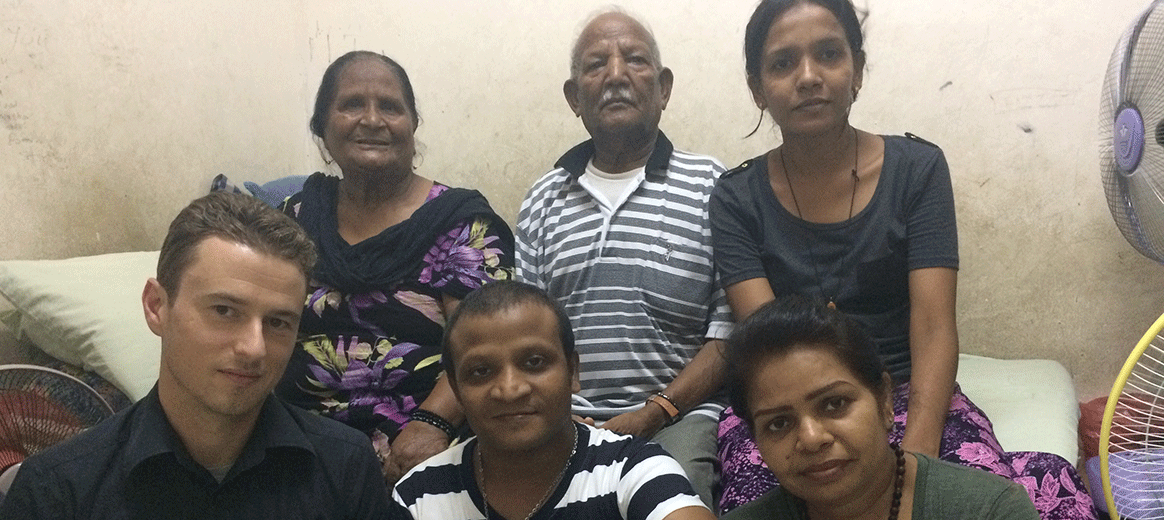
Chalk, his wife, Claire, and their newborn daughter moved to Bangkok in 2014 for his job managing the translation of news from local outlets into English. At their parish, they met numerous immigrants who were awaiting processing by the United Nations High Commissioner for Refugees (UNHCR). They became good friends with two families. The first was the D’Souzas, a family from Karachi, Pakistan.
According to the U.S. Commission on International Religious Freedom, Pakistan is 96.28 percent Muslim and 1.59 percent Christian. The USCIRF classified the country as one of the worst religious freedom offenders, noting that in 2020, “there was a sharp rise in targeted killings, blasphemy cases, forced conversions, and hate speech targeting religious minorities. The issue of abduction, forced conversion to Islam, rape, and forced marriage remained an imminent threat. Authorities often do not take any action, and in abduction cases that are brought to the courts, officials have claimed that victims willingly converted to Islam. Victims are often forced to testify that they converted voluntarily to protect themselves and their families from further harm.”
Islamic extremists, members of Tehrik-e-Taliban Pakistan (TTP), began to persecute Michael D’Souza, his wife, Rosemary, and their children in 2006. At first, they would come to his home and urge him to convert to Islam. Then they began to follow the family and verbally abuse them, then physically attack them on the way to their parish. The family moved around Karachi several times to different Christian enclaves but were always found by their persecutors.
Occasionally, the couple split up, visiting family and friends. Michael was with his uncle in Lahore and Rosemary and the children were with her sister Michelle in Karachi when Michelle didn’t come home from work one day. The next morning, someone threw a rock through their window with a note attached that said Michelle had been kidnapped by a local mullah, or Muslim leader, and that they all should convert to Islam.
“The police refused to write a report once (Michael) told them a TTP-affiliated mullah had kidnapped his sister-in-law,” wrote Chalk. “They declared that there was no chance of forcing the mullahs to return Michelle.” In 2012, the D’Souzas fled from Pakistan to Thailand in desperation.
Their several years in the country were marked by bureaucratic immigration logjams and, worse, lockups in a detention center. Eventually, Michael concluded they must return to Pakistan. The Holy Redeemer community rallied to furnish them with plane tickets and a motorized rickshaw Michael could drive to support his family.
Within several months, his former tormentors burned his rickshaw and nearly beat him to death. In the years since, attempts by Chalk and his wife to win them asylum in the U.S. have failed, as did the family’s effort to migrate to Poland. Now, Michael and Rosemary mostly hide out in their small apartment.
“Their kids are in school, but apart from that, that’s their existence,” he said. “He’s just terrified, afraid he’s going to get killed.”
The other family the Chalks met was led by Wilson William. Much like the D’Souza family, Wilson and his family faced targeted persecution in Karachi and ultimately fled to Thailand, said Chalk.
Four days after they arrived in Thailand, Wilson’s sister’s home in Pakistan was set on fire, causing severe burns to her and her daughters. The daughters soon fled to Thailand. Wilson lost contact with his sister and he doesn’t know whether she’s dead or alive.
The William family’s appeal to the UNHCR also was rejected. But the family prayed without ceasing, said Chalk. In 2019, they received visas to allow some members of the family to travel to Europe. A Pakistani businessman in Holland sponsored their resettlement. Chalk and others helped pay for their plane tickets. Wilson’s wife and children made it to Holland. But he stayed behind to help the rest of his family obtain the paperwork needed to leave Thailand. He’s still there.
Through the many trying years, Chalk was touched by the persistent faith of the families. Though he and his wife, parishioners of St. Veronica Church in Chantilly, now live with their four children in the U.S., he still keeps in touch with both families and tries to advocate for and support them. Chalk sees his Pakistani Catholic friends as living saints. “If I had to endure what they endured, I don’t know if I would have been able to stay faithful because the pressures are just so great,” he said.
Chalk wrote the book to fully tell the two families’ stories, including some documentation of their trials. He hopes it leads people to pray and financially support persecuted Christians, but also to be inspired by their incredible witness. “There are people out there who are willing to make these kinds of sacrifices for the faith.”