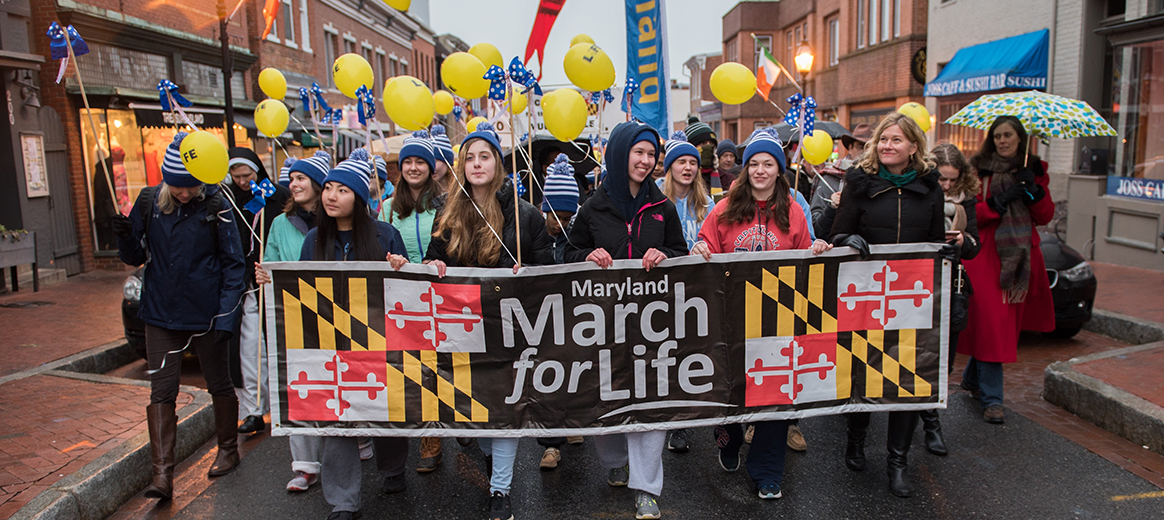
The Maryland Catholic Conference has urged Catholics and other pro-lifers to actively oppose several bills being considered by the state’s lawmakers in Annapolis that would broaden and strengthen abortion rights laws in Maryland.
“Given that abortion is ubiquitous in our state, Maryland women are not looking for abortion expansion, but rather help with the basic necessities they need to survive and thrive,” said Jenny Kraska, executive director of the Maryland Catholic Conference. “It is not more abortion that Maryland needs, but a clear understanding of the diverse demographic in our state and support and resources for growing families.”
Several measures to protect a right to abortion and expand the availability of abortion are being considered in the House of Delegates.
A bill introduced by House Speaker Adrienne Jones, a Democrat, would make abortion a right protected by the state’s constitution. Jones’ measure would put the issue forth as a ballot referendum to be decided by state voters.
“This is the most serious and all-encompassing abortion bill introduced this session,” said Susan Gibbs, a spokesperson for the Maryland Catholic Conference, the public policy arm of the Washington and Baltimore archdioceses and the Diocese of Wilmington, Del. The Washington Archdiocese and the Wilmington Diocese include a number of Maryland counties.
Two other abortion bills have been introduced in the House by Democratic Delegate Ariana Kelly.
One measure would require insurance plans to cover the cost of an abortion without copayments or deductible payments by the recipient. It does include a religious exemption. It would also make permanent Medicaid coverage of abortion. Right now, that coverage is voted on each year during the budget process.
The other bill introduced by Kelly would repeal state restrictions against physician assistants, nurse midwives and nurse practitioners from performing abortions. It would also provide training for nurses and doctors who relocate to Maryland to avoid stricter abortion laws in other states.
“These kinds of bills, which include expanding insurance coverage of abortion and allowing non-physicians to perform abortions, don’t offer women alternatives to abortion, and so become reproductive coercion, especially for low-income women, immigrants and women of color,” Kraska said.
Maryland State senators will consider a bill that would protect from civil and criminal liability abortion providers or people providing support to someone seeking an abortion.
Father Daniel B. Carson, vicar general and moderator of the curia for the Washington Archdiocese, lamented the proposals in a Feb. 18 letter to all priests of the archdiocese.
“The state of Maryland has some of the most permissive abortion laws in the country, permitting legal abortion at any stage in pregnancy,” he wrote. Since 1991, Maryland has had a state law that guarantees a woman’s right to an abortion up until the time a fetus is able to live outside the womb. Father Carson warned that the constitutional amendment “would enshrine abortion ‘rights’ into the Maryland Constitution.”
“Pastors are encouraged to share this information with their communities … We will continue to monitor this issue and provide additional information as it becomes available,” he wrote. He also urged the faithful “to contact our legislators and make sure they know that Catholics oppose these bills.”
Gibbs said the Maryland Catholic Conference has created “action alerts” for the measures being considered by the House of Delegates and the Senate, and “we also have set up an online petition so parishes and individuals can speak up against the constitutional amendment.”
“We must do better as a society to walk with mothers in need and help break down economic, social, racial, employment and emotional barriers that lead mothers into thinking abortion is the only option,” Kraska said.
The flurry of abortion-related bills in Maryland and other states is in reaction to what some see as a very real possibility that Roe v. Wade, the U.S. Supreme Court’s 1973 decision virtually guaranteeing abortion on demand, could be overturned or severely limited.
Right now, the Supreme Court justices are considering the constitutionality of a Mississippi law that bans most abortions in that state after the 15th week of pregnancy. A decision in the case — Dobbs v. Jackson Women’s Health Organization — is expected in June or July.
If the court’s ruling in Dobbs overturns the court’s 1973 Roe v. Wade decision legalizing abortion nationwide, it will leave it to the states to make abortion policies.
Also, in January, the high court decided not to overturn a lower court’s ruling that lets stand while it is being challenged a Texas law giving citizens the ability to sue doctors, nurses, or any others who help someone obtain an abortion after six weeks of pregnancy.
Szczepanowski is managing editor of the Catholic Standard, newspaper of the Archdiocese of Washington.