How to obtain relics?
Q. Please forgive my awful handwriting. I have multiple sclerosis and also Parkinson’s disease and can no longer do very well on a typewriter or computer. My question is: Why is it so hard to obtain first-class relics? (Also, do I need permission from my bishop to obtain them?)
I am now 65 years old and virtually bedridden, a convert to the Catholic Church in my teens. There are two saints to whom I have special devotion, and to have their relics would be a great comfort to me: St. Rita of Cascia and St. John Mary Vianney. I appreciate any advice you might offer. (Tell City, Ind.)
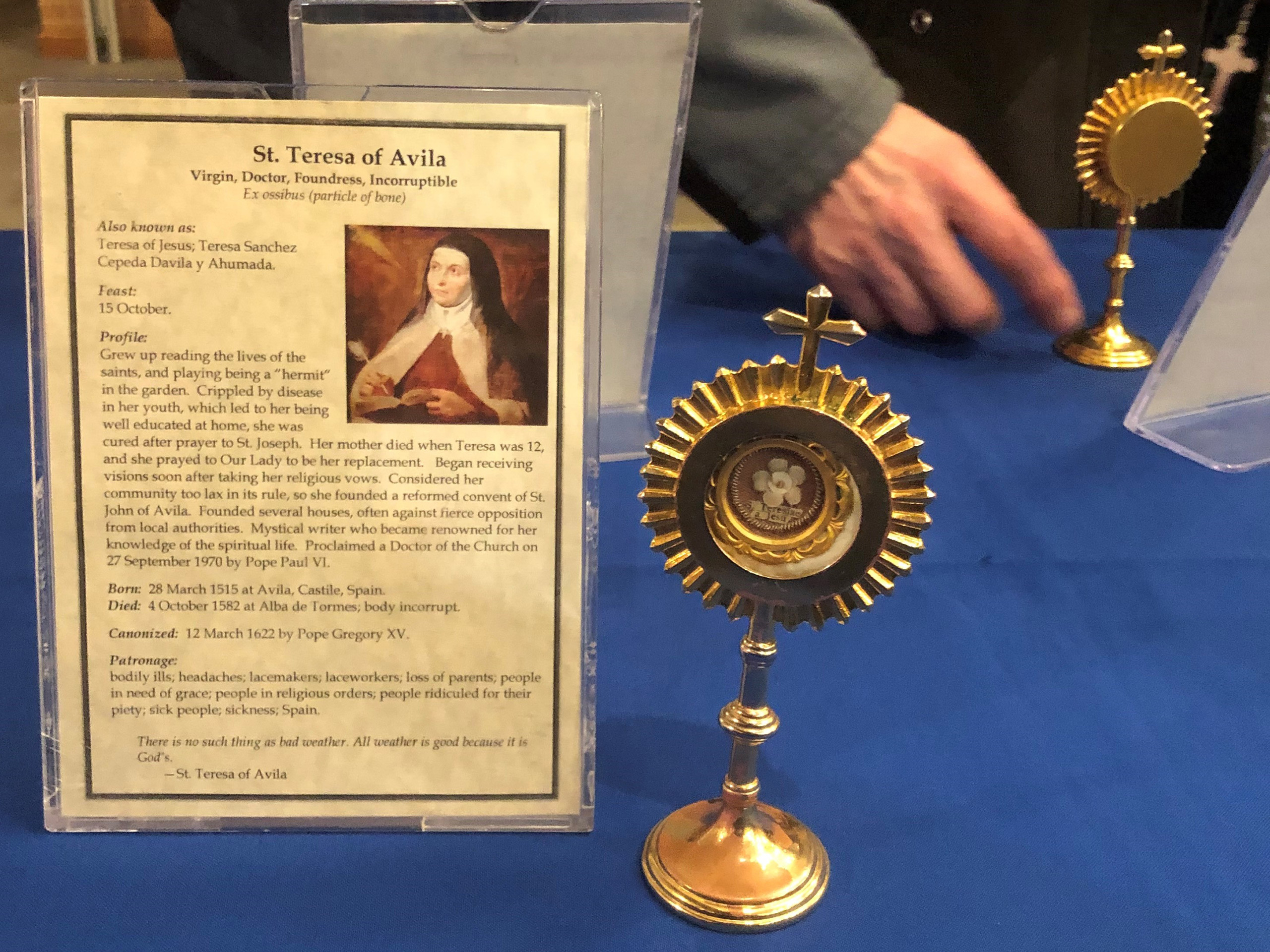
A. First, a primer on the three classes of relics. As explained by Catholic News Service: “A first-class relic is the physical bodily remains of a saint or blessed like bones, blood and hair; a second-class relic is a personal possession, such as clothing, devotional objects, handwritten letters or even furniture; and a third-class relic is an object that has touched a first-class relic. These — usually small snips of cloth that have touched a blessed or saint’s tomb — often end up in public distribution fixed onto prayer cards.”
Relics have been venerated in the church since the earliest centuries of the Christian era because they evoke the memory of the person honored and are thought to put one in closer contact with the virtues of that saint.
The largest collection of relics belongs to the Vatican and is kept at a convent adjacent to the Basilica of St. John Lateran in Rome. The practice of making relics generally available to the public, particularly first-class relics, ended about 20 years ago at the insistence of the Vatican.
Today, you can apply to the Vatican for a specific relic only with a letter of permission from your bishop and only if the relic will be used for a church altar or other public purpose. The private ownership, especially of first-class relics, is highly discouraged since it is seen as limiting the evangelizing effect of the saint’s memory.
Occasionally, second- or third-class relics can be obtained by contacting the religious order or shrine of a particular saint. (The national shrine of St. Rita of Cascia is in Philadelphia, and the shrine of St. John Mary Vianney is in Ars-sur-Formans in France). If these shrines are unable to provide you with relics, they can at least offer you devotional material on the saints and information about their lives.
The church’s Code of Canon Law says specifically and strongly (in No. 1190) that “it is absolutely forbidden to sell sacred relics.” When relics are obtained, there is often a charge for the metal container encasing the relic and for mailing costs, but not for the relic itself.
Destination Weddings
Q. What is the church’s position about “destination weddings,” which may or may not be performed by a priest? If two previously unmarried Catholics in good standing are married in such a non-church ceremony, will the church accept that marriage? (Schenectady, N.Y.)
A. My take on “destination weddings” is that they are fraught with complication — both from the religious point of view as well as the civil.
To answer your question simply, two Catholics must be married by a Catholic priest or deacon. Sometimes an “exotic” wedding venue will assure a couple that the venue will find a member of the clergy to officiate, but whether that will turn out to be a Catholic priest or deacon in good standing is always uncertain. (More often than not, it will not be a Catholic at all.)
Further, there is the matter of securing the proper license from a foreign municipal authority and assuring that the marriage will be recognized in the United States. On more than one occasion in the recent past, I have persuaded Catholic couples bent on a destination wedding to be married beforehand in a quiet ceremony in our parish church with me as the celebrant and with a marriage license from our own city hall.
Following that, they can leave and party in the tropics with their friends and family, confident that their marriage is recognized as official by the church and by the state.