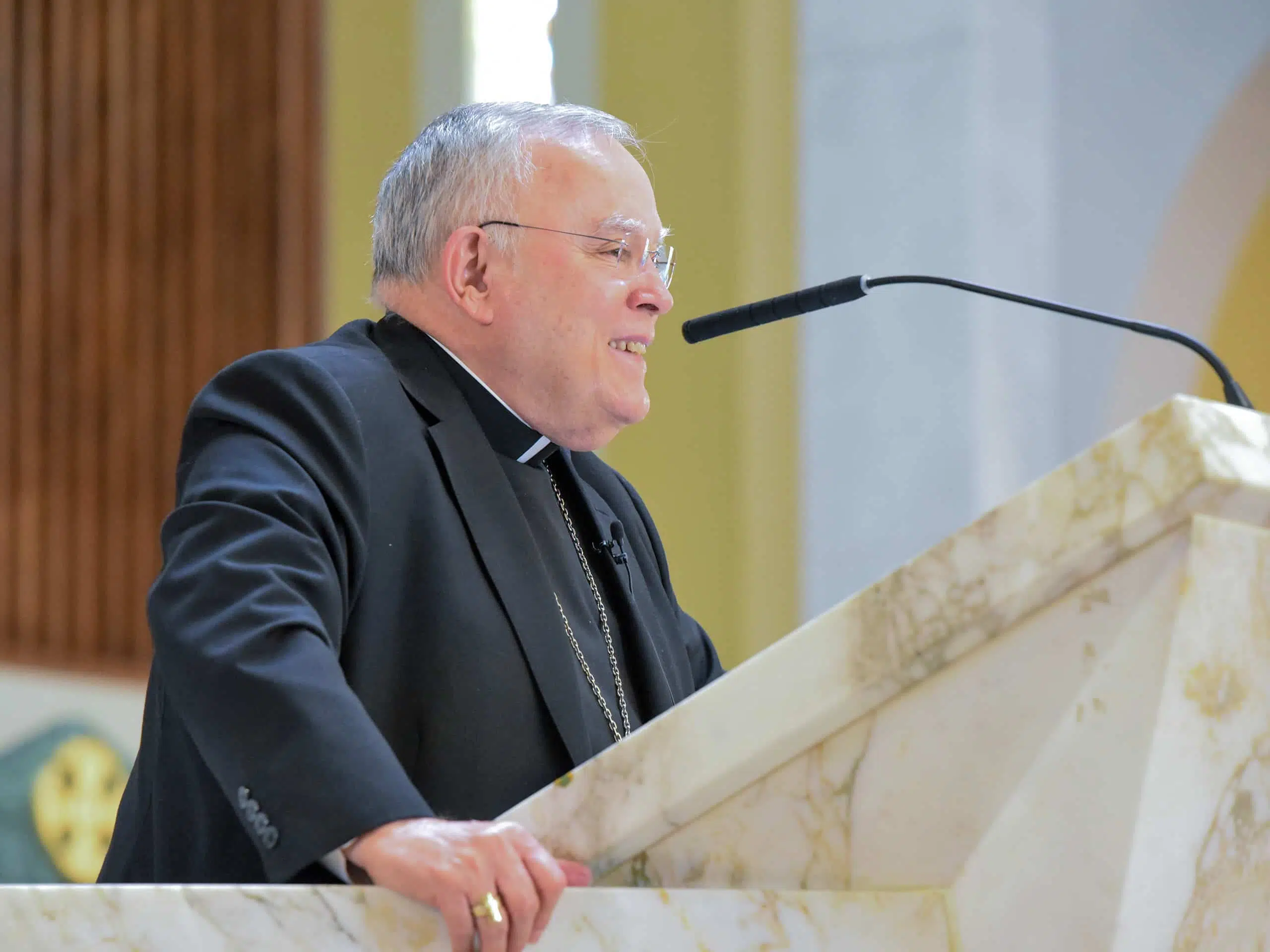
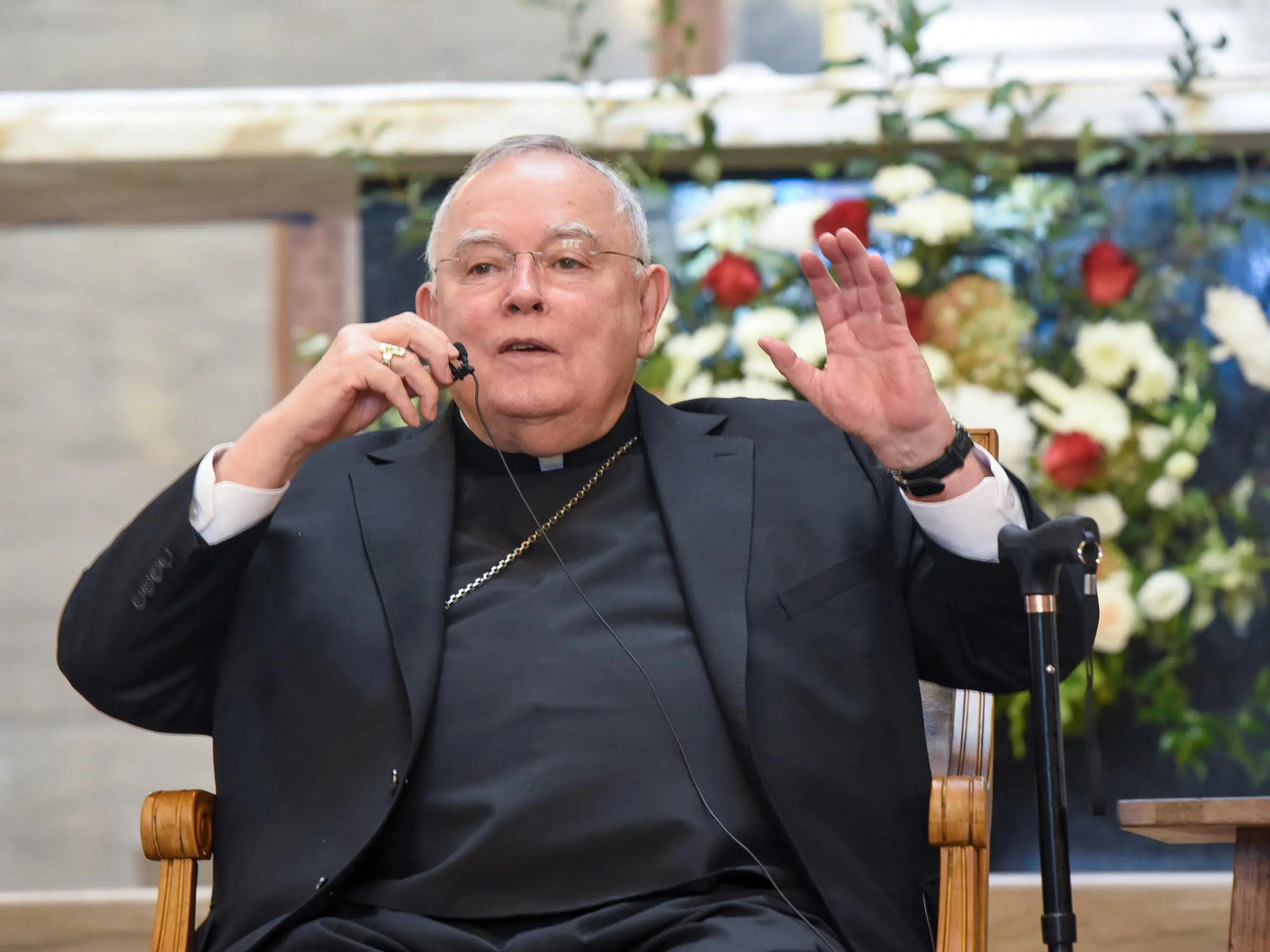
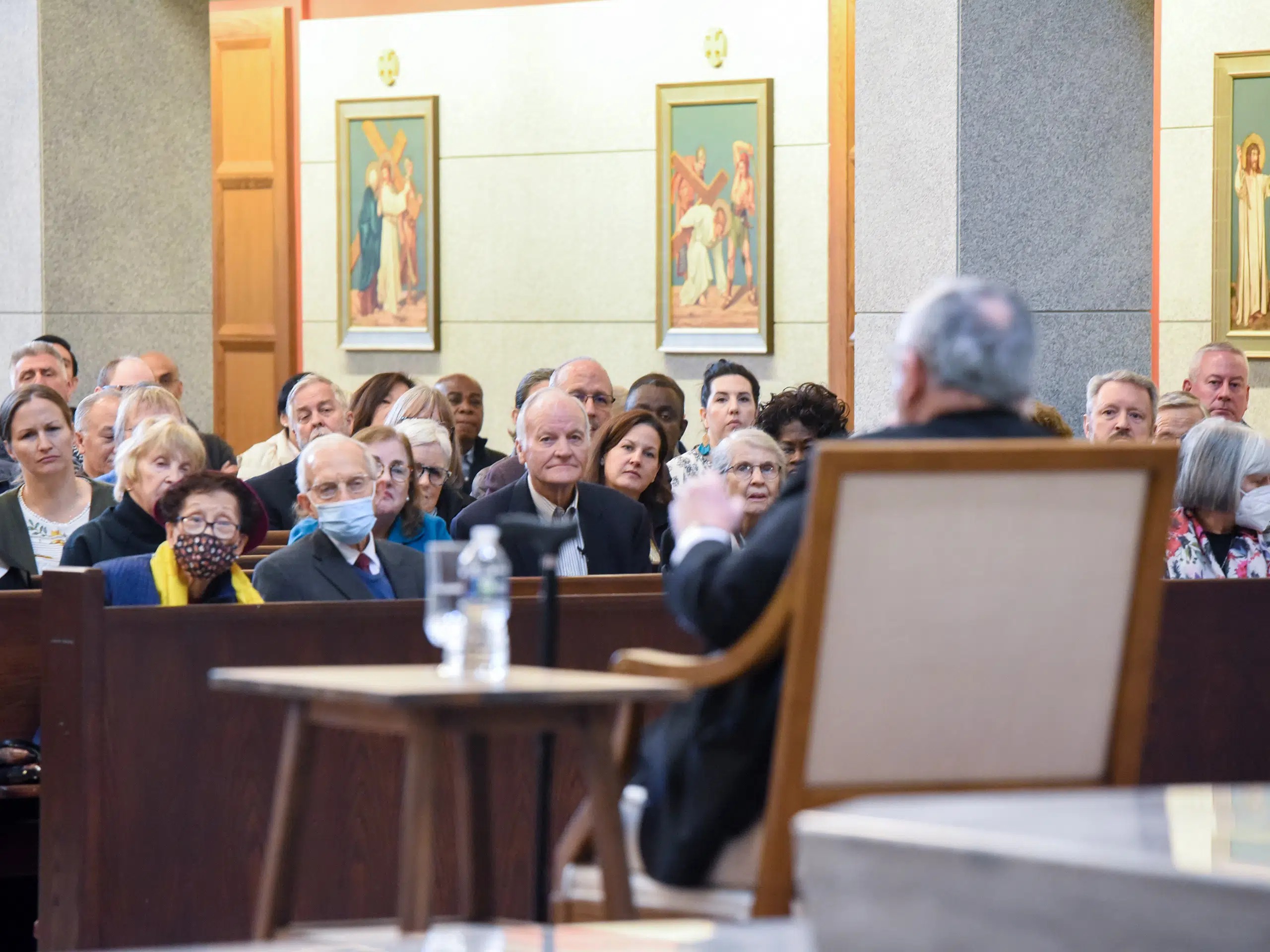
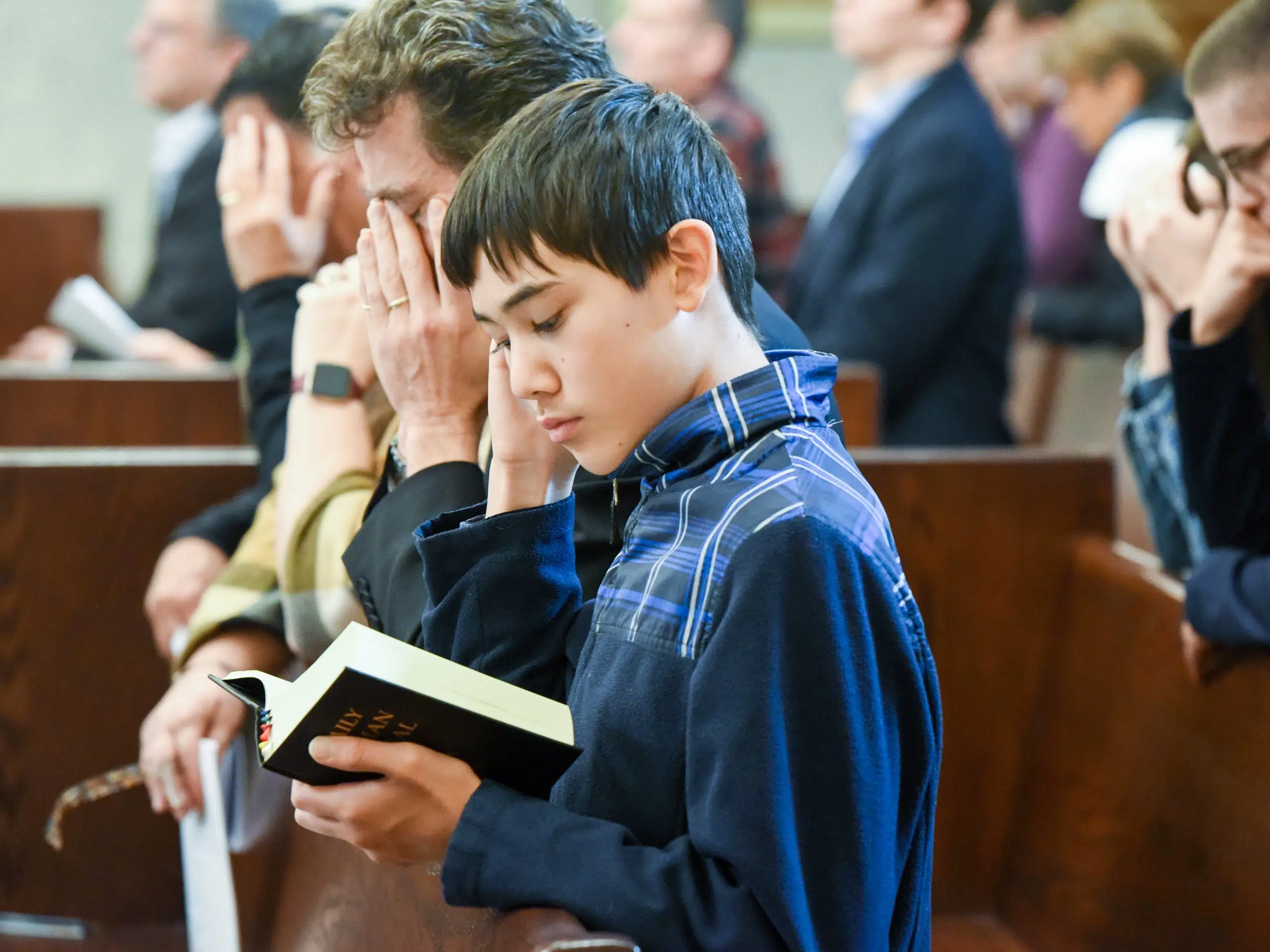
In a world full of distractions, the Eucharist can help Catholics remember who they are as a people of God, said Archbishop Charles J. Chaput, archbishop emeritus of Philadelphia. He delivered remarks to a crowd of nearly 1,000 at the Diocesan Eucharistic Symposium at the Cathedral of St. Thomas More in Arlington Oct. 22. The symposium corresponds to the theme for Year One of the Diocesan Golden Jubilee — “Remember,” taken from Christ’s words at the Last Supper, “Do this in remembrance of me.”
The morning began with Mass celebrated by Archbishop Chaput, Bishop Michael F. Burbidge and other diocesan clergy. Archbishop Chaput then gave a reflection, followed by a Q&A period. The symposium ended with adoration and benediction. The Office of Youth, Campus and Young Adult ministries provided complimentary child care for nearly two dozen kids.
Archbishop Chaput, a Native American, was born in 1944 and grew up in Kansas. He is a Capuchin friar. He previously was bishop of Rapid City, S.D., and Archbishop of Denver.
In his homily, Archbishop Chaput said that Catholics should not only profess a belief in the real presence of Christ in the Eucharist, but in the real sacrifice of the Mass and in its nourishing power. “When we celebrate Mass together, Jesus is present among us at the altar, offering himself — body and soul, humanity and divinity — to the father as he did on Calvary. You and I are invited to have the privilege of offering ourselves with him,” he said. “As a part of this, we’re enabled to be part of the self-giving of Jesus.”
In the Q&A, he said that believing in the real presence flows from believing in Jesus. “No one believes that the Eucharist is really Jesus Christ because we told them so,” he said . “I don’t believe that because the nuns told me that in grade school, I believe because Jesus tells me so. And unless you believe in Jesus, you’re not going to believe that something that looks like bread or looks like wine is truly his body and his blood.
“If you teach that to kids at catechism and they go home to their families who don’t go to Mass, how long will they believe that?” he said. “It’s all about getting back to a real relationship with the Lord as individuals and as a community.”
In his reflection on the phrase “Do this in remembrance of me,” Archbishop Chaput spoke about the importance of memory, the place of memory in American culture, and the role of the Eucharist in reminding humans who God is and who they are.
The ability to remember is vital, said Archbishop Chaput. “When we forget the past, we steal something precious from our own humanity, because the past created and informs the present,” he said. “When we forget the past, we sooner or later forget who we really are.”
But forgetting is tempting. “We live in a country that instinctively dislikes the past. The real past comes with obligations,” he said. “Remembering too much and too clearly can be a downer. It’s a millstone around our vanities in the present and our ambitions for the future.”
The current American culture also makes reasoning difficult, he said. “Reasoning requires time, it demands a reverence for the lessons of history, for the genealogy of ideas and the testing and comparison of arguments against learned truths,” said Archbishop Chaput. “But the America we have today is a culture built upon marketing. Marketing appeals to our immediate appetites, it locks us in the present. It depends on suppressing our critical thought and any memories that might feed it, because people who think clearly and remember carefully may not buy their product or believe the sales pitch.”
Americans are inundated with commercials and it’s altering our mindsets, said Archbishop Chaput. “It amounts to a university education in greed, self-absorption and impossible expectations that end in anxiety and resentment,” he said. Some industries, such as gambling, use knowledge from the behavioral sciences to create dependency by design, he said.
“In the name of serving consumers, we’ve permanently addicted consumers to a river of new goods and services,” said Archbishop Chaput. “Now we have millions of people who live artificially restless and dissatisfied lives and our economy depends on keeping them that way. We don’t allow ourselves to think through the logic of our own economic machinery because we don’t want to deal with the burdens of reforming the way we live.”
Catholics, too, are participants in this culture. “We fit in but in the process, we’ve been digested and bleached out by the culture rather than becoming a leavening in a fertile way with a distinctive Catholic witness,” he said. “President Biden’s apostasy on the abortion issue is only the most repugnant example. When you freely break communion with the church of Jesus Christ and her teaching, you can’t pretend to be in communion when it’s convenient. That’s a form of lying.”
This materialistic state of mind can keep us from the sacred, said Archbishop Chaput. “The same Jesus Christ is alive among us right now in every celebration of the Mass, in our tabernacles and in our adoration chapels. Many Catholics no longer really believe that,” he said. “So many of us live so much of our lives in a kind of half-conscious, narcoleptic haze of distraction, anxieties and anesthetics. The supernatural and miraculous seem remote and impractical.”
The solution is a real encounter with Christ. “There’s an antidote to that narcolepsy, and it begins by simply reading from the first verse in Matthew to the last verse in Revelation. It’s impossible to read the word of God without encountering God’s presence,” he said. “Every conscious, personal encounter with the sacred lifts us up out of ourselves into the transcendent beauty of God’s creation, and that’s why a materialist culture based on relentless commerce works so hard to choke us with distractions and noise and to drag us back down to the horizontal world.”
Remembering God’s presence in the world and giving thanks for his many gifts is a revolutionary act, he said. “As Joshua said to the tribes of Israel so long ago, we need to choose this day which God we will serve,” he said. “If we remember who we are as a believing people and choose well, then we and those we love and the wider world we’re called to sanctify will be the better for it.”