Kirsten Obadal had struggled for years with a mental health condition but could not find a community of other Catholics facing similar challenges. One day in prayer, she felt called to start a support group of her own. She then founded Saint Labre Community, a Catholic support group that provides community and supportive prayer. With the help of Father Edward C. Hathaway, rector of the Basilica of St. Mary in Alexandria, Obadal organized the first Day of Prayer for Mental Health at the basilica in 2018.
With the support of Bishop Michael F. Burbidge and Father Jamie R. Workman, diocesan vicar general, the Day of Prayer for Mental Health became an annual event in the diocese.
“Every day I learn something new about how the faith leads me to the fullness of life, and isn’t that really what mental health recovery is: finding the fullness of life and relating to God in others and getting beyond the pain that we have?” Obadal asked.
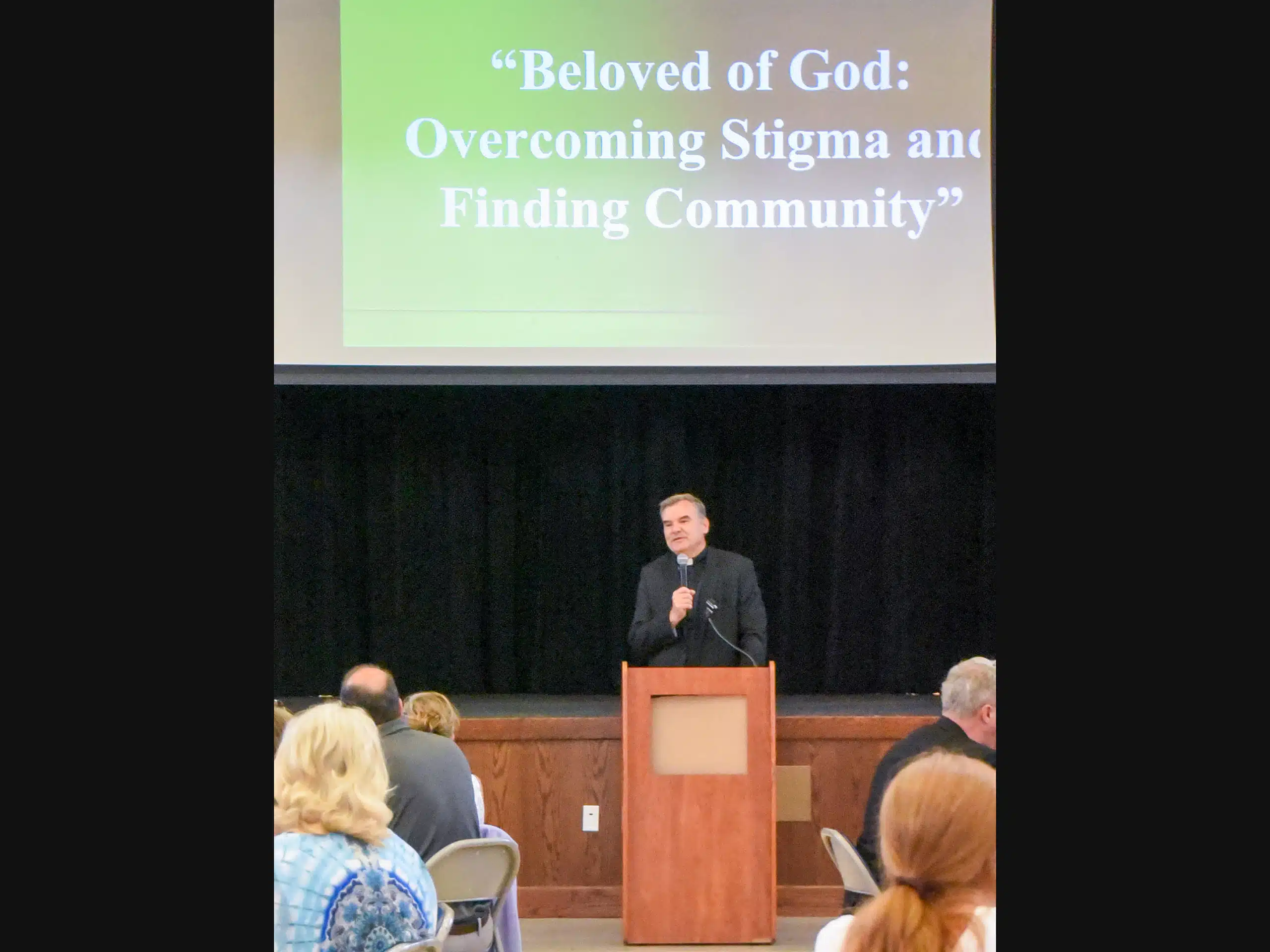
This year, the theme was “Beloved of God: Overcoming Stigma and Finding Community,” held at All Saints Catholic Church in Manassas. The event was cosponsored by Divine Mercy University in Sterling.
Bishop Burbidge celebrated Mass and in his homily, he highlighted the need for both faith in God’s healing and trust in medical and mental health professionals.
“Our faith is rooted in the understanding that the Lord will respond to our request in many ways, including through the special people he puts into our lives to encourage and support us. This includes the professionals, many of whom are here today, who have the skills and abilities to assist us in dealing with our mental health issues,” he said. “Remember: they are the Lord’s instruments, his gift to us, in and through whom he continues to work miracles.”
Following Mass, Legionaries of Christ Father Charles Sikorsky, president of Divine Mercy University, spoke on treating mental illness from a Catholic perspective.
The rate of mental illness in the United States has dramatically increased since the COVID-19 pandemic, Father Sikorsky began. As many seek treatment for mental illness, 60-70 percent of patients want to talk about their faith, moral values and existential questions, he said. Only 20-30 percent of therapists are willing to do this, partly due to lack of education or a discomfort with addressing religious beliefs, he said.
Secular culture deems religion unimportant or even harmful for healing mental illness, Father Sikorsky said, but research shows the opposite. “The growing amount of research over the last 40 years shows how beneficial it is to do just that: to integrate faith, to integrate virtue,” he said.
The Catholic response to the modern mental health crisis should be rooted in both compassion and church teaching, Father Sikorsky said. The Catholic belief of the human person as a unity of body, mind and soul is something that secular culture lacks and does not bring to professional treatment, he added.
He warned against the temptation to over-spiritualize psychological problems. “Sometimes people say, ‘You just need to pray more. You just need to grow in your faith, and you’ll get over your anxiety or depression,’ ” he said. While growing in virtue and receiving the sacraments can help, he added, “There’s a reciprocal relationship here: the confessor is not a physician or healer, and obviously, the professional is not the priest who can provide that spiritual guidance.”
After the talk, participants attended breakout sessions on living with a mental health condition or supporting loved ones with one.
In his breakout session, Deacon Edward R. Shoener from the Diocese of Scranton, Pa., and founder of the Association of Catholic Mental Health Ministers, shared his story of personal loss. After a long battle with bipolar disorder, his daughter Katie died by suicide in 2016. After Katie’s death, Deacon Shoener launched the Katie Foundation, a nonprofit that promotes access to mental health resources. He said he felt called to begin a ministry to help afflicted Catholics.
“I believe the Holy Spirit is working through this ministry to bring hope and healing into the lives of people who live with mental illness and those who care for them. And I’m absolutely certain that Christ wants to be in the midst of all of this, Christ wants to be with us when we suffer,” he said.
Deacon Shoener gave participants information on how to discuss mental illness. He added that to combat the stigma of mental illness, it is important to view it in the same manner as a physical illness or injury.
Dr. Frank Moncher, a psychologist and coordinator for the diocesan victim assistance office, said that the day of prayer is not only intended to promote spiritual support, “but also to provide an opportunity to connect personally with members of our parish communities who struggle at times from what can be quite painful conditions.”
Virginia Patton, a member of the Saint Labre Community, said that while treatment is essential for mental illness, she experienced healing after entering the church in 2017.
“I can honestly say that one of the major sources of my healing and my recovery has just been living the sacramental life, just the day-to-day in union with Christ in the Blessed Sacrament and in the sacrament of reconciliation,” she said. “I’ve tried so many things before being received into the church, and I can honestly say that ‘Mother Church’ has healed me more than anything.”
Find out more
For the Association of Catholic Mental Health Ministers, go to https://catholicmhm.org/
For the Saint Labre Community, go to https://bit.ly/47MdV3X