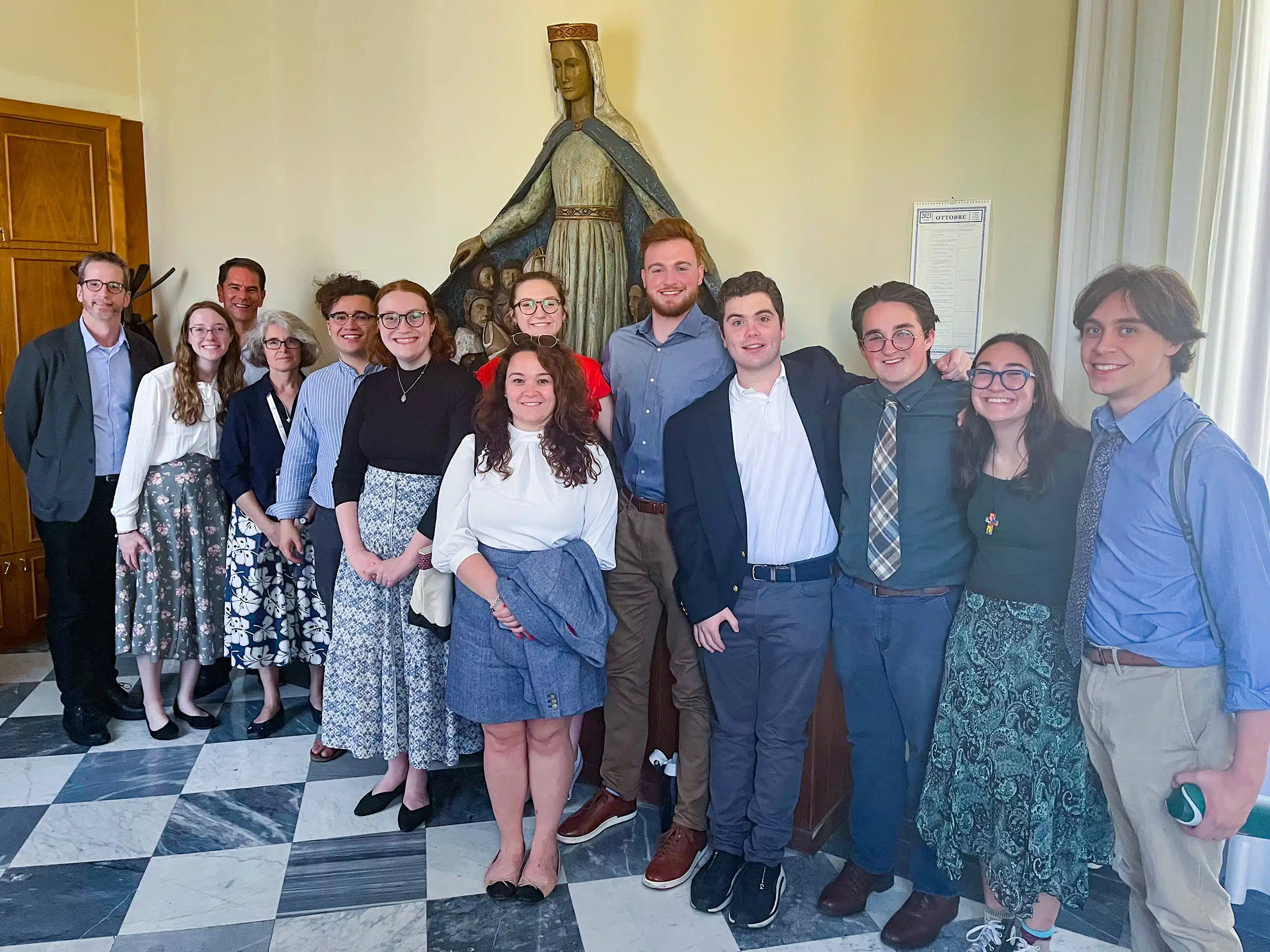
It’s not every day a college student gets to visit a historic synod. But Abigail Adams, a sophomore at Fordham University in New York City, received a rare opportunity to do just that. With four faculty members and 11 classmates, Adams visited Vatican City to meet with members and organizers of the Synod on Synodality Oct. 13-21.
Adams grew up in the Arlington diocese and attended the Basilica School of St. Mary in Alexandria and Oakcrest School in Vienna before heading to Fordham, where she studies politics, mathematics and economics.
An active student leader and member of campus ministry, Adams received the opportunity to enroll in a class on synodality. Open to students active in campus ministry and other leadership positions on campus, the class studied recent synods, Pope Francis’ statements on synodality and Catholic news articles on the topic. The highlight of the class was a trip to Rome to speak with synod organizers and members.
“I was nervous, but took this opportunity to educate myself and practice the whole purpose of the synod, which is to hear people with different backgrounds and their experiences,” Adams said.
Pope Francis opened the synod in October 2021 as a multiyear, worldwide process. Dioceses throughout the world were invited to collect feedback from the faithful answering the question, “What steps does the Spirit invite us to take in order to grow in our ‘journeying together?’ ” The synodal process has included local, national and continental stages of discussion. It will conclude in two global assemblies in Vatican City. The first of these assemblies occurred Oct. 4-28, and the second will follow next year.
While synod sessions are closed to foster candid exchanges, Adams said her class met with members of several dicasteries and synod organizers, including Sister Nathalie Becquart, an undersecretary for the General Secretariat of the Synod of Bishops. The group also met Jesuit Father David McCallum, who runs a program “Discerning Leadership” and discusses synodality.
The students practiced “conversations with the Spirit,” a model of communal discernment used in synod sessions. The model was inspired by Ignatian spirituality and involves sharing personal spiritual experiences before discussing solutions to certain issues.
“This could be a path that the institutional church could move forward on, because it really bonded me with those around me. I could really see them for who they were,” Adams said.
Adams said that her visit changed her impression of the church. “We would be wandering around in our spare time and pass cardinals, and I had never seen so many religious sisters in my life. It was so wonderful,” Adams said. “It really showed me that it’s a universal church.”
Encountering women and men participating in the synod was inspiring, she added. “These people who are so involved in the synod are such examples to me of humility and really wanted to ask me and the other students so many questions.”
Adams’ experience at the synod helped her reflect on her own journey of faith from childhood to adulthood. Having new conversations with others both at Fordham and the synod, “makes me first of all realize how lucky I am to have grown up in such a wonderful diocese, a wonderful church and a wonderful family.”