More than 600 women throughout the Arlington diocese gathered for spiritual renewal at the diocesan Women’s Conference at St. Joseph Church in Herndon March 9.
Sponsored by the diocesan Office of Marriage, Family and Respect Life, the conference opened with a talk from international speaker Dominican Sister of St. Cecilia Mary Madeline Todd. She reminded the attendees of their goodness as daughters of God.
“All of us have a life story that began with a divine love story. No matter what the circumstances of your coming into this world, no matter what the circumstances of your family life growing up, you wouldn’t be here, we wouldn’t be here (unless) God, the creator of the entire universe … had this unique, beautiful, unrepeatable idea, that he loved so much, he had to make it. And it’s you.”
Sr. Mary Madeline reminded the women, “For God, it’s all about the relationship.” She identified three temptations that distract women from hearing God’s voice in prayer: lies from the devil, human weakness and the secular world. “We need to hear the Father’s voice,” she said.
She encouraged the attendees to seek peace and security in eucharistic adoration. “I think sometimes we’re afraid to let the Lord look at us, but I think it’s one of his favorite things to do,” she said.
Ana Dacosta, a parishioner of St. Lawrence Church in Alexandria, said Sr. Mary Madeline’s advice on discerning God’s voice in prayer resonated with her. “I have trouble listening to God. She told me the difference between evil and God. When God is speaking to you, he encourages you, whereas evil is discouraging,” Dacosta said.
Patricia Sandoval, an international pro-life and chastity speaker, provided her testimonial of repentance and healing after having three abortions, working for Planned Parenthood, and suffering from homelessness and drug abuse.
Growing up in California, Sandoval said her family was culturally Catholic, but did not regularly attend Mass. As a child, she said she would write “love notes” to God the Father, tie them to a balloon, and release them into the sky. “But after I first received Holy Communion, I didn’t hear about God anymore,” she said.
When Sandoval was in sixth grade, Planned Parenthood came to her middle school to teach the students about sex and obtaining abortions if they experienced an unwanted pregnancy. “I remember, when I walked out of that class, I was pro-abortion at age 12.”
Sandoval’s mother left the family in 1992, and the subsequent trauma caused Sandoval to view motherhood as a roadblock to happiness. So, when Sandoval became pregnant at 19, she panicked. While her boyfriend offered to take care of her and the baby, Sandoval said she was swayed by her friends who told her to have an abortion: “You are making the hugest mistake of your life. You’re not ready to be a mom.”
Sandoval went to an abortion facility in California without telling her father or her boyfriend. “I had the abortion, and my heart dies. Every woman who has an abortion — there is something that dies in your heart,” she said.
Sandoval told her boyfriend about the abortion, and they began to suffer from post-abortion stress syndrome that includes depression, PTSD, bouts of anger and promiscuity. “My true problems began after my abortion,” she said.
Sandoval said she became pregnant a second time and secretly had another abortion, this time at Planned Parenthood. From there, her life became worse. “I was bulimic, I was anorexic, I was suicidal,” she said. She became pregnant a third time, and she had a third abortion, despite protests from her boyfriend.
After her third abortion, Sandoval began working at Planned Parenthood as a nurse, despite her lack of professional education and training. As many teen girls came in for abortions, Sandoval said she was forbidden from using words such as baby, mother and fetus “because the word ‘fetus’ gives human dignity.”
Sandoval said that when she was asked to assist an abortionist, she was told, “you cannot tell anyone what goes on behind these doors.” She provided a graphic description of an abortion procedure, which involved severe physical damage to the mother and the heartbreaking disposal of the baby’s remains.
“Working behind the doors of Planned Parenthood is one step before going to hell,” she said. She worked for three weeks at the facility before she ran out one day after meeting a young girl who was six months pregnant with twins: “I couldn’t do it.”
Sandoval began using cocaine and meth to numb the pain of her experiences, and soon became homeless. After three years of drug abuse, one day she broke down crying on a street curb and remembered love notes she used to send God as a child. She repented and returned to her father, who welcomed her into his home. Sandoval reunited with her mother, who had returned to California, returned to Catholicism, and had been praying and fasting for years for Sandoval’s repentance.
Sandoval then addressed mothers in the audience praying for their adult children: “God hears you. Never doubt God; he is faithful. Do you know how special a mother’s prayers are for God?”
Sandoval said that through the sacraments of penance and the Eucharist, her spiritual wounds began to heal. After a post-abortion healing retreat, she said she began to forgive herself for her own abortions. Today, she is married and has two children and is expecting a third.
Following the talks, the women attended Mass, celebrated by Bishop Michael F. Burbidge. In his homily, he reminded the attendees to seek the gift of the sacrament of penance frequently.
“All that Jesus asks from us in return is that we never tire of forgiving one another. It’s not always easy. It can be very difficult to forgive a spouse, a child, a family member, a colleague or a friend who’s hurt us or even betrayed us,” he said.
Only with God’s grace can we forgive betrayal, Bishop Burbidge said. “If you’re finding it difficult to forgive someone, beg the Lord for the strength to do so, to help, and also remember, remember how many times God has forgiven you and allowed you to begin anew.”
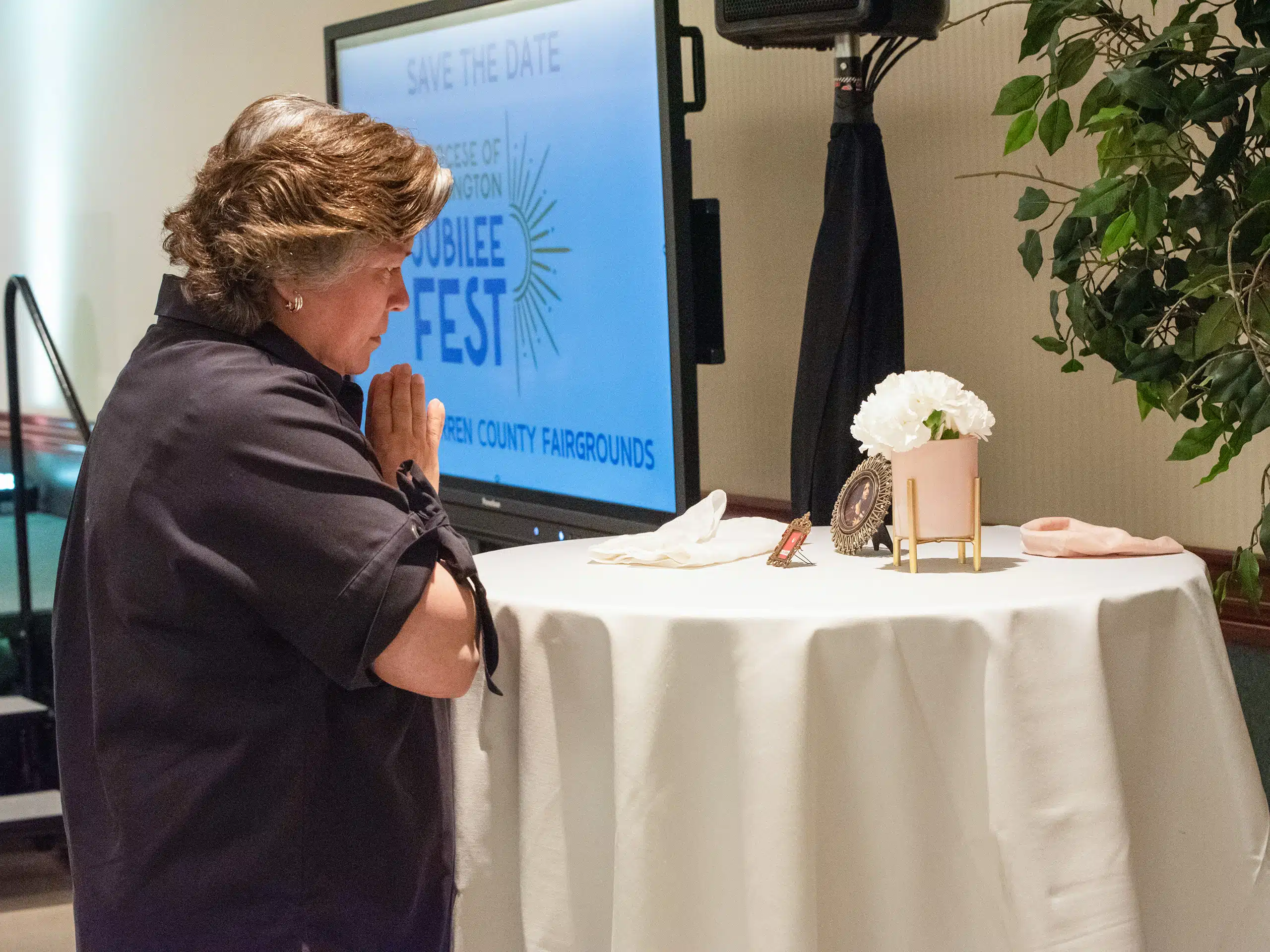
Throughout the day, women lined up to venerate a relic of St. Mary Magdalene. Following Mass, the attendees submitted questions to a panel featuring Bishop Burbidge, Sr. Mary Madeline and Sandoval. Questions ranged from ministering to women after abortion to praying for adult children who have strayed from the faith.
Caitlin McInerny, a parishioner of the Basilica of St. Mary in Alexandria, said the day’s talks gave her hope. “I think it’s important for women in the church, and in the Diocese of Arlington particularly, to have an evangelization mindset, whatever it is that they’re doing, whether it’s being in the workplace, raising kids. Bringing Christ’s light to whatever it is that you’re called to be is the most important thing.”