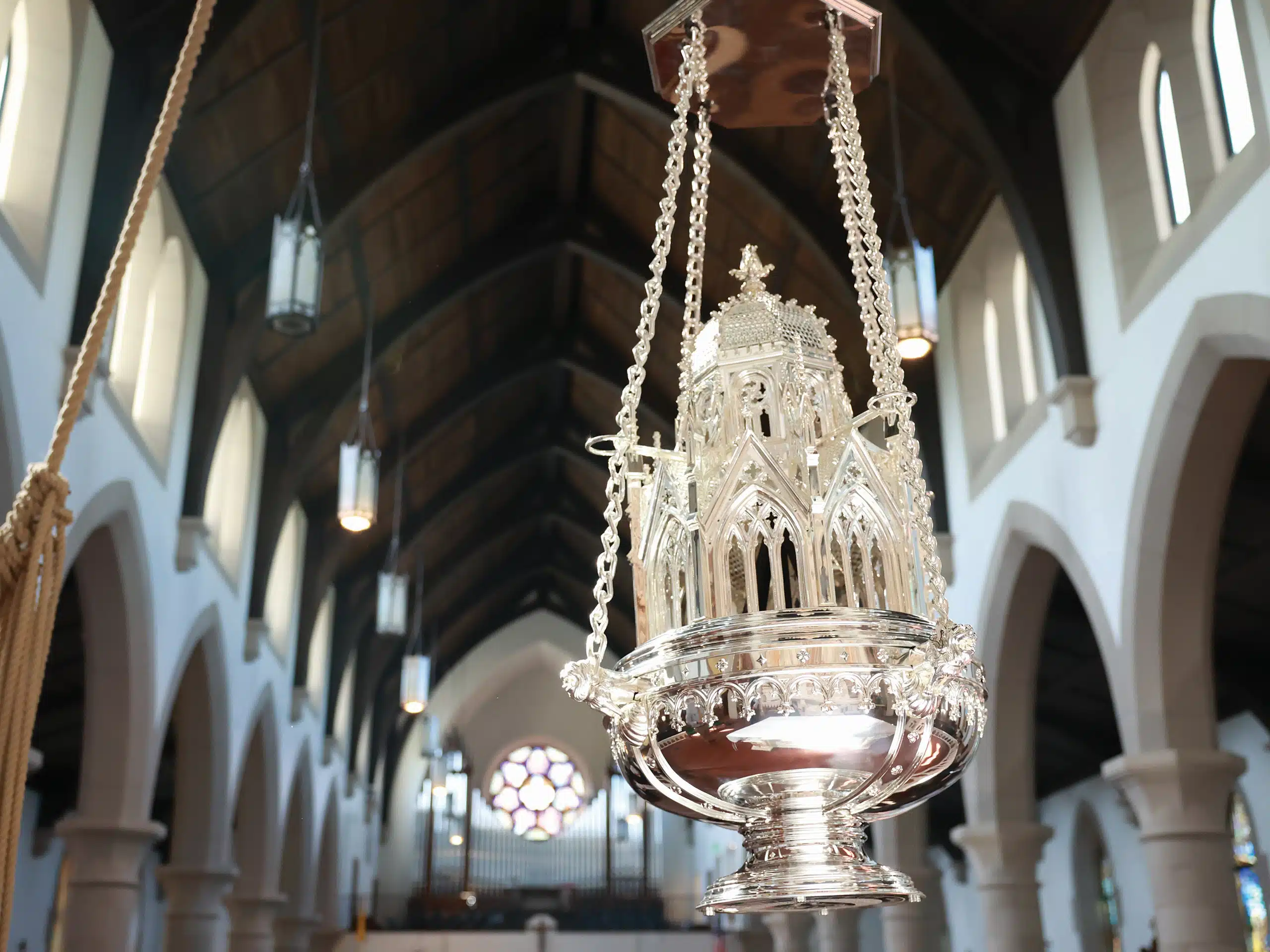
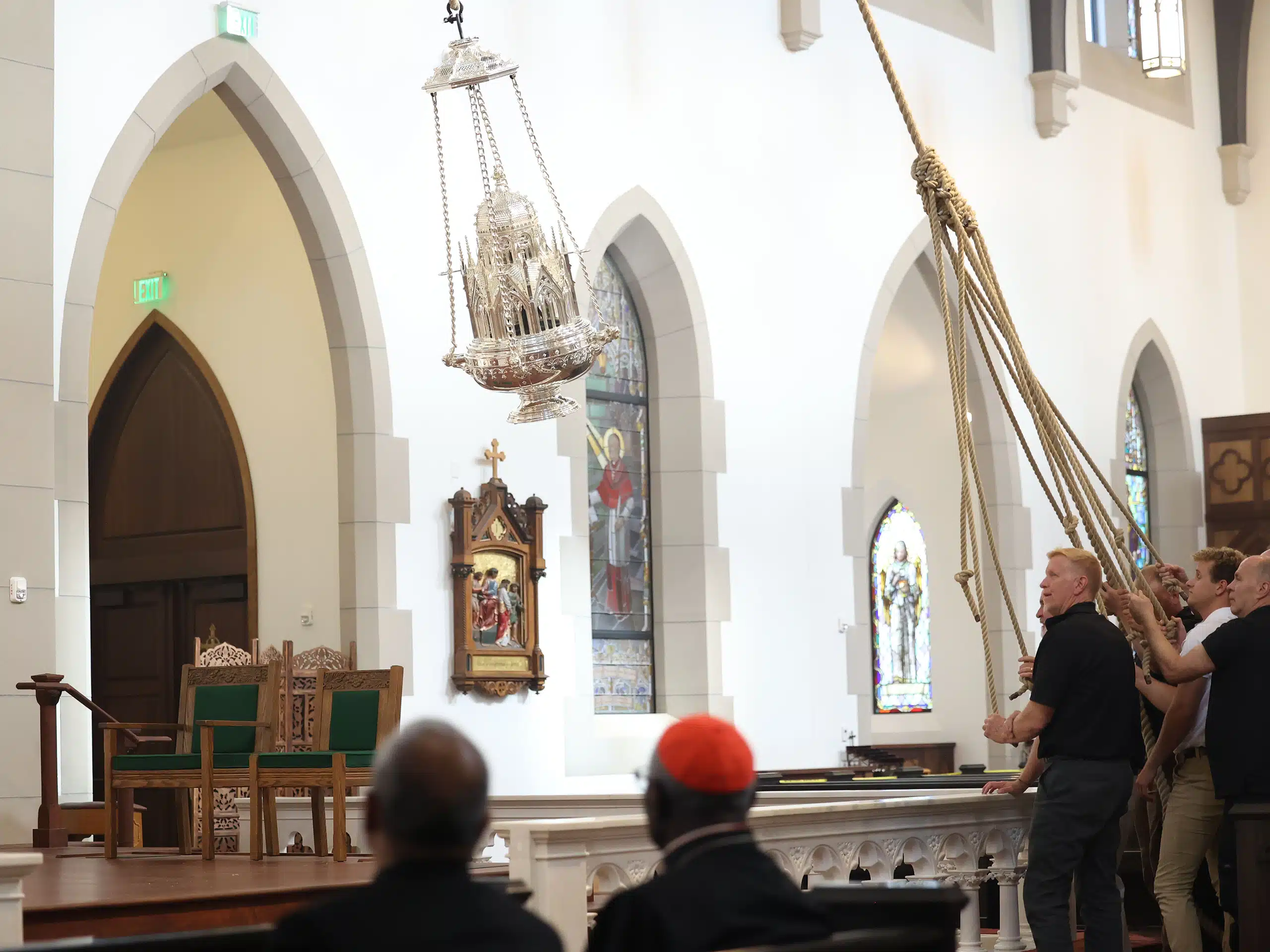
Christendom College unveiled its new “botafumeiro” June 15 weekend as part of the college’s Summer Consortium event. The botafumeiro — a large, silver-plated brass thurible, or censer — is a distinctive feature of the college’s new Christ the King Chapel and it will be swung on special liturgical occasions.
The botafumeiro is the result of years of work by skilled artisans, who sought to create a worthy companion to the famed botafumeiro that has swung in the Cathedral of Santiago de Compostela in Spain for centuries. The historic practice at Santiago de Compostela of reverencing Christ the King with such beauty and grandeur inspired the Christendom community to create a botafumeiro of their own, while also tying back to the college’s Spanish roots.
Before Christendom College began, college founder Warren H. Carroll led summer institutes in Spain, where many of the college’s future professors and benefactors were first connected.
The college’s botafumeiro shares some common traits with its Spanish inspiration, including a large brass basin sitting on a pedestal or “foot” that will contain the charcoal and incense. Above the bowl rests a unique, eight-sided lid presenting as a Gothic-styled architectural cupola. Four structural chains are attached to gargoyle lion heads around the bowl, passing through standoff loops at the lid and terminating several feet above at an ornamental cap piece affectionately called a sombrero. A welded steel frame inside the bowl and the cap provides the necessary structural support to withstand the gravitational forces that triple the thurible’s 180 pounds when weighed at full swing. All the intricate details over the surface were hand-chased or embossed, including various arches, trefoils and tiled roofing. The base of the foot, only viewable from below, is engraved with the college seal. The entire structure was finished by plating in a silver bath.
Heritage Liturgical, led by Enzo Selvaggi, created the design of the botafumeiro, with renowned silversmith Emilio Leon executing the design finalized by Selvaggi and the Christendom team. While the original design more closely resembled the Santiago censer, a far more ambitious, and larger, Gothic-styled design was proposed later, resulting in the finished product.
The support, rigging, and specialized pulley system necessary to make the botafumeiro swing was a complicated process, with John Stevenson of Morrison Engineers providing system and loading support design, while Jason Davis, a former Disney Imagineer, managed the design and fabrication of the
specialized pulley system. Local steel fabricator Albert Andersen of Greenway Welding produced the steel a-frame structure that holds a two-ton chain hoist located at the top of the crossing tower.
The botafumeiro was shipped from Spain and arrived on campus in February after nearly two years of work. In April, the college conducted extensive testing using the botafumeiro and all pieces worked as designed. A guild of students has been formed for the purpose of swinging the thurible, and a group of seniors was able to assist in the testing.
The botafumeiro will be used on special occasions, tied in with vespers and other liturgical functions, though not during Mass. When swung, the piece will be used to offer to God a holy incense and bring to mind the words of Revelation 8:3-4: “And another angel came and stood before the altar, having a golden censer; and there was given to him much incense, that he might offer it with the prayers of all the saints upon the golden altar which is before the throne. And with the prayers of the saints, there went up before God from the angel’s hand the smoke of the incense.”
When not being used, the botafumeiro can be viewed in the chapel.