Imagine a famous modern artist who never created art on any Christian theme in his long career. Add to that, the artist does not create paintings that tell stories and avoids any theme that evokes violence. He is best known for his paintings in brilliant splashes of contrasting color celebrating music, flowers and carefree young women.
And yet: Henri Matisse, in his last years, created a beautiful chapel in southern France dedicated to Holy Rosary, in which every inch from the blue, yellow and green stained glass windows, to the altar he chose to be made of stone the color of bread, down to the vestments, is designed by him.
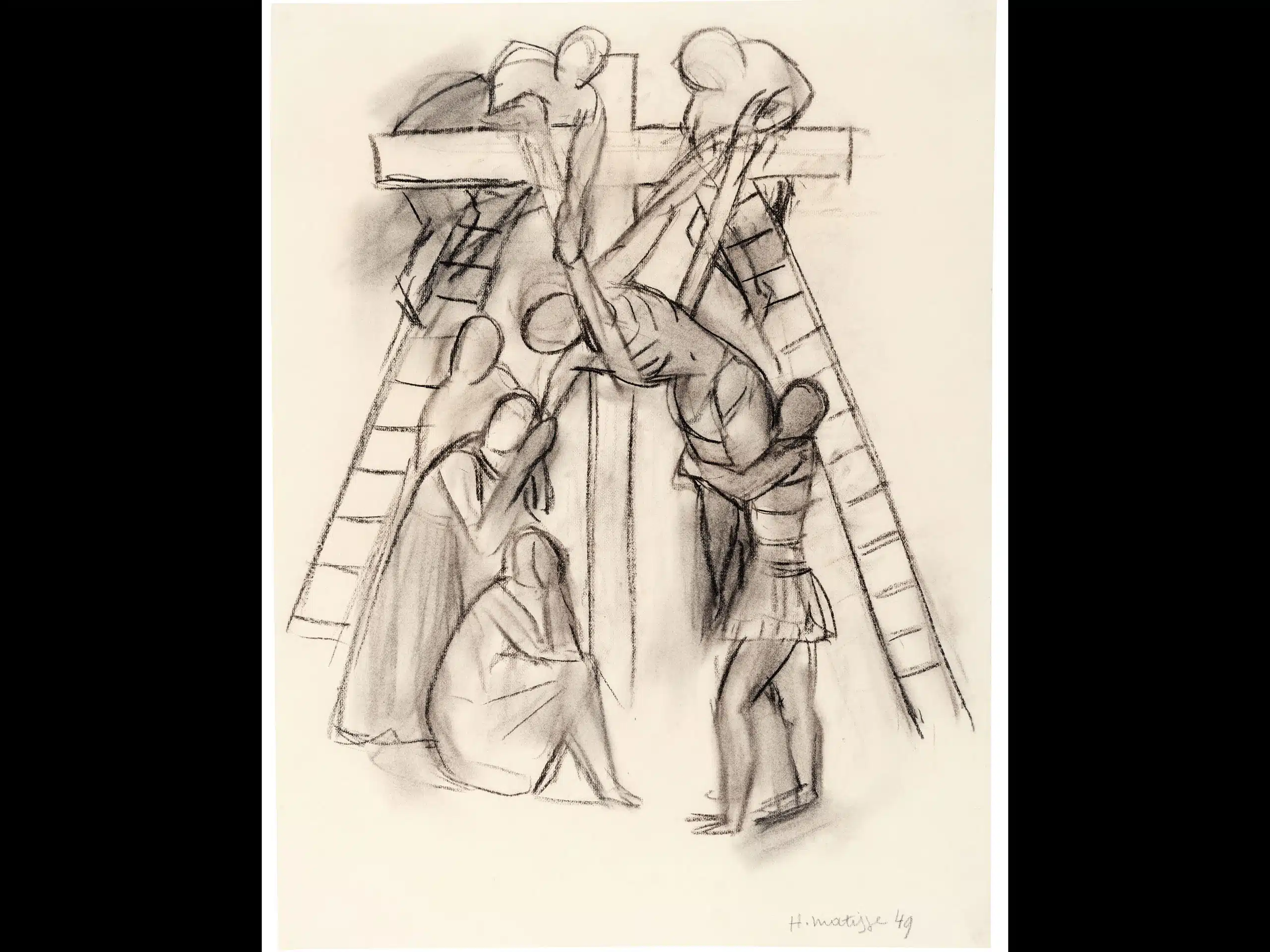
The chapel is at Vence, a town near Nice, where Henri Matisse worked on it during his declining years from 1947 to 1951. (He died in 1954 but was bedridden and unable to attend the dedication ceremony.) The Baltimore Museum of Art is hosting a loan exhibition of Matisse’s drawings preparatory for the Stations of the Cross. Although the BMA owns more Matisse works than any other museum in the world, the stations drawings were bequeathed to the chapel at Vence. Most of them have never left France and many have never been exhibited anywhere.
What you will learn at the exhibit is how the artist dug deeply into the entire tradition of European Catholic art for each image. Then, in a series of progressive modifications, often involving live models who came to pose — sometimes in very painful positions — Matisse transformed these narrative images into a final, sharply abbreviated form.
How did this project come about? In 1941 wartime France, the artist was hospitalized for a major operation from which he barely survived. During his recovery in 1942, Matisse was nursed by a young woman Monique Bourgeois, who subsequently became a novice in the Dominican Order and ultimately a nun as Sister Jacques-Marie. They met again in the village of Vence where Sister Jacques-Marie worked at a Dominican convalescent home. The nun had dreams of turning the garage where the nuns had Mass into a chapel. When she showed Matisse her drawings, the artist seized on the project and made it the culminating work of his artistic life.
There are three black-and-white ceramic walls in the chapel. One has a towering figure of St. Dominic, to whom the Virgin Mary first gave the rosary. Another is the Virgin and Child. The third, which the churchgoer only sees on the way out of the chapel, displays the 14 Stations of the Cross, arranged in a serpentine pattern from the lower right corner and each identified by an Arabic number.
Of course, such an arrangement runs completely contrary to a 200-year-old tradition of stopping to contemplate each station with an appropriate prayer. This had arisen for Christians who could not make the journey to Jerusalem to follow in the footsteps of Jesus. Around the beginning of the 19th century, Western churches started to have the stations spaced along their walls, as they still are today. But in earlier times — starting in the 1400s — Christ’s journey to Calvary had often been represented in a single painting with many individual moments depicted.
Matisse resorted to a process that had no precedent, as recounted by Father Albert-Marie Avril, who supervised the two young Dominican priests who collaborated with Matisse on the project. “First, he had someone read a meditation on each of the stations. Then he invited a young man to serve as his model, asking him to strike the pose suggested by the text. He then had him change his pose according to his instructions, and pencil in hand, explored the meaning of each scene in greater depth. Afterward, he worked on them tirelessly on his own,” Father Avril is quoted in the exhibition catalog.
Matisse often began each station by copying a famous composition by European Renaissance artists. A particularly poignant example is the drawing he made based on a fresco from the life of St. James, painted by Renaissance artist Andrea Mantegna at the Eremitani church in Padua.
Matisse felt the Mantegna composition evoked Pontius Pilate enthroned on high condemning Jesus to death. He had been deeply impressed by the painting on a visit in the early 1930s. Ironically, the fresco was blown to smithereens by a bomb during World War II. In the Baltimore exhibit, viewers can follow Matisse’s creative process from the Mantegna original all the way to the starkly simplified final image.
The Stations of the Cross by Matisse is on view at the Baltimore Museum of Art until June 28.
Hamerman is a freelancer from Reston.