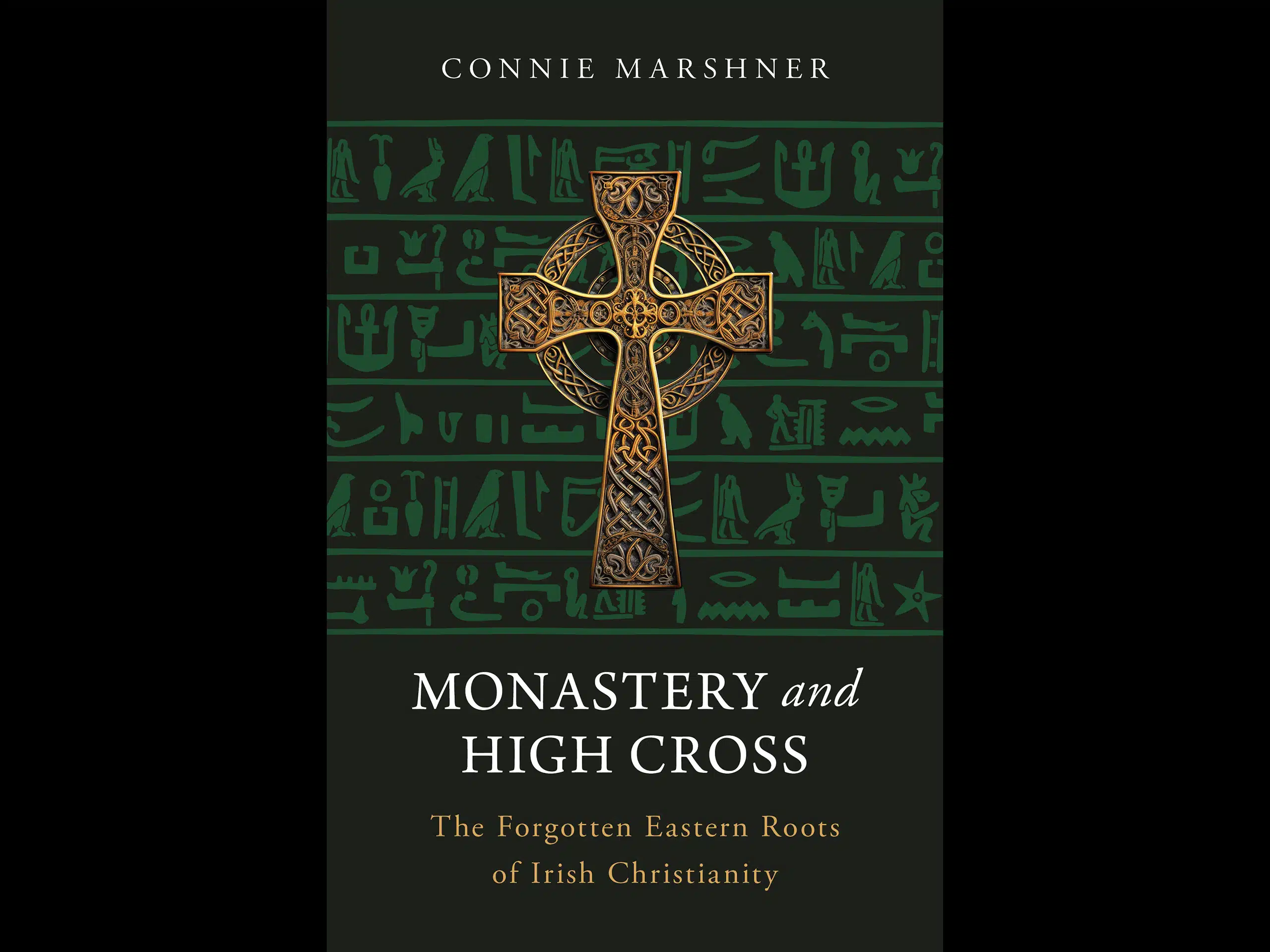

“Monastery and High Cross: The Forgotten Eastern Roots of Irish Christianity” (Sophia Institute Press, 2024)
Author: Connie Marshner, a parishioner of Sts. Joachim and Anna Ukrainian Catholic Church in Front Royal, who considers Holy Transfiguration Melkite Greek Catholic Church in McLean her home parish. She serves on the Institute of Catholic Culture board of directors and was previously executive director of the Susan B. Anthony List. Read more about her at conniemarshner.com.
Why did you write this book? In the 1990s, there was a mini fad of “Celtic spirituality” articles and books. In that appeared some translations of ancient Irish hymns and prayers. Reading them I heard an echo of the Eastern church — of antiphons or hymns that I had heard in my decades at Holy Transfiguration. It wasn’t until the COVID-19 era, when I enrolled in an online master’s in Gaelic literature at University College Cork, that I was able to follow the echo. I discovered that there was a long history of scholars recognizing Eastern elements in the early Irish church, and I was able to follow footnotes that went back more than a hundred years.
Synopsis: In essence, this work is a summary, a meta-analysis if you will, of the work of many, many other studies in history, archaeology, art, literature, liturgy, and ecclesiology. Ireland’s golden age was in the time of late antiquity. Ireland had never been invaded by Rome, so Gaelic culture developed independently of continental Europe — as did Gaelic Christianity for centuries. Art, archaeology, and surviving literature give evidence that the church in Ireland had links with the ancient apostolic see of Alexandria (Egypt), and was conversant with Constantinople, while being in union with Rome all the while. There is even evidence that Egyptian monks were in Ireland before St. Patrick.
What’s something else the average Catholic in the pew should know about it? The average Catholic probably does not realize what a high culture there was in Gaelic Ireland for centuries before the Norman Invasion of 1179 — nor how the faith in Ireland preserved so much of the passion of the apostolic church in those early centuries — such as, for instance, a hymn to the Virgin Mary centuries before any were written in Europe.