

“Why a Catholic paper?”
Those words appeared on the pages of the first issue of the Catholic Herald in 1976 in a column by Charles W. Carruth, its original editor, may he rest in peace.
Carruth’s question endures today for different reasons.
Times change, and then they don’t. In 1976, gasoline was $0.59 a gallon, milk was $1.65 a gallon and a brand-new Honda Civic cost $2,729. The Herald had one platform (print) and now has eight, including a website and weekly e-newsletter. The number of registered Catholics in the Arlington diocese has nearly tripled to 432,700. Print publications, diocesan and secular alike, have shuttered left and right.
Yet, many of the same Catholic topics covered in those early issues of the Herald remain all the more relevant today, even if we no longer ask parishes, schools and readers to submit news articles through the mail “typed, double spaced, on 8½ by 11 paper on one side only, with an inch-and-a-half margin on the left-hand side and at the top and a one-inch margin on the right and at the bottom.” We published those words Jan. 22, 1976.
“Many Christian values are under attack in the secular media,” Bishop Thomas J. Welsh wrote in the Herald’s inaugural issue. “They are often ignored in public school classrooms and in other public forums to which millions of Catholics are exposed. Indeed we are subjected with regularity to influences opposed to these values.”
Sound familiar?
Reading the early issues, such commentary, along with parochial school news, family topics, pro-life advocacy and the timeless wisdom of the Gospel are common and echo today 50 years later on the pages of the Herald, whether you read it in print or online.
Which brings us to the modern-day iteration of Carruth’s question: Why a Catholic paper in the digital age?
For starters, people are busier and juggling more demands than ever. Office workers spend many waking hours looking at a screen. In a contrarian sense, the proliferation of various obligations, digital media, endless email, you name it, makes the presence of a print publication different and refreshing. At those precious few moments when you can take a breath, it’s there, waiting to boost your Catholic faith in some unexpected way. You pass it along to someone else in your household, and that’s evangelization. While that also takes place with digital media (perhaps sometimes more than we’d like on certain topics), with print, it’s just different. That’s why parishes still print weekly bulletins. Parishioners read them.
Occasionally, we hear from readers who want to read the Herald only online. We respect that, and work to make our website and weekly e-newsletter good reader experiences. (They have also won awards in the Catholic Media Association’s national competition.) Yet, the overwhelming majority of Herald subscribers stick with the print edition. They contact us with story ideas or to say they’ve moved and “here’s the new address.”
A few years ago, researchers with the Interdisciplinary Reading Research Structure of the University of Valencia in Spain set out to evaluate the difference in reading comprehension between printed versus digital media on a screen. They reviewed dozens of studies on the topic from the years 2020-22 and concluded that students who read books on paper had comprehension rates six to eight times higher than peers reading on digital screens. When I tell that to people, they nod. It’s intuitive.
The Arlington diocese can be a transient area with people moving in and out. Anecdotally, we hear from well-traveled Catholics and lifelong Virginians alike who express their appreciation for the Herald. We hear constructive criticisms, too, and we listen objectively.
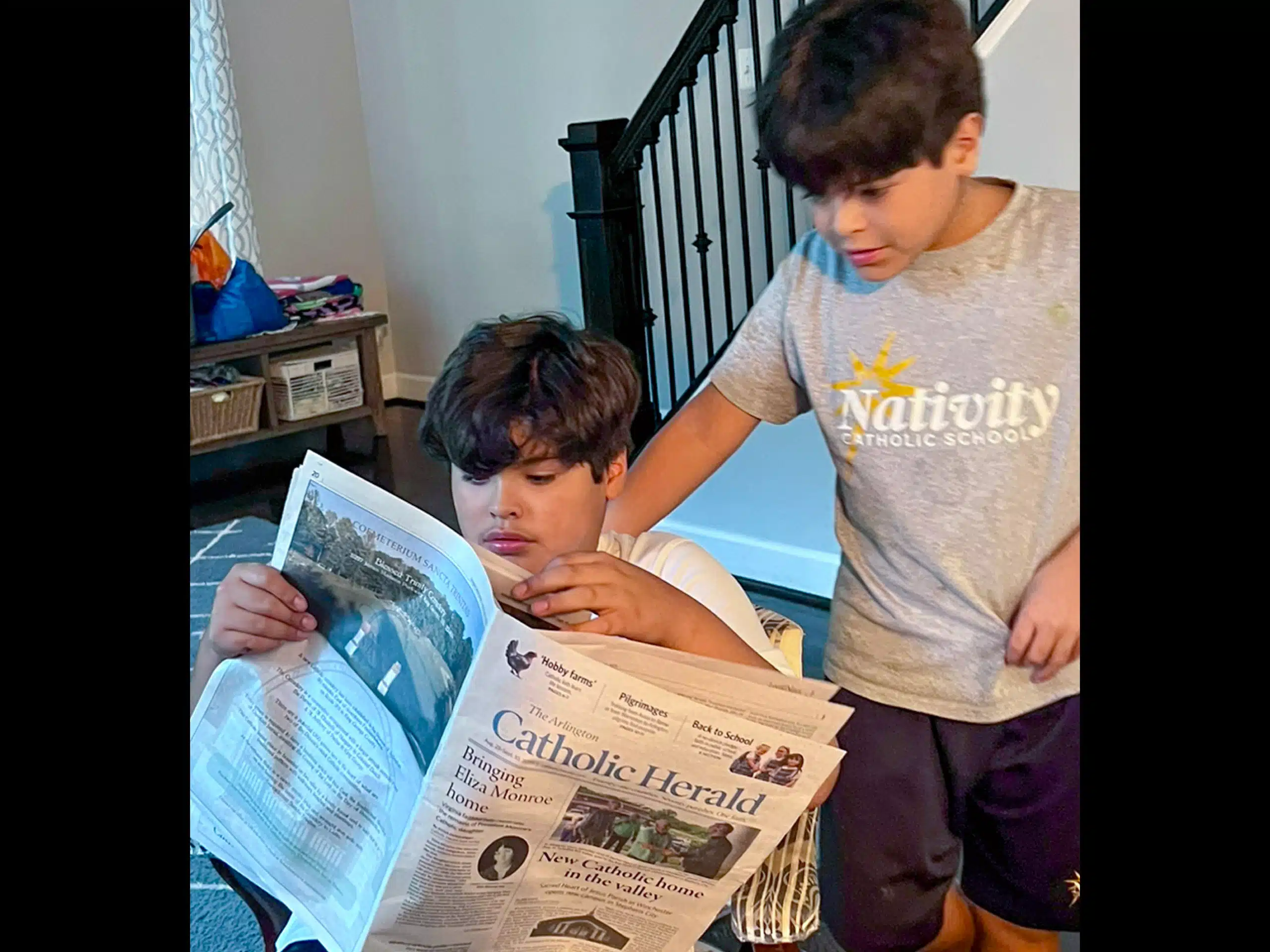
Dr. Marcella Villa, a parishioner of Nativity Catholic Church in Burke, recently sent us an email titled, “A family moment inspired by the Herald.” Attached to it was a picture of her two sons, Santiago and Nicholas, huddled over a copy of the Herald.
“It was such a beautiful moment of them connecting through uplifting news about our faith,” Villa wrote. “Thank you for the gift of your work and for providing families like ours with stories that inspire and encourage us.”
Thank you, Marcella, and thanks to every other reader. We hope you’ll stay with us for the next 50 years.
Schweers can be reached at [email protected].


Made for communion