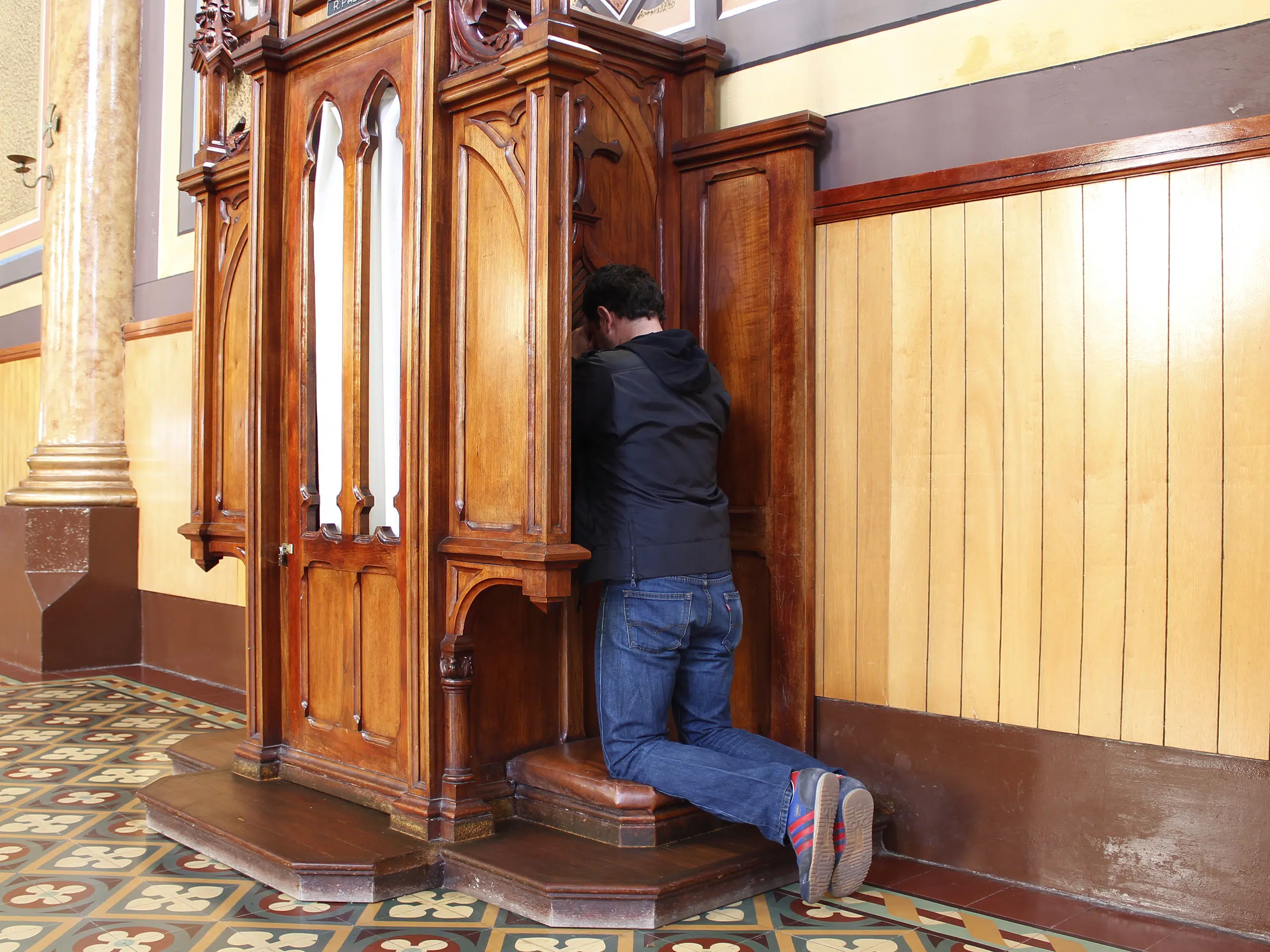
Stop me if this sounds familiar. You go to confession regularly. You confess basically the same sins every time. Nothing serious, just your “regular rotation” of garden variety vices. You generally, at the time, intend to stop. But there’s a part of you that wonders what you would confess if you jettisoned them. So, you continue to do them, and then confess them. Lather, rinse, repeat.
And then you wonder why you aren’t growing in holiness.
How do I know this happens? Because it happens to me. Because it is me. The whole thing. The same sins, the feeling stagnant in spiritual growth. Just stuck, stuck, stuck.
But, this Lent, I’m very much hoping to finally get unstuck.
I have almost accidentally tripped over the tool that is going to help me. (But we all know that, in the spiritual life, there are not accidents.) Because I had eight jillion Audible credits, I saw no reason to continue paying $15 a month to accumulate still more. So, I went on an Audible buying binge, ordering every title I thought seemed remotely interesting, so that I could use up all my credits and discontinue the membership.
When it came time to listen to my newfound audio library, the first book I went to was “Little Sins Mean a Lot,” by Elizabeth Scalia. I was spellbound — so much so that, as soon as I finished the audio book, I ordered the paperback so that I could work through it more slowly.
To put it bluntly, she showed me a whole lot more sins, a lot more areas of my life that I frankly never really thought to work on — or to confess — but that could definitely stand some attention.
Not that confession — or even the idea of sin — is necessary to benefit from this book. Anybody who is interested in self-improvement will get a lot out of it.
It didn’t take long to realize that, in this book, she was talking directly to me. The very first chapter was about procrastination. The example she used from her own life was her delay in beginning work on the book, and the impact that most likely had on her editors.
Just ask my editors how “timely” my monthly column submissions are.
Here’s the thing: with something like procrastination, we don’t generally think “that’s a sin.” We think “that’s just how I am. I procrastinate. I don’t start things until the last minute. It’s not really hurting anybody, is it?”
Of course, in procrastination we frequently hurt ourselves. We don’t do things that we ought to do, things that could make our lives better. But we also hurt others. How many people, at any given time, are waiting for something from you? An answer, a commitment, a response to an email or a text or a phone call? How many people’s plans have you held up with your procrastination? We hurt them by not doing things that could make their lives better, or simply by inconveniencing them.
Likewise with the other 12 “little sins” Scalia lists. In excessive self-interest, we focus — and force others to focus — only on us, to the exclusion of their lives, their interests and their struggles. On the other hand, when we neglect ourselves, we force others to look at (and smell) our same neglected selves. Plus, we dishonor the image and likeness of God in ourselves. When we decide that we constantly need to “treat ourselves,” we excuse ourselves from our obligations to others, and we diminish the joy in the no-longer-rare treat itself. And, of course, submitting others to our perennial gloom or spite or passive-aggressiveness is just downright unpleasant.
And so, it goes on.
The other one that I felt really hit me where I live is “phoning it in.” This is where we do our work, but we do it halfway. We don’t really give it our best effort. We do it just to get it done. Wow, how many times have I done this? And how has my half-done work impacted others. Even in the simplest tasks, the ones we think matter to no one but us, the kind of job we do matters. If for no other reason than that even if nobody else is watching, God is. And, as he pointed out in Scripture, the attention we pay to the little things is an excellent predictor of our work on the big things.
As I said above, these are traits we tend to accept in ourselves, writing them off as “just how I am.” And Scalia notes that, not wanting to feel badly about ourselves, we often excuse our behavior with that holy grail of self-affirmation, “It doesn’t make me a bad person.”
But what is a bad person? What is a good person? I think it’s safe to assume that a good person is always trying to improve, just as a good Christian is always trying to come closer to imitating Christ. And I think it is safe to assume that he never “phoned in” any job in his life — divine or human.
If we want to be “good people,” we need to keep trying to become better people. And, as Catholics, we have the beautiful sacrament of reconciliation to help us reflect on how we are doing in that area, and to give us the strength we need to start over.
Thanks to this beautiful little book, I have realized that I have a lot of work to do. I’m planning to take a chapter a month, and just try to take a good hard look at myself and my behavior and see if I can form some new habits and get rid of some old ones.
If you are looking for some way, during this Lenten season, to make some changes in your life, I would highly recommend you do the same.
If nothing else, we’ll add some variety to our confessional “routines.”
Bonacci is a syndicated columnist based in Denver.