For the past several months, I’ve been writing about the themes in St. John Paul II’s “Theology of the Body.” We have reached the point where St. John Paul II unpacks perhaps the most interesting verse in the entire creation account: And the man and his wife were naked and not ashamed. (Gn 2:25)
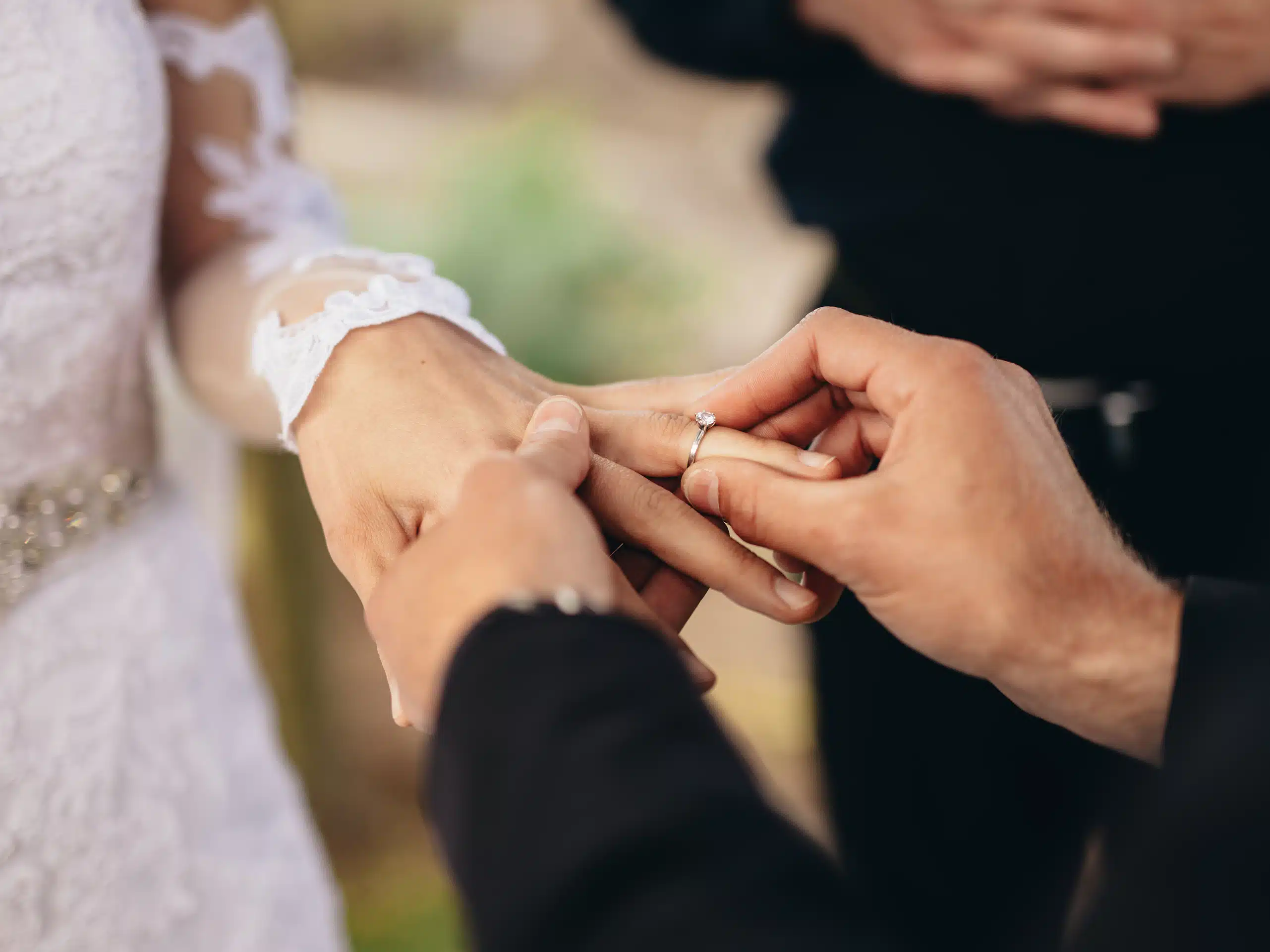
In his apostolic letter “Familiaris Consortio,” Pope John Paul II talks about marriage. He writes about the sacrifice which Jesus Christ makes of himself on the cross for his bride, the church, and how it revealed the plan that God has imprinted on the humanity of man and woman since their creation. The marriage of baptized persons thus becomes a real symbol of that new and eternal covenant sanctioned in the blood of Christ. (FC 13)
In other words, Christian marriage echoes the Crucifixion. On the cross, Jesus gave himself completely, down to his last drop of blood, for his bride, the church. And, in marriage, spouses give themselves completely, “down to the last drop of blood” for each other and for their families.
We here in 21st century America tend to think of marriage as simply a contract between two people. Like it’s our invention. But that has never been the church’s position. Marriage goes clear back to the beginning, to Adam and Eve. It was the man and his wife who were naked and not ashamed. Adam’s gaze toward Eve was a gaze of unmitigated love. He looked at her and saw a human person created by God out of love. And all he wanted was to do what was absolutely best for her. And Eve likewise saw Adam only through the lens of love. Their lives were a complete and total gift to each other. A marriage.
Of course, we don’t necessarily believe that the book of Genesis is literal history, or that two people named Adam and Eve lived in a garden and talked to a snake. But, especially given Christ’s frequent references to Genesis and “the beginning,” we know that the spiritual truth it imparts is real. And one of those truths is that marriage goes back to the very beginning, and that it was instituted by God, not man.
Scripture is rife with marital imagery. Isaiah says, “For as a young man marries a virgin, your Builder shall marry you; And as a bridegroom rejoices in his bride so shall your God rejoice in you.” (Is 62:5) In Jeremiah, “Go, cry out this message for Jerusalem to hear! I remember the devotion of your youth, how you loved me as a bride.” (Jer 2:2) The entire book of Hosea is the story of Hosea’s faithfulness to his faithless (and unfortunately named) wife, Gomer — an allegory reflecting God’s steadfast love for the fickle and wavering nation of Israel.
And in the New Testament, we find frequent references to Christ as the bridegroom of his bride, the church he founded and to which he will be faithful to the end of time.
The message is clear. Christian marriage is not just a contract to be renegotiated at will. It is a covenant. A contract is an exchange of goods and services — “I will do this for you if you do that for me.” A covenant is an exchange of persons — “I am yours and you are mine.” But the “my” here isn’t a “my” of domination (“I own you”) but rather of reciprocity (“Your heart is in my hands, your well-being is my responsibility.”)
So, all of this sounds lovely in theory. And it indeed was lovely for Adam and Eve, before they sinned and messed everything up. Before the fall, Adam and Eve operated under a different composition of forces. They were “wired” differently. As St. John Paul II describes it, “the ethos and the ethic were one.” Ethos, to put it simply, is what we are naturally inclined to do, what we want to do. And our ethic is what we are supposed to do. So, in a world without sin, there was no tension between desire and duty. They were naturally inclined to do the right thing.
So, it was easy for Adam and Eve to love each other perfectly. But it isn’t so easy for us. We, living under concupiscence, struggle to love even adequately, much less perfectly. And yet, even in our imperfect state, God still deems the marriage of baptized persons a symbol of the new covenant “sanctioned in the blood of Christ.”
Jesus knew the difficulty. When the disciples asked him about divorce, he said, “For your hardness of heart Moses allowed divorce. But from the beginning it was not so.” (Mt 19:8) Allowances were made for weak human nature. But, in elevating marriage to a sacrament, and to a symbol of his new covenant with the church, Christ set the bar high again. Marriage could once more be what it was from the beginning — a permanent union of self-donating love, reflecting his unwavering commitment to us.
Of course, it is always important to reiterate that Christ’s unwavering faithfulness to his church is not an invitation for a spouse to be abused, or to remain in a situation where abuse continues. And someone who enters into a “marriage” with no intent to be faithful, or with no intent to commit to a permanent union, or under some other form of manipulation, is not truly marrying at all. The church’s teaching on that has always been clear.
But what about the rest of us — the ones who marry with good intentions, but find human nature getting in the way in big and small ways? How could total self-donation be possible in such a sinful world?
It is made possible by Christ, by graces he won for us on the cross. Whenever we love well, whenever we put another’s needs ahead of our own, whenever we truly give ourselves, we are accessing the activity of the Holy Spirit in our hearts. And the best way to increase that love is to follow him, to ask him to make us into the “new creation” that the redemption promised.
And so, in this Easter season, rejoice in the gift of new life that he has won for you. And ask him, through that gift, for the grace to grow in love for everyone around you.
Especially your spouse.
Bonacci is a syndicated columnist based in Denver.