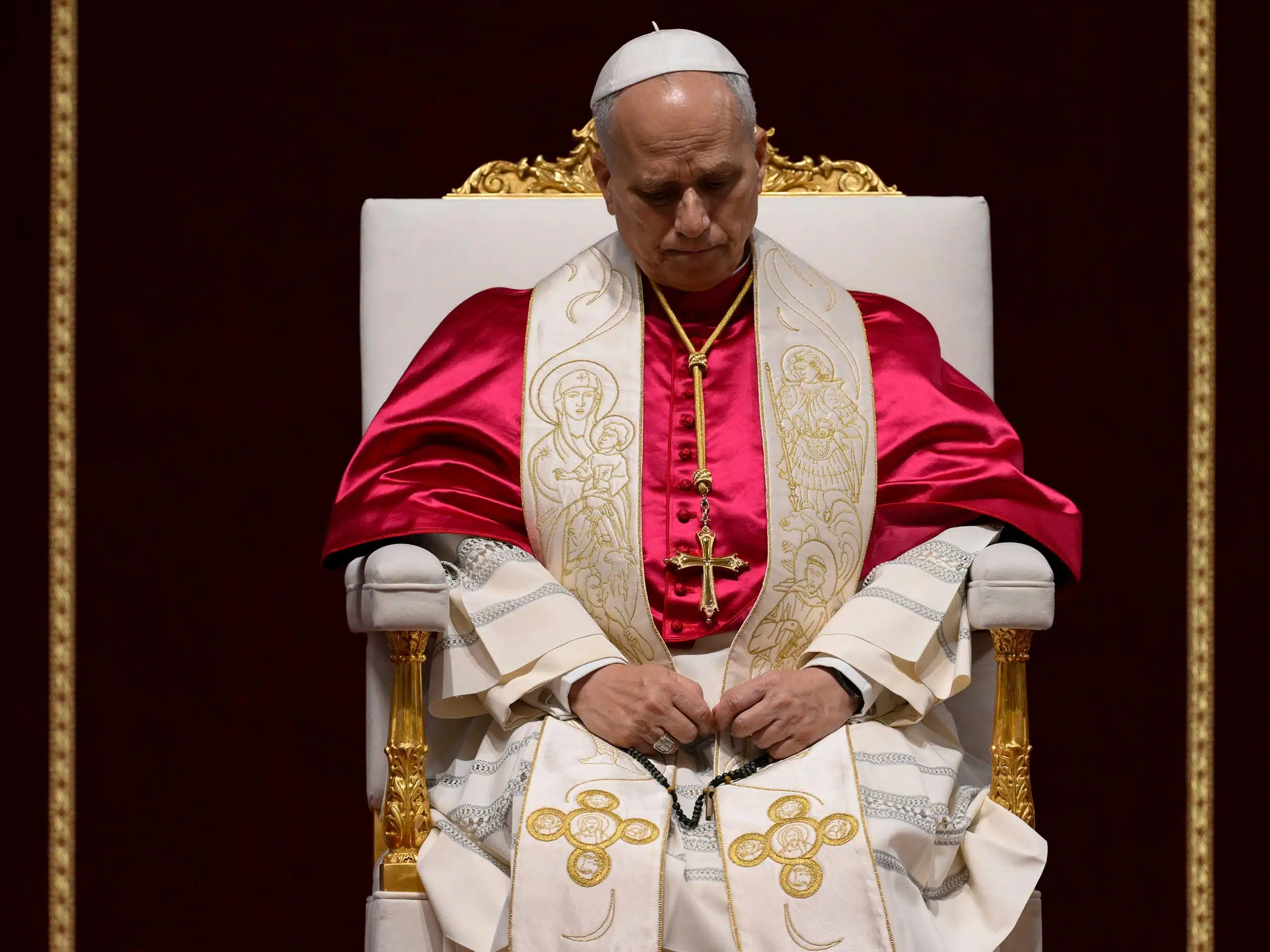
Pope Leo XIV recently warned that “war is back in vogue.”
He lamented recent talks of peace through force rather than justice. He echoed Pope Paul VI’s 1967 encyclical, “Populorum Progressio,” that said “(human) development is the new name for peace.”
“The principle established after the Second World War, which prohibited nations from using force to violate the borders of others, has been completely undermined,” Pope Leo said, noting that this mindset threatens the rule of law itself.
Let’s revisit some history.
Flashback to the 1920s
After World War I, the League of Nations was founded in Versailles. President Woodrow Wilson was its architect. The league’s preamble was wordy: “THE HIGH CONTRACTING PARTIES, in order to promote international co-operation and to achieve international peace and security by the acceptance of obligations not to resort to war … by the firm establishment of the understandings of international law as the actual rule of conduct among Governments … ”
Wilson left office, and the U.S. never joined the league. Britain’s financial hegemony lapsed. The U.S. did not fill Britain’s leadership gap in finance. Easy money boomed the U.S. economy. Banks overleveraged. As for German war reparations: “We will squeeze the German lemon until the pips squeak,” said Sir Eric Campbell. Allied war-debt repayments were interwoven with over-leveraged American capital. The bubble burst in 1929. Banks retrenched. Money liquidity dried up. Depression ensued, fueling nationalism and antisemitism. Without U.S. leadership, the league was not equipped to “achieve international peace and security.”
Flash forward to 1945
The League of Nations bore witness to the need for “international law as the actual rule of conduct among Governments.” After World War II, there was no turning back. Nations either cooperate or risk mutual destruction. Cordell Hull (U.S. Secretary of State), John Foster Dulles (senior U.S. adviser on the U.N.), and Anthony Eden (U.K. Foreign Secretary) crafted the forthcoming Charter of the United Nations. Written in San Francisco, the U.N. charter was open for signature June 26, 1945, by any nation willing to abide. Fifty nations signed it that day.
The charter’s preamble begins, “We the peoples of the United Nations, determined to save succeeding generations from the scourge of war, which twice in our lifetime has brought untold sorrow to mankind, and to reaffirm faith in fundamental rights, in the dignity and worth of the human person, in the equal rights of men and women and of nations large and small … ”
The tone changed from the preamble of the league’s covenant, which is addressed by “THE HIGH CONTRACTING PARTIES.” The U.N.’s charter begins with, “We the peoples … ” The contrast is notable. The bloodbath of two world wars, a financial crash, a depression, racial nationalism, and 6 million holocaust victims inspired a more humane choice of words. The point: We are all in this together. Read the charter for yourself.
President Harry Truman then authorized dropping an atomic bomb on Hiroshima and then Nagasaki. Japan surrendered. Allied victory was a brief calm unless peace arrangements were not forthcoming. The stakes for the U.N. charter were critical. In 1945, everyone knew it. A new game was about to begin when former European colonies became independent states.
Challenges for the United Nations
Overwhelming challenges that would strain the U.N.’s institutional capacities would come to pass: the Cold War, the nuclear arms race, conflicts over the new state of Israel (1948), and more than 35 former colonies becoming independent states between 1945 and 1960.
In 1948, the U.N. General Assembly adopted the Universal Declaration of Human Rights. It “was drafted in direct response to the calamities and barbarous acts experienced by the peoples of the world during the Second World War” (U.N. preamble). Arguably, the declaration is a masterpiece of human civilization. Its preamble begins, “Whereas recognition of the inherent dignity and of the equal and inalienable rights of all members of the human family is the foundation of freedom, justice and peace in the world … ” The declaration consisted of 30 articles. It stated that the articles are principles of universal human rights which are a “common standard of achievement for all peoples and all nations, to the end that every individual and every organ of society, keeping this declaration constantly in mind, shall strive by teaching and education to promote respect for these rights and freedoms and by progressive measures, national and international, to secure their universal and effective recognition and observance … ”
Article 1 states, “All human beings are born free and equal in dignity and rights.” Article 3 says, “Everyone has the right to life, liberty and security of person.” Article 6 says, “Everyone has the right to recognition everywhere as a person before the law.” Article 14 says, “Everyone has the right to seek and to enjoy in other countries asylum from persecution.” Other articles speak of “the right to own property alone as well as in association with others” (Article 17) and the right to “freedom of thought, conscience and religion” (Article 18). That is a remarkable achievement of human civilization. One wonders how the founding principles of the U.S. influenced the declaration. On the last page of the U.S. passport is a quote from Anna Julia Cooper: “The cause of freedom is not the cause of a race or a sect, a party or a class — it is the cause of humankind, the very birthright of humanity.”
The problem of uneven development
Uneven development challenged the post-colonial world. Emerging states needed liquid cash reserves, which were dependent on commodity prices, for necessary imports. The interplay between domestic corruption and multinational corporations challenged development. The Cold War’s ideological crossfire often derailed democracy and hindered development.
Pope Pius XII favored multilateral institutions, such as the U.N. Catholic diplomats influenced the creation of post-war institutions. The Venerable Robert Schuman, architect of the European Coal and Steel Community (predecessor of the European Union) who served as French prime minister and minister of foreign affairs, also served as president of the European Parliament. He helped found the United Nations, the North Atlantic Treaty Organization and the Council of Europe. Other Catholic post-war influencers were Konrad Adenaur (West German chancellor, 1946-66) and Alcide de Garpari (Italian prime minister, 1945-53). In brief, post-war structures for peace and prosperity were influenced by Catholics equipped with the ethos of “Rerum Novarum” (Pope Leo XIII, 1891) and “Quadragesimo Anno” (Pope Pius XI, 1931).
Hidden in the background was Dominican Father Louis-Joseph Lebret, a recognized expert in the challenges of uneven development. He was an adviser to the U.N. and emerging states. He was a ghost-writer for Pope Paul VI’s 1967 encyclical “Populorum Progressio” (On the Development of Peoples), which stated, “Development is the new name for peace.”
Pope John XXIII and ‘Pacem in Terris’
The Catholic Church’s international involvement went public April 11, 1963, with Pope John XXIII’s “Pacem in Terris” (Peace on Earth), which was addressed to “all people of goodwill.” The Cuban Missile Crisis of October 1962 provoked the letter. The U.S. and U.S.S.R. came within a hair’s breadth of nuclear war. In Catholic eyes, the scare was not just about the Cold War. It was about uneven development — or what Pope Paul VI would call “human development.”
In Pacem in Terris, Pope John XXIII proposed enhancing U.N. “structures and methods” for human development. “May the day be not long delayed when every human being can find in this organization an effective safeguard of his personal rights; those rights, that is, which derive directly from his dignity as a human person, and which are therefore universal, inviolable and inalienable. (People) are taking an ever more active part in the public life of their own nations … They’re becoming more conscious of being living members of the universal family of mankind” (PT 145).
Nation-states alone are not equipped to cultivate their own development, said the pope. U.N. institutions must be enhanced to help countries promote development, the common good and resolve conflicts. Nation-states “are unequal to the task of promoting the common good of all peoples” (PT 135). The “universal common good” is at stake as it “presents us with problems which are worldwide in their dimensions; problems, therefore, which cannot be solved except by a public authority with power, organization, and means co-extensive with these problems, and with a worldwide sphere of activity. Consequently, the moral order itself demands the establishment of some general form of public authority” (PT 137).
Pope John XXIII did not call for a “super-state.” He emphasized the “principle of subsidiarity” (PT 140). Rather, he proposed collaboration among states that would change the calculus or “law” in which all states — even potential aggressors — must act. In the language of political economy, international law is not enforced, but it is a structured collaboration within which states operate: a Christian game theory. No state can pursue its own interests in isolation from the rest.
The pope proposed a new statecraft: the art of multilateral cooperation that enhances each nation’s ability to promote its own common good. This new statecraft entails a rules-based international order. Pope Francis proposed this: “True statecraft is manifest when … we uphold high principles and think of the long-term common good” (“Laudato Si,” 178). Building on Pacem in Terris, Pope Francis said politics can be a high form of charity, providing for the common good of future generations.
Pacem in Terris opened a whole new dimension for Catholic social teaching that was perhaps more groundbreaking than Rerum Novarum, the first modern social encyclical by Pope Leo XIII in 1891. The latter addressed the conflicts of the Industrial Revolution, which were mostly European and American problems. On the other hand, Pacem in Terris addressed global problems.
After Pacem in Terris, Catholic social teaching went global. It influenced the Second Vatican Council, especially in “Gaudium et Spes” (The Pastoral Constitution of the Church in the Modern World). Pope Paul VI’s 1967 Populorum Progressio was its sequel. Catholic social teaching was now addressed to “all people of good will.”
A brave new statecraft
This explains Pope Leo XIV’s Jan. 9, 2026, words to diplomats and recent statements. Nations “going it alone” would lead to global anarchy.
Since 1963, the church has been calling for a new kind of statecraft entailing the tedious art of cultivating cooperation among all peoples, even among those who resist. It is painstaking. It requires wisdom, patience, perseverance, thought, study and prayer. It is a brave new outlook and a prophetic challenge for all of us. It is a Catholic vision.
Fr. Edlefsen is pastor of Our Lady of Lourdes Church in Arlington.