As he began to speak at the Refugee
Student Achievement Banquet, Jamshid Forugh’s mind flashed back to when he
arrived in the United States four years earlier. Megan Dougherty, a school
liaison for diocesan Catholic Charities’ Migration and Refugee Services, had
come up to him and asked him how he was doing. And Forugh had no idea what she was
saying.
Now, as he was about to deliver a
three-page speech that he had written in English, Dougherty stood in the
audience, listening. “She saw me, (and in) that moment I kept remembering”
everything that had happened since, said Forugh.
When he arrived in Fredericksburg in
2014, Forugh would talk with other Afghan teens about what they would
accomplish in their new homeland. “One of them wished to have a very nice car,
(one) wanted to have a boat. What I used to wish for was to speak English one
day with no problem,” he said in near perfect English with all the
self-assuredness of an American teen. “Here I am.”
Life in Afghanistan
Forugh was born in 2000 and grew up in
the relatively safe city of Mazari Sharif in northern Afghanistan. When he was 6
years old, he started attending the neighborhood school. There were different
shifts for boys and girls, he said, and some 50 students would cram into the
classroom, sit on the floor and watch as one teacher wrote on the blackboard.
“There’s no technology” in Afghanistan, said Forugh, and the healthcare system is often inadequate. Some even travel to India for certain medical procedures. Many Afghans try to immigrate illegally through Iran into Europe, he said.
“(In Afghanistan), there’s basically no sign of life, no opportunities.” But because Forugh’s father trained policemen alongside U.S. forces, Forugh and his family had the chance to leave.
Afghan and Iraqi people who have worked with the U.S. military or government are eligible for a special immigrant visa, but it’s no guarantee, said Forugh. He and his family went through interviews, paid a lot of money for vaccinations and waited for a year and half before hearing they had been accepted. Then they had to leave, quickly, before the visa expired.
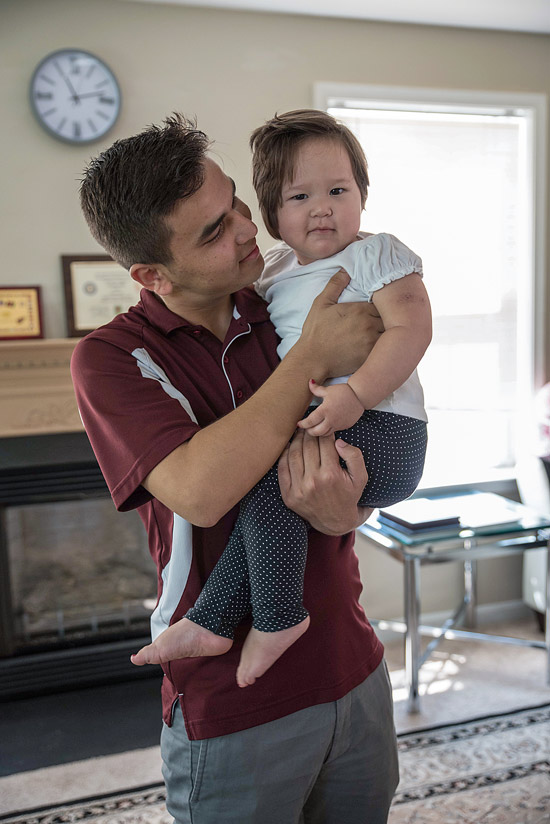
Jamshid Forugh holds his baby sister, Diana, 1. ZOEY MARAIST | CATHOLIC HERALD
So they packed their bags, gave the rest
of their belongings to charity and sold their home. “For the first time in my
life I was in a plane — it was terrifying — and we went from Kabul to Dubai,” he
said. “In Dubai I heard the word Wi-Fi for the first time.”
Settling in
A few months after arriving, Forugh
started as a freshman at Stafford High School, with no knowledge of English.
“The first year was so frustrating,” he said. “I used to have Google translate
every little sentence.” Forugh remembers arriving at Junior ROTC class and
after failing to understand the instructions, having an upper classmen walk him
to the bathroom with his uniform, gesturing that he should go and put it on. Years
later, as a senior, he led the class. “As a freshman I never could imagine it,”
he said.
In Afghanistan, Forugh played soccer in
the streets with his friends, using a “cheap plastic ball.” At Stafford, he
played on the junior varsity and varsity teams. “I wore cleats for the first
time,” he said.
During his freshman year, Forugh got a
3.7 GPA; by his senior year, he had earned nearly a 4.0.
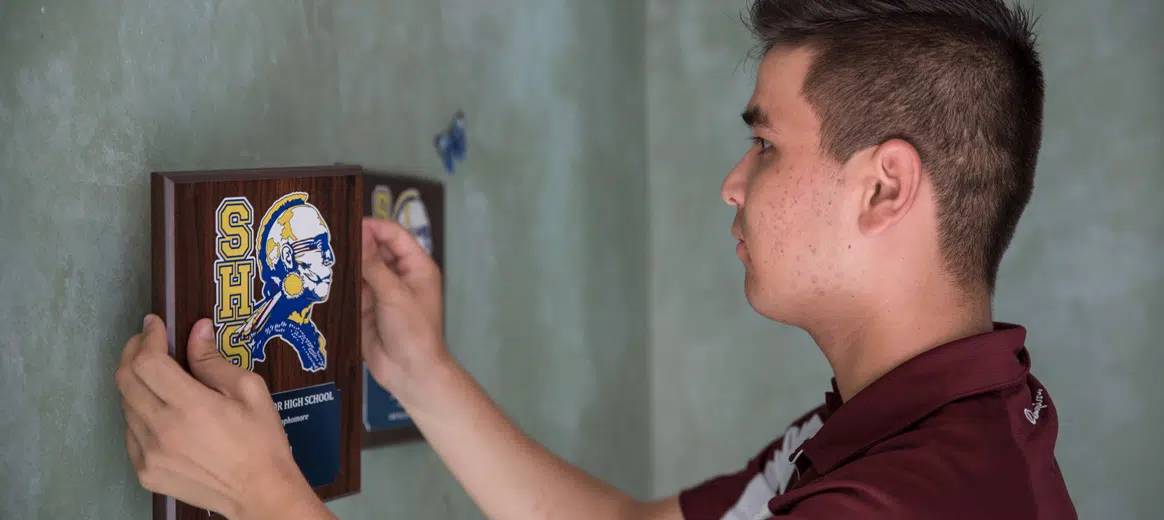
Forugh’s hard work didn’t go unnoticed
by his teachers, and during his second year they named him outstanding sophomore
of the year. The next year, he was junior of the year. Stafford High School
opened in the 1950s, said Forugh, but he is the only student to have received
the award two years in a row. The plaques marking the achievement hang in his
room next to a plastic butterfly — a beloved symbol in Afghanistan. “I will
never lose these,” he said.
Looking ahead
“Once you leave your homeland, you’re
going to miss everything — I miss the food, my friends, everything,” said
Forugh. But he’s embraced his new country and opportunities it’s given him. Forugh
was the first Afghan student from his school to graduate with honors, he says
with pride. In the fall, Forugh will attend Virginia Commonwealth University in
Richmond. He hopes to follow in the footsteps of his grandfather and become a
doctor.
This summer, he’s working at Panda
Express to earn money for college. He spent much of senior year applying for
300 scholarships. After reaching out to Dougherty, he applied to one available
through the Fredericksburg office of diocesan Migration and Refugee Services. He learned he won the scholarship at the
banquet honoring refugee students June 27. Two hundred students, ages 5-18,
teachers and parents were present. The Arlington office of Migration and
Refugee Serves held a similar ceremony June 30.
School liaisons such as Dougherty work
throughout the year to help families like Forugh’s — newly resettled asylees,
refugees and special immigrant visa holders — adjust socially and academically.
A volunteer tutor is matched with each family to help students with homework
and parents understand what comes home in their child’s backpack, said Laurel
Collins, the Fredericksburg associate director. Sometimes they’ll take the
students on trips to places such as the Baltimore Aquarium, or for older
students, workshops to explain the college application process.
For many of the newcomers, the chance to
have their child receive an education is what made them leave everything they
knew and come to the United States.
“They’ve sacrificed everything so their
kids can have a better future,” said Collins. That sacrifice has not been
wasted — between the two ceremonies, there were nine graduating seniors, all of
whom are headed of to college.