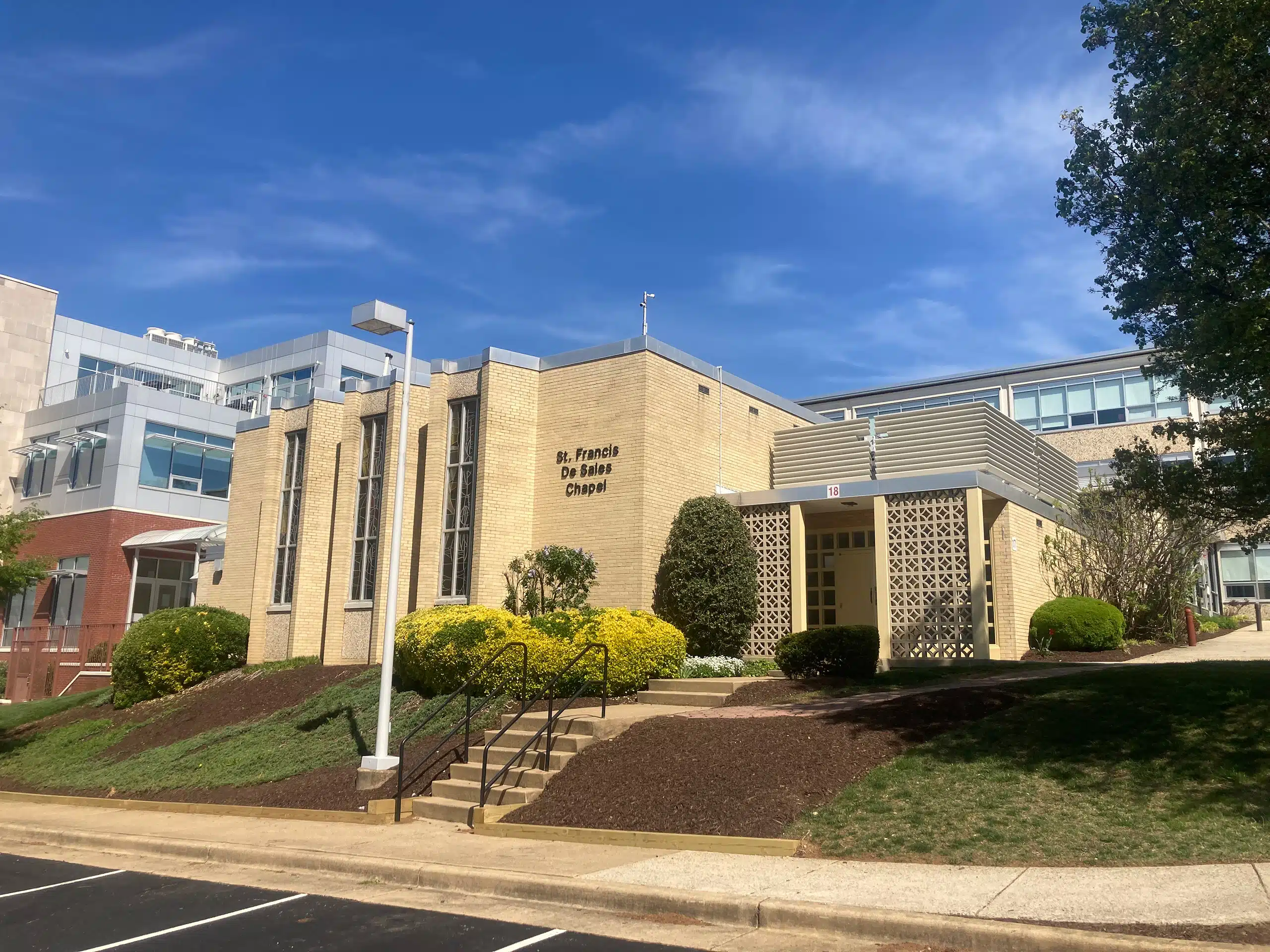
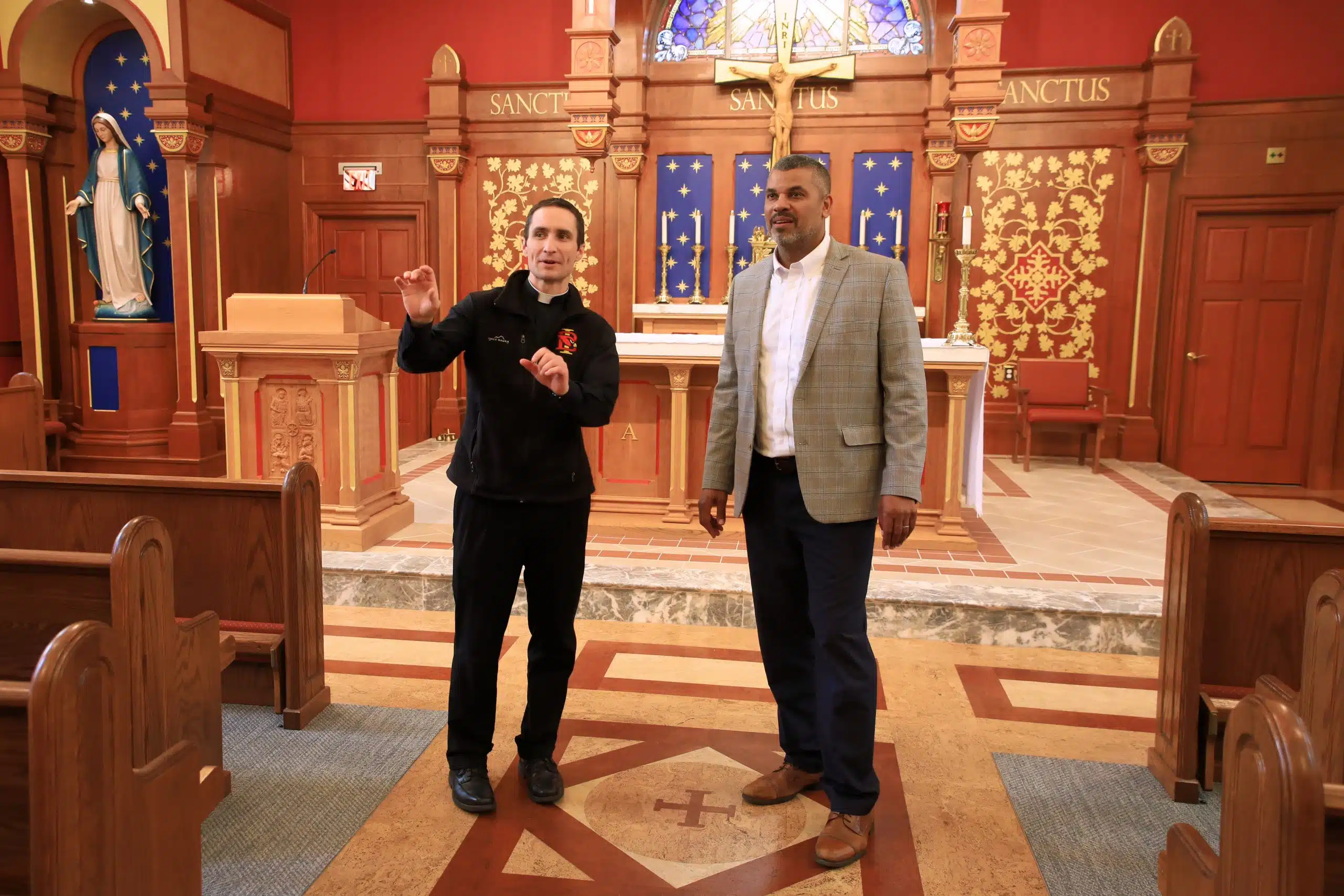
Bishop Ireton High School’s chapel didn’t look like one from the outside, and its yellow bricks clashed with a red-brick addition to the Alexandria school.
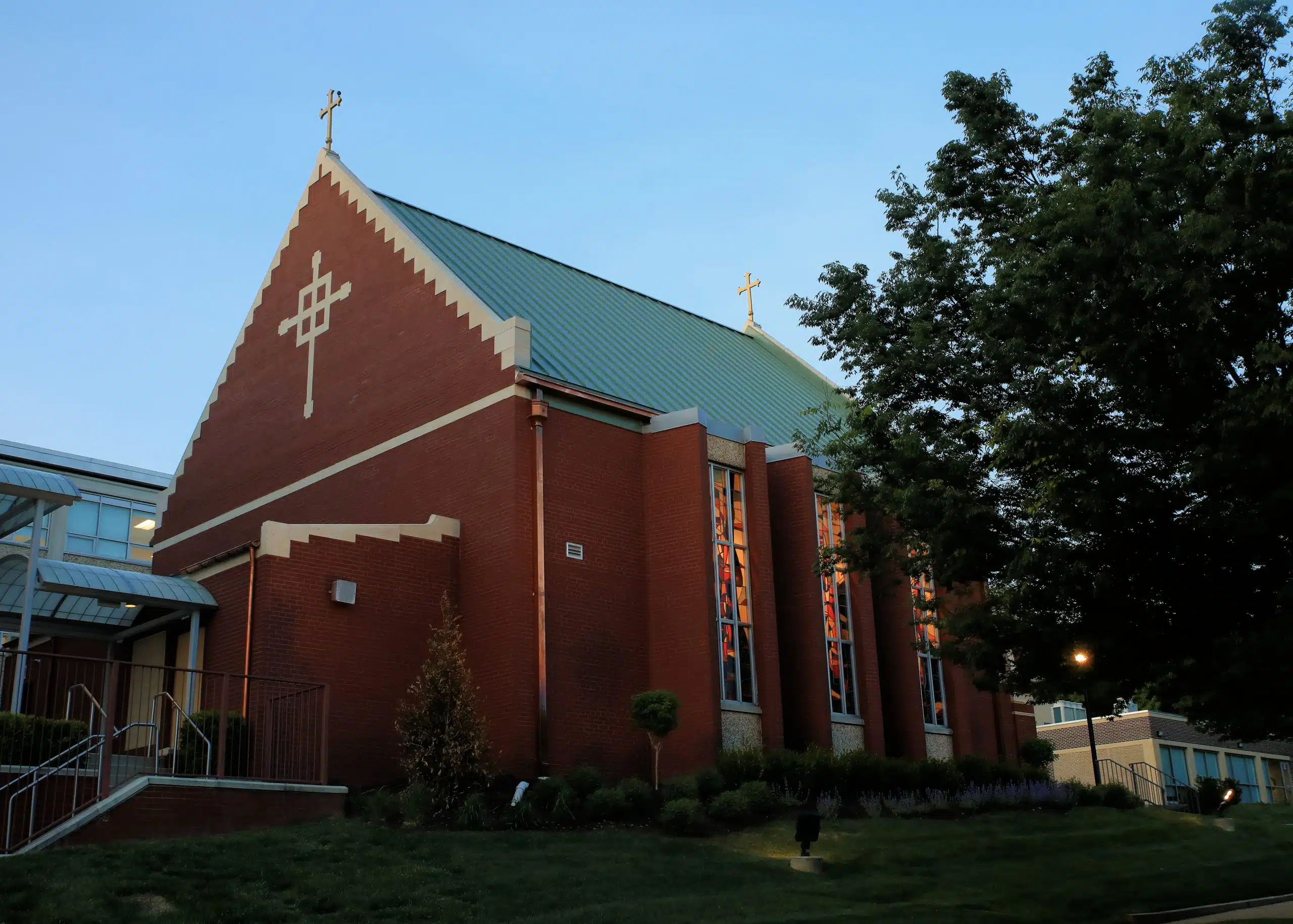
The recent renovation led by local architect C.J. Howard aimed to correct this by making the chapel look distinctly sacred from both the inside and outside.
For Kathleen McNutt, head of school, it was about “creating a sacred space through beauty. We wanted people to see the beauty, be able to take time, and pause and reflect.”
Achieving that vision required an ambitious design shift transforming the chapel’s original art deco style into something more reminiscent of a Romanesque church, a challenge that fell to Howard. His winning design included an elevated gable roof and a tower, creating a more traditional church presence.
“He really understood that dual process,” said McNutt, noting how the newly renovated chapel now reflects its purpose at first glance.
“It looks like a chapel from the outside,” said Father Noah Morey, chaplain, who joined the school in 2019. Positioned at the school’s entrance circle, the chapel now stands as an evangelistic opportunity for parents and students who pass it daily.
Howard lived in Germany for a few years as a child, and “European architecture left an imprint.” His interest in classical and traditional design grew during his studies at the University of Notre Dame’s School of Architecture. The school stood at the forefront of a return to classicism in American architecture and was described by The New York Times in 1995 as “the Athens of the new movement.” Classicism is an architectural style inspired by ancient Greece and Rome, and characterized by a focus on order, symmetry, and proportion.
After moving to the area, Howard, a father of seven, worked for McCrery Architects in Washington, contributing to major ecclesiastical projects, including the Sacred Heart Cathedral of Knoxville, Tenn. He recently established his own firm with the Ireton chapel renovation, begun in 2022, marking his first large project. Upcoming projects include work for Bishop O’Connell High School in Arlington, alongside his teaching role at The Catholic University of America in Washington, where he serves as director of studies in classical and traditional architecture. He credits his wife, Leah, for efficiently managing their bustling two-career household. Their five younger children attend diocesan schools while the two oldest attend Catholic U.
Howard, a parishioner of St. Louis Church in Alexandria, is keenly aware of the potential spiritual impact of his work. The redesign allowed him to include several elements of the Catholic faith, he said, both inside and outside. The school and the chapel are building a community “that is not just of this world,” he said, in reference to the Mystical Body of Christ. “We have a sense of being amongst others, whereas before that wasn’t really there.”
Father Morey worked closely with both Howard and diocesan officials involved in the renovation. The architectural project was a first for the priest. He praised Howard’s artistic sense and attention to detail. Among many hurdles, he described their difficulties finding Stations of the Cross to match the chapel size and style, and their decision to create a set using canvas wall art and custom wooden frames designed by Howard. McNutt also praised Howard’s commitment to precision when he had a wall torn down and rebuilt after finding that its measurements were off by a few inches.
When the chapel was dedicated by Bishop Michael F. Burbidge March 21, it exceeded expectations.
“You get the drawing, and when it’s time to build, you really hope it’s going to look like this,” McNutt said. For Father Morey, the dedication was a defining moment. “It was the happiest day of my priesthood,” he said, recalling the joy of guiding students through their new space, hoping they would return often.
Chapman is a freelancer in Alexandria.