An Alexandria man realizes the power of persistent prayer and lit candles.
Luis Barrera hesitated for months before agreeing to be interviewed. He ultimately said yes because he hopes his story “will help others in my situation.” He knows what it’s like to receive “a miracle.”
He was born in Guatemala and was raised by his grandparents, whom he “loves dearly.” He came to the United States when he was 17 years old. He earned his GED, took college classes and became a U.S. citizen several years later — something he struggles to describe without getting choked up. “I am so grateful to be part of this beautiful country,” he said.
Barrera was living a full, healthy life. “I used to ride my bike. I loved swimming and running.” He volunteered at St. Anthony of Padua in Falls Church, where he attends Mass.
Everything changed in 2012. During a routine physical, his doctor told him he was in kidney failure because of high blood pressure. “Psychologically, I was devastated,” he said. “I didn’t know what to do. I knew nothing about kidney failure.” His doctor put him on a strict diet cutting back on salt, started him on blood pressure and cholesterol meds, and told him to change his lifestyle.
He was put on a waiting list for a kidney transplant. More than 94,000 Americans are waiting for a kidney transplant, according to national data. Many never receive one.
Barrera was told he needed to start dialysis, something he had been reluctant to do. He would be hooked up to a machine that would clean his blood. He recalled his first dialysis in November 2024, when he “sat on that chair … and it was just me and God, no one else. I remember looking at the ceiling and saying to God, ‘What have I done to deserve this? Why have you abandoned me?’ No response.”
He went to dialysis three days a week for four hours each time. “Afterward, I felt tired, ready to go to bed. I was mentally not even present. I was doing dialysis just to keep living, but I felt like I was dying,” he said, clearing his throat.
But over time his health stabilized and symptoms eased. “It gave me a better quality of life,” he said.
He encourages anyone faced with dialysis to do it, and without fear. It makes a difference.
Barrera said that every dialysis patient’s dream is to receive “the phone call.”
“The ‘phone call’ translated to a ‘miracle’ for me,” he said.
In early April 2025, Barrera was back home after dialysis. “It was a Friday afternoon. I had just laid down to take a nap after my treatment and my phone rang,” he said. “It said, ‘Unknown number.’ A voice asked for me by name and confirmed it was me. She said, ‘We have great news for you. We have a living donor for you.’
“My brain could not process it. I asked her, ‘Would you mind repeating that again?’ When I finally processed it, I could breathe again. That call brought me back to life.”
The caller told him that the donor wanted to surprise him and didn’t want to reveal their identity yet. He confided that, at that moment, he hoped the donor wouldn’t back down.
“So many people are on the waiting list. So many don’t make it,” he said. “Somehow along the way you lose hope.
“You see all these people on dialysis who probably have more family support than me, and they can’t get a kidney,” he said, loosening his necktie, coughing and apologizing for getting emotional. “And for me, without that support, to get it.”
Barrera mentioned a song about enduring fire before new life. “That’s what God did with me,” he said. “I felt like I was dying, but I could not tell people what I felt; God said carry that with a smile while you go through those struggles,” he said.
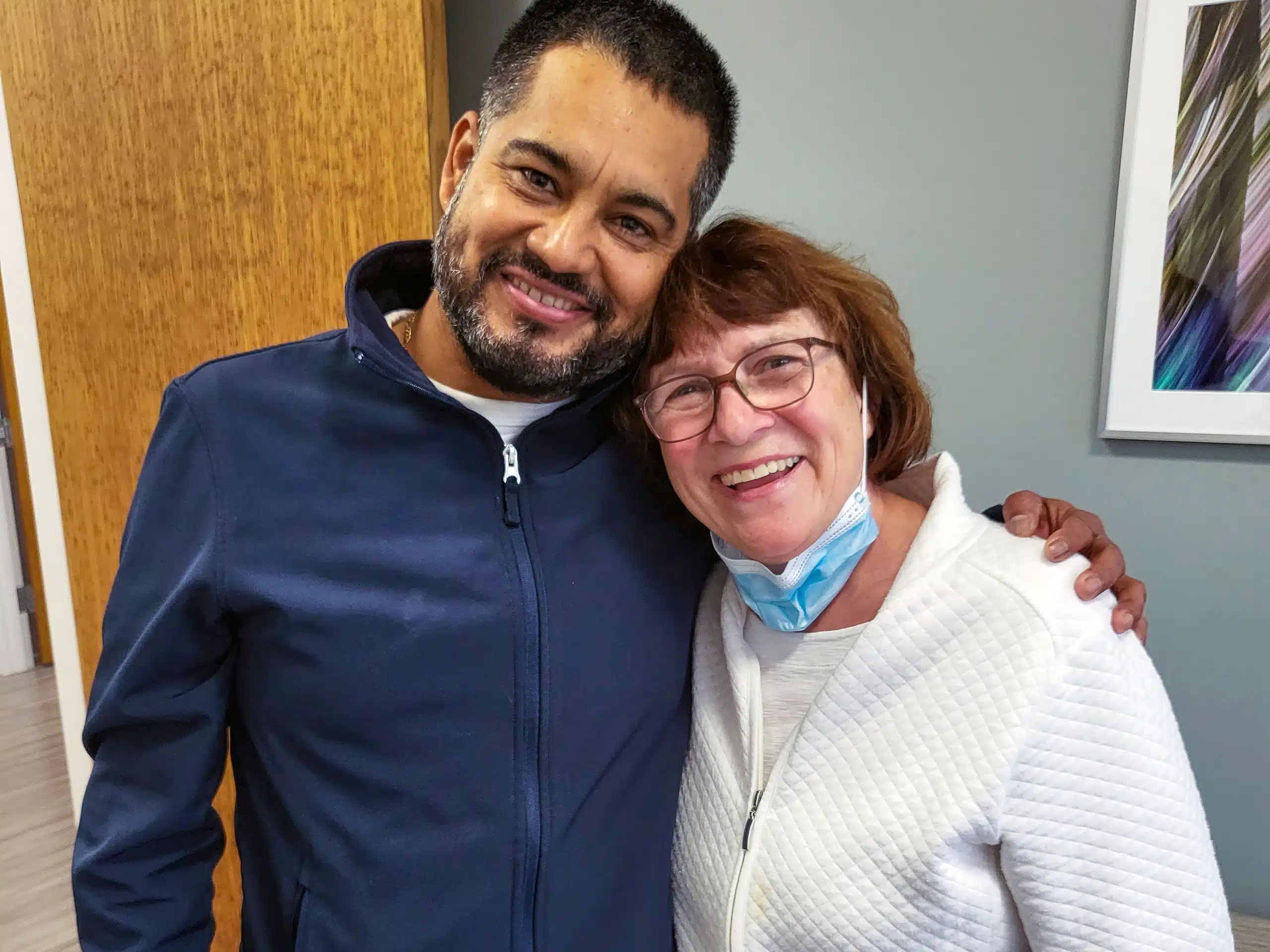
A week prior to surgery he met his donor. The nurses at Inova Transplant Center arranged a “reveal” when they both were there for their pre-op appointments. They even videotaped it.
Nancy Zevgolis, 66, a nurse at St. John the Evangelist School in Warrenton, was his donor.
Months earlier, she received an email about a man who needed a kidney. She knew Barrera a little and immediately wanted to help.
Zevgolis reached out to the National Kidney Foundation after Christmas and started getting basic tests done. Her information was shared with hospital registries and Georgetown University called. She said she wanted to donate her kidney to a specific person. They got in touch with Inova and more extensive testing began. With each step, everything fell into place and “it kept moving on,” she said. “I just put it right in God’s hands.”
She didn’t want to tell Barrera in case it didn’t work out but she was ecstatic when the transplant center confirmed that they had the same blood type. After all the tests — including blood work, EKGs, heart tests, nuclear studies — she was a perfect match.
When they met, Barrera said, “(She) cried so much for me. I thought I was going to cry but I didn’t, my body was numb.”
Barrera knows tragedy with a difficult upbringing back home, and the loss of family members including his younger brother. But this was a different kind of struggle.
On the day of the surgery, “May 6, 2025, the day I was born again,” Barrera needed one more dialysis treatment. The technicians were all upbeat. One told him, “You must have done something good in your life to deserve this. Not many in life get this.” Just repeating this brought more tears to his eyes and another tug at his shirt collar.
Barrera is so grateful to his donor. Months after the surgery, he got up early one morning and drove an hour to drop off an orchid at her front door. Then he went to a nearby church to pray. She discovered the plant and called him to come back. He did and then together they went back to the church, her church. “She told me, ‘Luis, if this church could speak, it would tell you how many candles I lit for you.’ ”
“I didn’t know what she was going through, while I was trying to survive on my end, and she was in the process of saving my life,” he said.
Zevgolis said she’s “been fortunate in my life, I’ve been very healthy.” Some 20 years earlier she’d started the process of becoming a bone marrow donor, but she moved and no one ever followed up with her.
“This has been a great journey, no regrets, no second thoughts,” she said. The Inova Transplant Center team “was amazing. They follow up regularly, about once a month they email asking how I’m doing, do you need anything, checking in.”
From her side, the story is “not super long. Luis and I are friends and we get together once a month or so.”
Barrera also is quick to thank “the surgeons, doctors, nurses, therapists, his employer (who sent that email months earlier), friends and family.”
But his faith in God has been the constant in his life since he was a young child going to church in Guatemala, he said. “The church was always a safe place for me.”
He reflected on his prayers that first day of dialysis. Since then, he said he’s heard God tell him, “Son I was always there for you; I never abandoned you. I was there that first day of dialysis, and I’m here now again.”
It’s coming up on a year since Barrera’s new birthdate. “The old me died and now I am getting to know my own self. I am starting to know what it’s like to be alive all over again,” he said.
“Never give up on praying and hoping,” he said. “Be patient. He will make the miracle.”
A living donor can donate one of their two kidneys and continue to live a normal life. One example is Father “Tuck” Grinnell. Years ago, he was leafing through a magazine when an article about kidney donation caught his eye. The retired pastor of St. Peter Church in Washington didn’t know anyone who needed a kidney, but he knew that donating his would better the life of a stranger for years to come. He donated a kidney in 2020 at the age of 73.
Barrera said he encourages people to consider donating. “Talk to God, he will give the answer. They will make a huge difference in someone’s life and God will repay them in ways they can’t imagine.
“I am sharing my story that God is here, and angels exist on earth.”
Barrera’s angel is ready to answer any questions from prospective donors. “I feel like so many people could help,” Zevgolis said. “It was very easy. There was a lot of testing, I had to take time off, but it meant so much to me.” She said she is feeling fine.
“It was a beautiful experience, and I have never regretted one moment of it,” she said. “It was all divine intervention.”
Find out more
To reach Nancy Zevgolis, email [email protected].
March is National Kidney Month
March is National Kidney Month and World Kidney Day is March 13.
Kidney disease affects 37 million people in the U.S. and more than 90,000 people are on the national transplant list, according to the Centers for Disease Control and Prevention.
- Chronic Kidney Disease is often preventable and manageable with early detection. Risk factors include diabetes, high blood pressure and family history.
- This month highlights the critical need for donors as 85% of the national transplant waiting list is comprised of patients needing kidneys.
- 1 in 7 adults in the U.S. has CKD.
Read more
Go to the National Kidney Foundation, kidney.org, for patient education.
Go to the American Kidney Fund, kidneyfund.org, for assistance with bills and recipes.
Go to the National Kidney Registry, kidneyregistry.com, for more on living kidney donations.
Go to American Association of Kidney Patients, aakp.org, for patient advocacy and education.