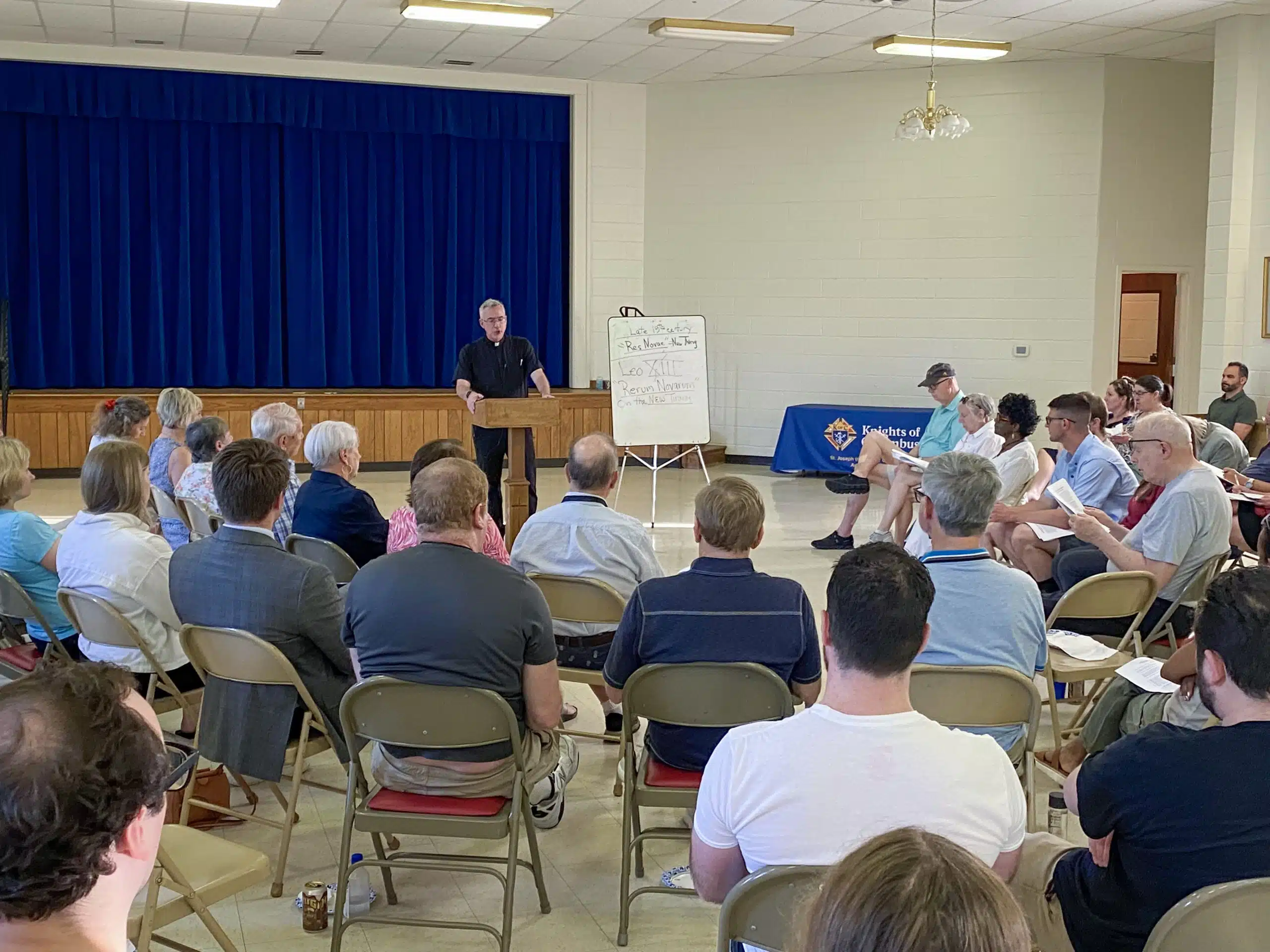
The chairs were arranged in the round, the pizza was served and summer school was in session on a hot Tuesday night in an Arlington parish hall, with Catholic social teaching on the curriculum.
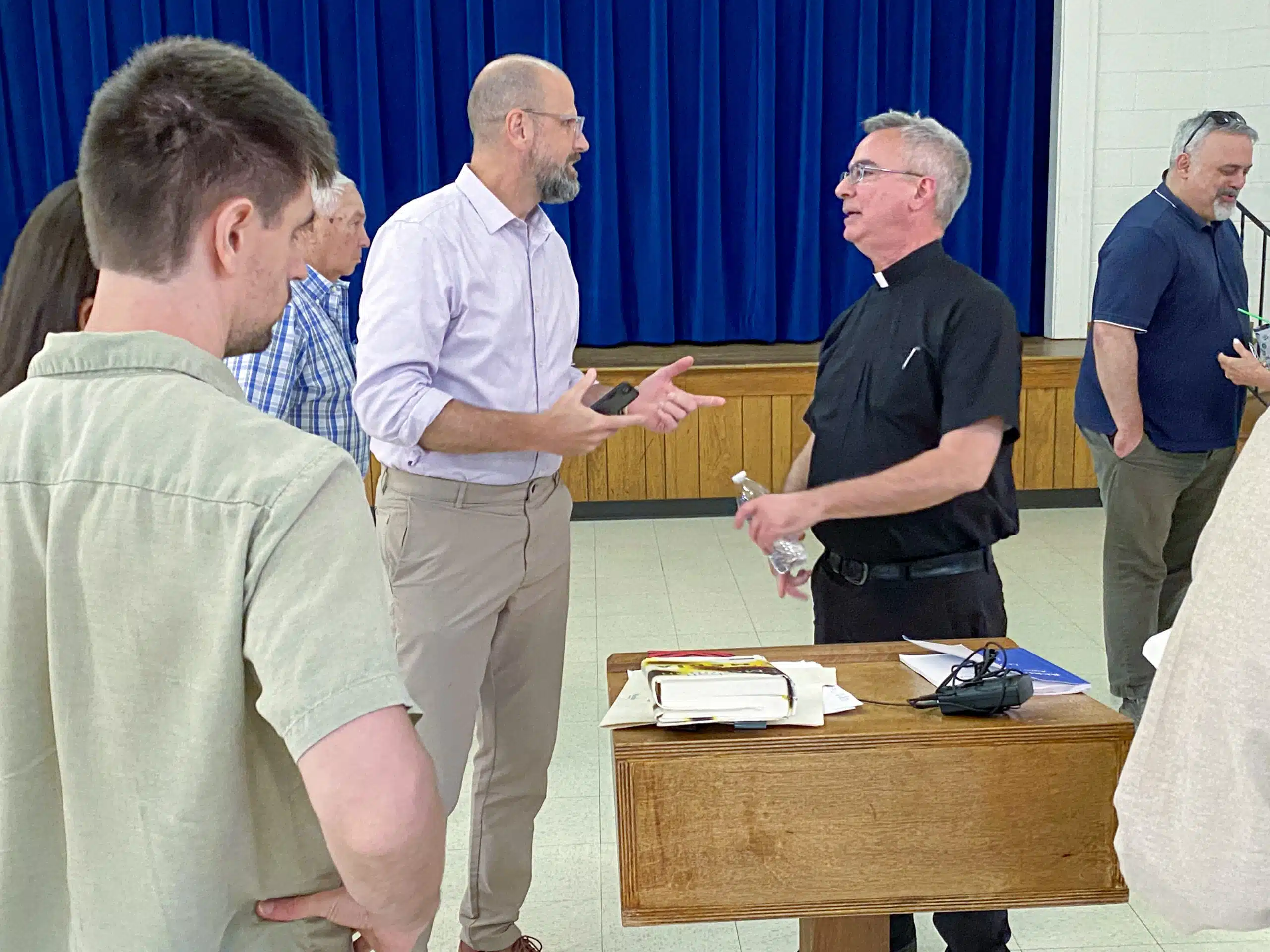
Father Frederick H. Edlefsen, pastor of Our Lady of Lourdes Church in Arlington, delivered a talk June 24 titled, “From Industrial Revolution to AI,” about the groundbreaking and lasting impact of the seminal work by the previous Pope Leo and its influence on what is expected to be a hallmark of the present pontificate: addressing artificial intelligence.
Pope Leo XIII promulgated “Rerum Novarum” (“Of New Things”) in 1891 in response to the seismic changes wrought by the Industrial Revolution and questions it prompted about workforce protections, private property rights, and the state’s role in regulating commerce.
Father Edlefsen, who has a bachelor’s in international trade and finance and a master’s in international political economy, recommended everyone read Rerum Novarum in full. He lauded its simultaneous defense of the right to private property (in the face of Communist detractors) and rejection of unfettered capitalism (“capital cannot do without labor, nor labor without capital”).
“Rerum Novarum is utterly groundbreaking in the history of the Catholic Church,” Father Edlefsen said. “Never before had the church had to deal with something so pointed and new. And it changed the trajectory of Catholic social teaching.”
He ticked through highlights of the encyclical, also listed on a handout like a greatest hits list of Catholic social teaching. All are embodied in what are today referred to as the teaching’s four principles: dignity of the human person; common good (an economy that serves people); subsidiarity (the family as the building block of society, with rights outside the state’s) and solidarity (one human family that prioritizes the needs of those experiencing poverty).
“Whether you realize it or not, (Rerum Novarum) had enormous impact in the 20th century on the political economy, especially in Western Europe and even in the United States,” he said.
In selecting the name he did, Pope Leo XIV “grafted” his pontificate onto that of Pope Leo XIII, and made a priority of addressing artificial intelligence, which Father Edlefsen said supplanted the post-World War II age of electronic circuitry that succeeded the Industrial Revolution.
AI will affect all aspects of human ecology, he said, posing a series of questions it raises from education and research to employment to family and social life. Its application will create economic winners and losers, and accelerate the pace of work and expectations.
AI won’t write the priest’s homilies any time soon, he assured parishioners over their laughter. Asked for a homily about Jesus’ parable of the wicked servant, the technology produced a perfectly readable sermon that he said missed Jesus’ point.
Father Edlefsen quoted a recent story in The Wall Street Journal detailing Silicon Valley’s efforts to woo the Vatican, and also cited Pope Leo’s words on AI, which hit home for many. As he read the pope’s June 20 warning that “access to data — however extensive — must not be confused with intelligence,” heads nodded, and anecdotes rang out from the audience attesting to the words’ veracity.
The turnout of approximately 100 people ranging from young adults to veteran parishioners exceeded organizers’ expectations, according to Sid Thurston, Grand Knight of the parish’s St. Joseph the Worker Council of the Knights of Columbus, which sponsored dinner and refreshments. Members of the audience lingered afterward to share observations and reactions as he tidied up and turned out the lights.
“There were still people out in the parking lot talking about it,” said Thurston. He particularly appreciated the pastor’s closing message citing the new pontiff’s words that “we received life before we ever desired it,” and would not have survived without someone extending “a free and freeing relationship of human kindness and mutual care.”
“That can never be replaced by anything,” Father Edlefsen said.
Schweers can be reached at [email protected].