Bishops of the Baltimore Province gathered for a provincial
meeting in Arlington March 18. The neighboring bishops meet regularly to
discuss ministry challenges and topics of mutual concerns. They also draw up a
provincial list — priests who might be suitable as future bishops.
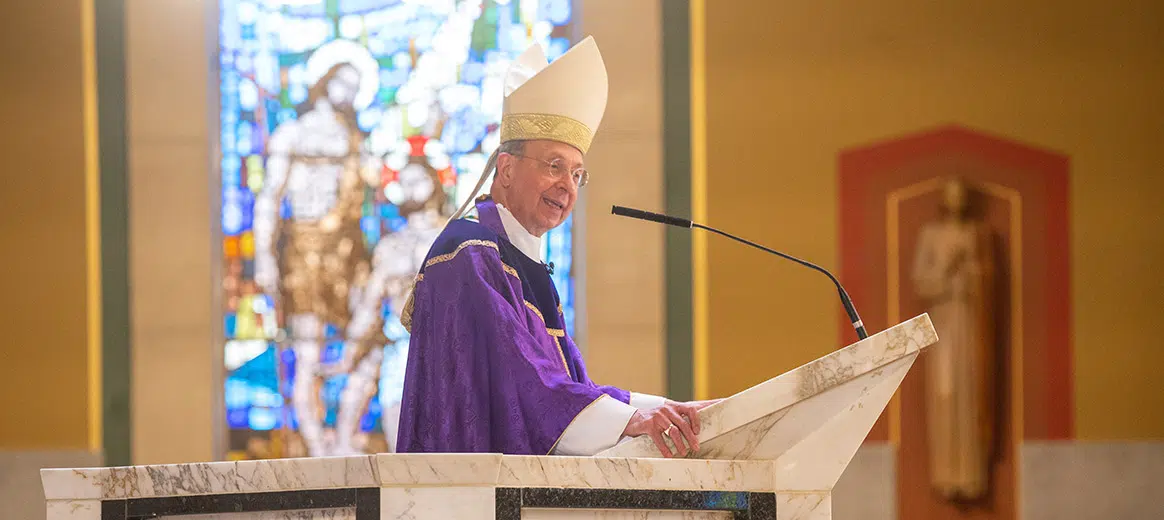
Those gathered included Baltimore Archbishop William E. Lori;
Baltimore Auxiliary Bishop Denis J. Madden; Baltimore Auxiliary Bishop Adam J.
Parker; Baltimore Auxiliary Bishop Bruce A. Lewandowski, C.Ss.R.; Arlington
Bishop Michael F. Burbidge; Arlington Bishop Emeritus Paul S. Loverde; Richmond
Bishop Barry C. Knestout; and Wheeling-Charleston, W.Va., Bishop Mark E.
Brennan.
Archbishop Lori, the metropolitan archbishop, sat down with the Catholic Herald for a brief interview.
You’re visiting today to attend the provincial meeting. Can
you explain a little bit about the role of a province?
The way the church is organized, there are dioceses all over the
world. There’s no place where there’s not a diocese. From early on, they’ve
been grouped together, usually the oldest diocese or the major city in the area
is called the metropolitan archdiocese and under that are suffragan dioceses.
In the case of our geography here, it’s a little unusual because we have
Baltimore and Washington and the surrounding dioceses.
Baltimore is the first diocese in the United States, having been
founded in 1789. So it has remained the metropolitan archdiocese for the
dioceses of Wilmington, Del.; Wheeling-Charleston, W.Va.; the great diocese of
Arlington; and the venerable diocese of Richmond. Washington is its own
province and its suffragency is the Virgin Islands, which must be faithfully
visited every January.
What do you enjoy about gatherings like this?
The first thing you enjoy is praying together. Not only did we
have Mass, but we’ll pray vespers together. Second is the camaraderie. We work
together even when we don’t meet officially like this. We’re (often) times on
Zoom, especially these days, but it’s great to be together in person. Not only
are we colleagues, but also friends. It’s great to learn the wisdom of other
bishops and to see what they’re doing. It’s a lot of good give and take.
Finally, it’s nice to share a meal together, which we’ll do two times over
today.
Jumping to Baltimore, you are celebrating the 200th
anniversary of the Baltimore Basilica. What do you like most about the
basilica?
The basilica is the first cathedral in the United States. It was
designed by Benjamin Henry Latrobe, who was an architect of the U.S. Capitol.
It was begun in 1806. John Carroll, the first bishop of the United States, broke
ground for it, but it wasn’t finished until 1821. They had trouble raising
money. There was also the War of 1812. The structure of the cathedral was
already in place, but since it sat on a high hill and there were no big
buildings between the cathedral and the inner harbor, it was a look-out
station.
Fortunately, it survived, the Brits didn’t burn it, and
Archbishop (Ambrose) Maréchal, the third archbishop of Baltimore, completed it
in 1821. On the old high altar, engraved in the marble, are the initials AM.
When I first saw it I said, that must stand for Ambrose Maréchal. I said that’s
pretty cheeky to put your own initials on the high altar. But it actually
stands for “Auspice Maria” (under the protection of Mary), which is of course a
beautiful expression of devotion to Our Blessed Lady.
There’s so much to like (about the basilica). Number one is that
it’s an active parish and that it has young people and that it has Eucharistic
adoration. It’s producing vocations, it sends missionaries out on the streets
of Baltimore who actually know and love the homeless. What beauty. That’s
spiritual beauty and that’s the first thing that I love about it.
After that, you’d have to say the basilica is itself a place of
great beauty. The pastoral life and beauty of the architecture and the
beautiful way the liturgy is celebrated all go together and you have this
beauty compounded. I live next door to the basilica, my house is actually
attached to it. I love the fact that many bishops in the United States were
ordained bishops there. I love the fact that the provincial councils of
Baltimore and the plenary councils of Baltimore ratified in the basilica,
(including the approval of the Baltimore Catechism in 1884-85). The history is
rich and deep. Father (Michael J.) McGivney, who has just been beatified,
founder of the Knights of Columbus, was ordained a priest in the Baltimore
Basilica by then-Archbishop James Gibbons in 1877.
There’s so much great Catholic history in the Archdiocese of
Baltimore. What pilgrimage sites should members of the Arlington diocese visit?
Well, first of all, welcome to Baltimore. Everybody is most
welcome. An obvious pilgrimage site is the basilica, the nation’s oldest
cathedral. Not far from there, just a few blocks away is St. Alphonsus Church.
It was originally run by the Redemptorists and that is where St. John Neumann
was ordained a bishop in 1852 by Archbishop (Francis P.) Kenrick of Baltimore.
Then, not far from that is St. Mary’s Spiritual Center, that’s
where the original St. Mary’s Seminary was. It’s no longer there but we’ve
retained the chapel and we’ve retained a place for pilgrimage. Right next to
that is a little house where Mother (Elizabeth Ann) Seton opened her first
school.
Going out a ways to central Maryland, to Emmitsburg, you come to
the basilica of St. Elizabeth Ann Seton where her sacred remains are to be
found. It’s really set up as a beautiful place of pilgrimage. And not far away
from that is Mount St. Mary’s Seminary and the grotto. That’s a beautiful place
of pilgrimage. Those are some, though not all, of the places of pilgrimage one
could visit in the Archdiocese of Baltimore.
How can the Catholic Herald readers pray for you and your
fellow bishops?
There’s so much to pray for. Jesus said pray that we would be one
so that the world would believe. And in this time when our society is so
divided and people are so roiled about so many things, we should pray earnestly
for the unity of the church. Not that we’re not going to have our differences —
we are — but if we model how to do this well and if our unity is not just
compromise but it’s rooted in the person of Jesus Christ and the living faith
of the church, our church will flourish.
Who wants to join a bunch of divided, angry people? What people
want to join is a church that’s united. And if it’s united, it’s going to be
vibrant and people will grow spiritually. Pray for that.